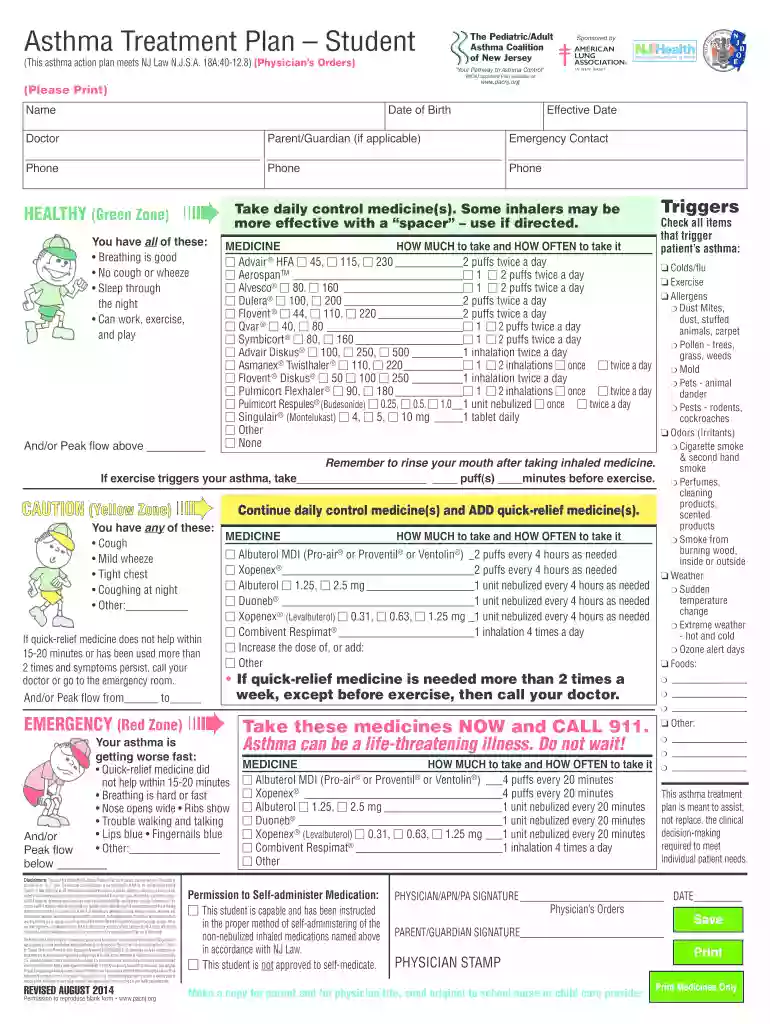
Asthma treatment plan 2026

Get Form
asthma action plan example filled out Preview on Page 1

Here's how it works

01. Edit your asthma action plan example filled out online
Type text, add images, blackout confidential details, add comments, highlights and more.

02. Sign it in a few clicks
Draw your signature, type it, upload its image, or use your mobile device as a signature pad.

03. Share your form with others
Send asthma action plan filled out example via email, link, or fax. You can also download it, export it or print it out.

How to use or fill out asthma treatment plan with our platform

Form edit decoration
9.5
Ease of Setup
DocHub User Ratings on G2
9.0
Ease of Use
DocHub User Ratings on G2
  1. Click ‘Get Form’ to open the asthma treatment plan in the editor.
  2. Begin by filling in the top left section with your child's name, date of birth, and contact information for both the parent/guardian and emergency contact.
  3. Next, collaborate with your healthcare provider to complete the effective date and medication details. Ensure they check the appropriate boxes for daily control medicines and specify dosages.
  4. Discuss and fill out the triggers section by checking all items that may provoke your child's asthma symptoms. This helps in managing their condition effectively.
  5. Finally, review the self-administration permission section. Both you and your healthcare provider must sign this form to authorize your child’s ability to manage their medication independently.

Start using our platform today to easily manage your asthma treatment plan online for free!

See more asthma treatment plan versions

We've got more versions of the asthma treatment plan form. Select the right asthma treatment plan version from the list and start editing it straight away!
Versions Form popularity Fillable & printable
2017 4.8 Satisfied (138 Votes)
2014 4.7 Satisfied (42 Votes)
2013 4.3 Satisfied (106 Votes)
2012 4.2 Satisfied (38 Votes)
be ready to get more

Complete this form in 5 minutes or less

Get form

Got questions?

We have answers to the most popular questions from our customers. If you can't find an answer to your question, please contact us.
Contact us
Typical treatment includes inhaled corticosteroids. Your healthcare provider may also recommend adding biologic medicines or allergy shots, which can be specific to the allergen. Some people only have seasonal allergic asthma, which means that they do not have symptoms outside of a certain pollen season.
The main treatment for asthma is medicines you breathe in using an inhaler. For most people they work well to reduce or prevent asthma symptoms. Depending on how severe your symptoms are, you may be offered either: an inhaler to use only when you get symptoms this is called an anti-inflammatory reliever (AIR) inhaler.
An asthma action plan tells your patients: which medicines they need to take every day. what to do if their asthma symptoms get worse. what emergency action to take if they have an asthma attack.
The best way to remember the steps is the 6 breaths, 6 puffs, 6 minutes rule. Take 6 puffs of your reliever inhaler, with 6 deep breaths per puff. Repeat this every 6 minutes until help arrives or until regular breathing returns.
English Transcript. Allergist Steve Dorman, MD: The Rule of Twos inside asthma is if somebody is well controlled per our guidelines. They use the rescue inhaler less than two times a week during the day, less than two times a month during the night, and they have no limitation during their physical activities.

Security and compliance

At DocHub, your data security is our priority. We follow HIPAA, SOC2, GDPR, and other standards, so you can work on your documents with confidence.

Learn more
ccpa2
pci-dss
gdpr-compliance
hipaa
soc-compliance
be ready to get more

Complete this form in 5 minutes or less

Get form

People also ask

Treatment usually involves learning to recognize your triggers, taking steps to avoid triggers and tracking your breathing to make sure your medications are keeping symptoms under control. In case of an asthma flare-up, you may need to use a quick-relief inhaler.
Quick-relief inhalers (bronchodilators) quickly open swollen airways that are limiting breathing. In some cases, allergy medications are necessary. Long-term asthma control medications, generally taken daily, are the cornerstone of asthma treatment.
Keep giving the person 4 separate puffs, taking 4 breaths for each puff, every 4 minutes until emergency assistance arrives.

asthma form 2023