




01. Edit your centrelink carer payment form sa332a online
Type text, add images, blackout confidential details, add comments, highlights and more.

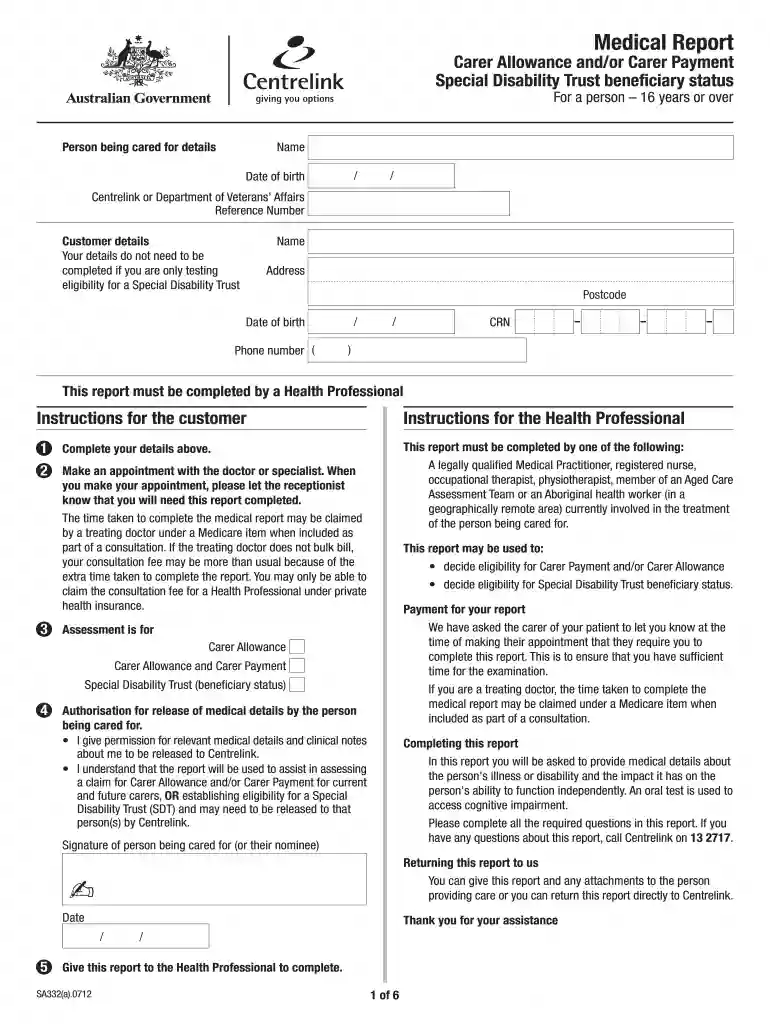
Type text, add images, blackout confidential details, add comments, highlights and more.

Draw your signature, type it, upload its image, or use your mobile device as a signature pad.

Send sa332a via email, link, or fax. You can also download it, export it or print it out.
The SA332A form, often referred to as the Centrelink Carer Payment form, is crucial for those supporting an individual with a disability or a chronic medical condition. This form assesses eligibility for benefits designed to support carers in the United States. The following sections will break down its relevance, use, and specific details regarding the application process.


Each component of the SA332A form is integral to ensuring that carers can receive the help they need to provide adequate support for those in their care, managing the challenges posed by caring for individuals with disabilities or medical conditions efficiently.
We've got more versions of the centrelink carer payment form sa332a form. Select the right centrelink carer payment form sa332a version from the list and start editing it straight away!
Electronic signatures are a great alternative to traditional signing, as they save time, effort, and money people spend on printing, scanning, and paper delivery. You can electronically sign your carer payment form utilizing a reliable and robust online document processing tool like DocHub. It complies with major eSignature policies (ESIGN and UETA), so all documents approved there are legally binding and have the same validity as physically signed ones.
If you are looking for a state-specific carers payment form sample, you can find it in our DocHub Forms & Templates catalog. Use the search field, key in your form’s name, and search through the results for your state. You may also filter out irrelevant results while searching our catalog by categories.
At DocHub, your data security is our priority. We follow HIPAA, SOC2, GDPR, and other standards, so you can work on your documents with confidence.
by AR Petrosian 1995 Cited by 27 The distribution of SNIa appear similar in both samples, confirming that their progenitors are not the same as those of SNII and lb. The SN rates are related toRead more
SA 332A. SPARE. SA 3328. SPARE. SA 332C*. SPARE. SA 3320*. HV MU6GA RCP 2-1 SEAL IN ISO VLV. SA 332E* c. 21 2F. HV MU38 RCP SEAL RET ISO VLV. SA 332F* c. 21 2F.Read more


