



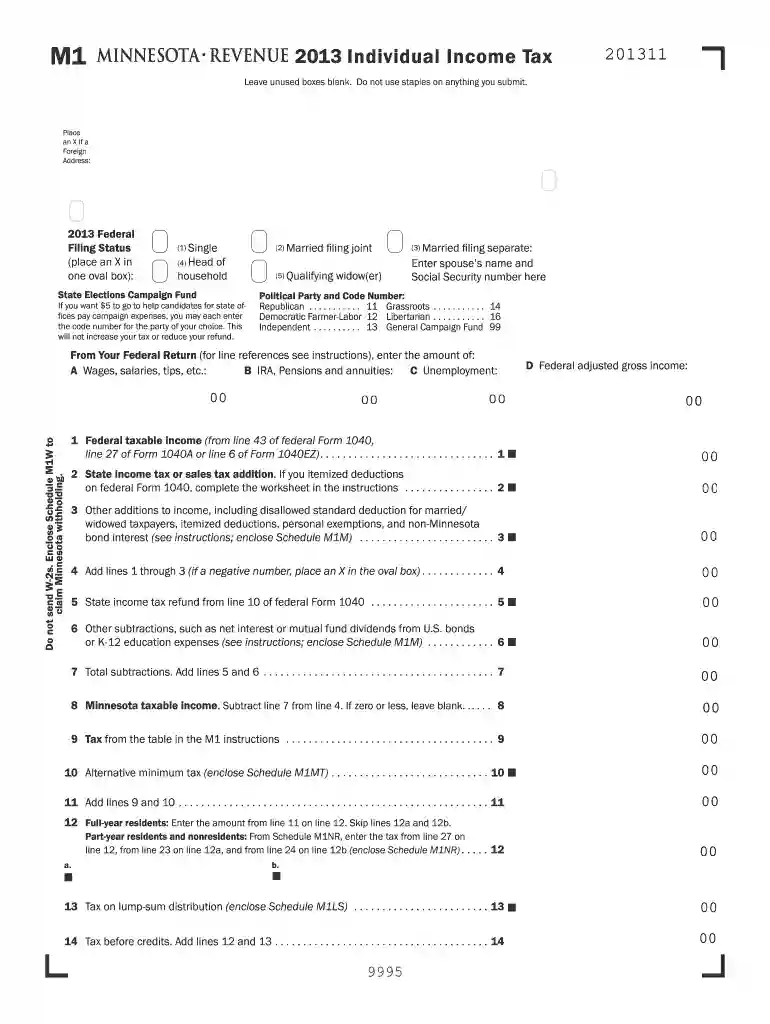
01. Edit your 2013 mn online
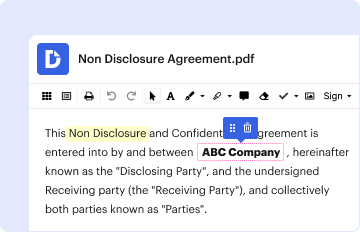
Type text, add images, blackout confidential details, add comments, highlights and more.

Type text, add images, blackout confidential details, add comments, highlights and more.
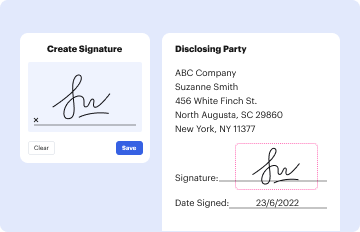
Draw your signature, type it, upload its image, or use your mobile device as a signature pad.

Send it via email, link, or fax. You can also download it, export it or print it out.
The "2013 Minnesota Form Tax" refers to the official document used by residents of Minnesota in 2013 to file their state income taxes. This form facilitates the reporting of various types of income, claiming of deductions and credits, and the determination of the refund or payment due to the state. It is a central tool for ensuring compliance with Minnesota's state tax laws and is essential for individuals to accurately report their financial activities to state authorities.
Using the 2013 Minnesota Form Tax involves multiple steps to ensure proper filing:
There are several ways to obtain the 2013 Minnesota Form Tax:
Filing state income taxes with the 2013 Minnesota Form Tax requires attention to detail:
The form comprises several important sections:
Minnesota has specific tax rules that may affect filing:
The standard filing deadline for the 2013 Minnesota Form Tax was April 15, 2014. Extensions could be requested, generally providing up to six more months. However, any taxes owed must still be paid by the original deadline to avoid penalties and interest.
Failing to file or pay taxes correctly in Minnesota may result in penalties:
To accurately file the 2013 Minnesota Form Tax, ensure you have:
The 2013 Minnesota Form Tax could be submitted via:
Consider scenarios illustrating tax filing with this form:
Taxpayers had the option to file the 2013 Minnesota Form Tax either digitally or on paper. Digital filing offers the advantages of error checking, quicker processing, and electronic records, while the paper version provides a tangible document for those who prefer traditional methods.
We've got more versions of the 2013 mn form. Select the right 2013 mn version from the list and start editing it straight away!
| Versions | Form popularity | Fillable & printable |
|---|---|---|
| 2025 | 4.1 Satisfied (57 Votes) | |
| 2024 | 4.3 Satisfied (40 Votes) | |
| 2023 | 4.4 Satisfied (51 Votes) | |
| 2022 | 4.5 Satisfied (67 Votes) | |
| 2021 | 4.8 Satisfied (90 Votes) | |
| 2020 | 4.4 Satisfied (159 Votes) | |
| 2019 | 4.3 Satisfied (92 Votes) | |
| 2018 | 4.3 Satisfied (99 Votes) | |
| 2017 | 4.2 Satisfied (77 Votes) | |
| 2016 | 4.4 Satisfied (127 Votes) | |
| 2015 | 4.3 Satisfied (48 Votes) | |
| 2013 | 4 Satisfied (21 Votes) | |
| 2012 | 4.2 Satisfied (41 Votes) | |
| 2011 | 4.4 Satisfied (60 Votes) | |
| 2010 | 4.1 Satisfied (54 Votes) |
At DocHub, your data security is our priority. We follow HIPAA, SOC2, GDPR, and other standards, so you can work on your documents with confidence.
An eligible entity uses Form 8832 to elect how it will be classified for federal tax purposes, as a corporation, a partnership, or an entity disregarded asRead more
Form ST-17. (Rev. 9-86). RV-01014-02. Minnesota Department of Revenue. CERTIFICATE OF EXEMPT STATUS. -. EXEMPT ORGANIZATION. Under the provisions of SectionRead more
Calendar year taxpayers having no household employees in 2013 do not have to complete this form for 2013. A. Did you pay any one household employee cash wagesRead more


