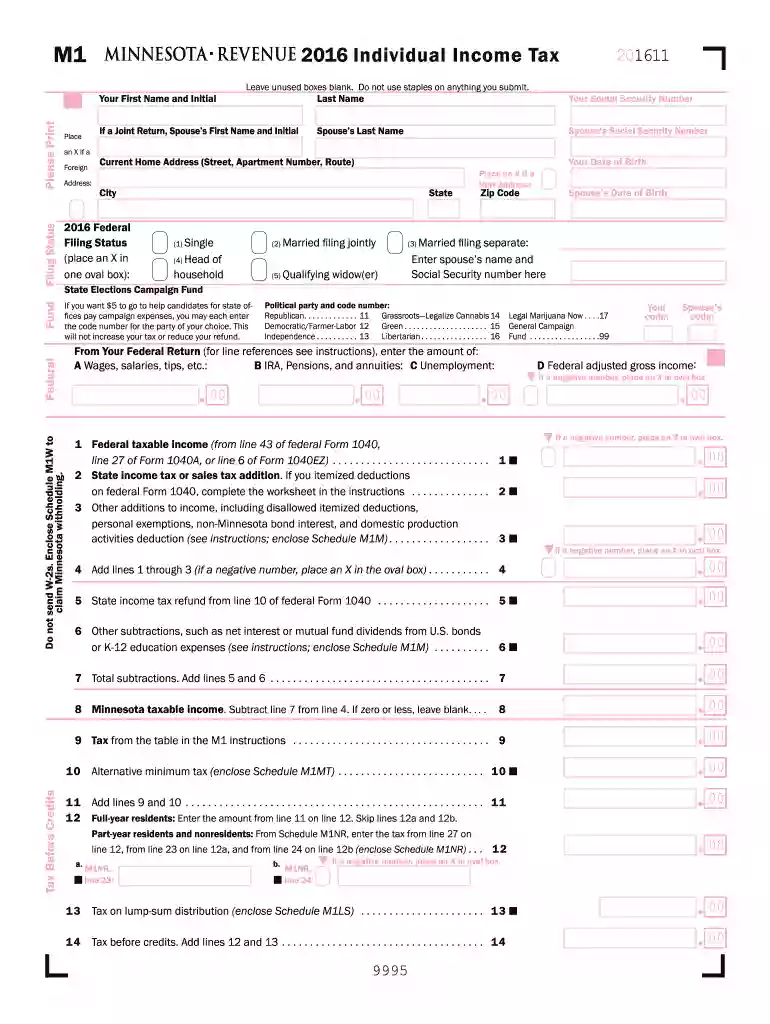
Mn form m1 2016-2026

Get Form
minnesota 2016 tax Preview on Page 1

Here's how it works

01. Edit your minnesota 2016 tax online
Type text, add images, blackout confidential details, add comments, highlights and more.

02. Sign it in a few clicks
Draw your signature, type it, upload its image, or use your mobile device as a signature pad.

03. Share your form with others
Send form m1 instructions via email, link, or fax. You can also download it, export it or print it out.

Overview of the MN Form M1 2016

The MN Form M1 2016 is the individual income tax return form used by residents of Minnesota to file their state income taxes for the year 2016. This form is crucial for calculating state tax liabilities and for reporting income, deductions, and credits.

Key Components of the MN Form M1 2016

  • Personal Information: This section requires basic details such as name, address, and Social Security number. Accuracy in these details is essential to ensure proper processing.
  • Filing Status: Taxpayers must select their filing status, which can include options such as single, married filing jointly, or head of household. The chosen status will affect the tax rates and eligibility for certain credits.
  • Income Calculation: Individuals must report all sources of income, including wages, interest, dividends, and any other earnings. Proper documentation, such as W-2 and 1099 forms, should accompany the filing.
  • Deductions and Credits: Taxpayers can claim eligible deductions and credits to reduce their overall tax liability. Important items to consider include standard deductions, itemized deductions, and specific credits applicable to Minnesota residents.

Instructions for Completing the MN Form M1 2016

Completing the MN Form M1 requires careful attention to detail. Follow these steps for accurate filings:

  1. Gather Necessary Documents: Collect all relevant documentation such as W-2s, 1099s, and any support for deductions like mortgage interest statements.
  2. Complete the Personal Information Section: Fill in your name, address, and Social Security number accurately.
  3. Determine Your Filing Status: Based on your situation, select the appropriate filing status to ensure the correct tax rates are applied.
  4. Report Income: Enter all sources of income on the designated lines. Ensure consistency with IRS documents.
  5. Calculate Deductions and Credits: Review eligible deductions and credits, inputting them carefully to maximize potential savings on tax obligations.
  6. Follow Submission Instructions: After completing the form, check for accuracy before submitting it online, by mail, or in person at designated locations.

Important Dates and Deadlines for Filing the MN Form M1 2016

Filing deadlines are crucial to avoid penalties related to late submissions. For the tax year 2016, the deadline for submitting the MN Form M1 was generally April 18, 2017. It is important to keep in mind the following points regarding deadlines:

  • Extension Requests: If unable to file by the deadline, taxpayers may request an extension, which typically provides an additional six months.
  • Amendments: If an error is identified post-filing, amendments using Form M1X should be filed to correct any inaccuracies.

Common Scenarios for Using the MN Form M1 2016

The MN Form M1 may be utilized by a variety of individuals based on their personal or financial situations:

  • Wage Earners: Salaried employees filing their taxes based on W-2 income.
  • Self-Employed Individuals: Those who require accurate reporting of business income and expenses using Schedule C.
  • Retirees: Seniors reporting pension income and Social Security benefits can specifically benefit from age-related credits.
  • Students: Young taxpayers with part-time income from summer jobs or internships must report earnings accurately, ensuring deductions for educational expenses are applied.

State-Specific Guidelines for the MN Form M1 2016

Minnesota has unique regulations that affect the filing process and tax calculations. Key points of consideration include:

  • State Tax Rates: The 2016 MN state tax rates vary based on income brackets, impacting overall tax obligations.
  • Local Taxes: Certain jurisdictions may have additional local taxes that need to be reported alongside state taxes to ensure compliance.
  • Education and Other Credits: Minnesota offers credits that are specific to residents, such as the education credit and property tax refunds, which can further reduce tax liabilities.

Available Submission Methods for the MN Form M1 2016

Taxpayers can submit the MN Form M1 using several methods:

  • Online Filing: Electronic submission via approved tax software is encouraged, as it can expedite processing times and reduce errors.
  • Mail Submission: Paper forms can be mailed to the Minnesota Department of Revenue. Ensure to use the correct address based on your filing status.
  • In-Person: Taxpayers may visit local offices for assistance or to submit forms directly.

Penalties for Non-Compliance with the MN Form M1 2016

Failing to comply with filing requirements can result in significant penalties. Taxpayers should be aware of the following risks:

  • Late Filing Penalties: Submitting after the deadline without an extension can incur fines based on the amount owed.
  • Interest on Unpaid Taxes: Delinquencies on tax payments accrue interest, which can compound quickly over time.
  • Potential Legal Actions: Continued non-compliance might lead to enforceable actions such as garnishments or liens against property if owed taxes remain unpaid.

Digital vs. Paper Versions of the MN Form M1 2016

When choosing between the digital or paper version of the MN Form M1, consider the benefits of each:

  • Digital Form: The electronic version allows for easier calculations, automatic error checking, and faster processing. It is also accessible on various devices, providing convenience and flexibility.
  • Paper Form: A printed version may be preferred by those who are more comfortable with physical paperwork. While it allows for personal notes and alterations, it may require more time for processing once submitted.

The MN Form M1 2016 is essential for individuals to ensure compliance with state tax laws, optimize their deductions, and avoid potential penalties. It is important for taxpayers to familiarize themselves with this form and its requirements to facilitate a seamless tax filing process.

See more mn form m1 2016 versions

We've got more versions of the mn form m1 2016 form. Select the right mn form m1 2016 version from the list and start editing it straight away!
Versions Form popularity Fillable & printable
2023 4.4 Satisfied (51 Votes)
2022 4.5 Satisfied (67 Votes)
2021 4.8 Satisfied (90 Votes)
2020 4.4 Satisfied (159 Votes)
2019 4.3 Satisfied (92 Votes)
2018 4.3 Satisfied (99 Votes)
2017 4.2 Satisfied (77 Votes)
2016 4.4 Satisfied (127 Votes)
2015 4.3 Satisfied (48 Votes)
2013 4 Satisfied (21 Votes)
2012 4.2 Satisfied (41 Votes)
2011 4.4 Satisfied (60 Votes)
2010 4.1 Satisfied (54 Votes)
2009 4.4 Satisfied (158 Votes)
2005 4.3 Satisfied (140 Votes)
be ready to get more

Complete this form in 5 minutes or less

Get form

Got questions?

We have answers to the most popular questions from our customers. If you can't find an answer to your question, please contact us.
Contact us
Schedule M-1 is the bridge (reconciliation) between the books and records of a corporation and its income tax return. Items included on this schedule will not be found in the corporate books and must be analyzed from workpapers prepared by the taxpayer.
Statute of Limitations To claim a refund from aYou must file by Property Tax Refund 1 year from the due date Commissioner Filed Return (CFR) replacement 3 1/2 years from the original due date or 1 year from the date we notify you the CFR is filed, whichever is later. You must file your own return to replace the CFR.1 more row Jul 22, 2025
Social security tax cuts Retired couples earning up to $100,000 and individuals making up to $78,000 will not pay any state taxes on their social security benefits starting with tax year 2023. Half of seniors in the state already didnt pay state taxes on those benefits.
Here are the standard deduction amounts for each filing status in 2024: $14,575 for Single $29,150 for Married Filing Jointly or Qualifying Surviving Spouse $14,575 for Married Filing Separately $21,900 for Head of Household If you are married and filing a separate return, you may only claim the standard
M-1 adjustments: reconciliation of book and taxable income (income and deductions.) Differences exist because of the difference in GAAP and tax law. Deferred tax assets and deferred tax liabilities: book assets or book liabilities involving deferred tax amounts.
be ready to get more

Complete this form in 5 minutes or less

Get form

People also ask

Form M1 is the individual income tax form in Minnesota.
The Form M-1 is an annual report that must be filed by Multiple Employer Welfare Arrangements (MEWAs). In general, MEWAs are arrangements that offer health and other benefits to the employees of two or more different employers. Filers should not complete a Form M-1 if the plan does not include Medical Benefits.
Minnesota State Income Tax Forms If you need Minnesota income tax forms: Download forms from the Minnesota Department of Revenue. Photocopy the forms you need at a library. Call 800-657-3676 or 651-296-4444 to place an order.

2016 minnesota tax forms