Tax mn 2026

Get Form
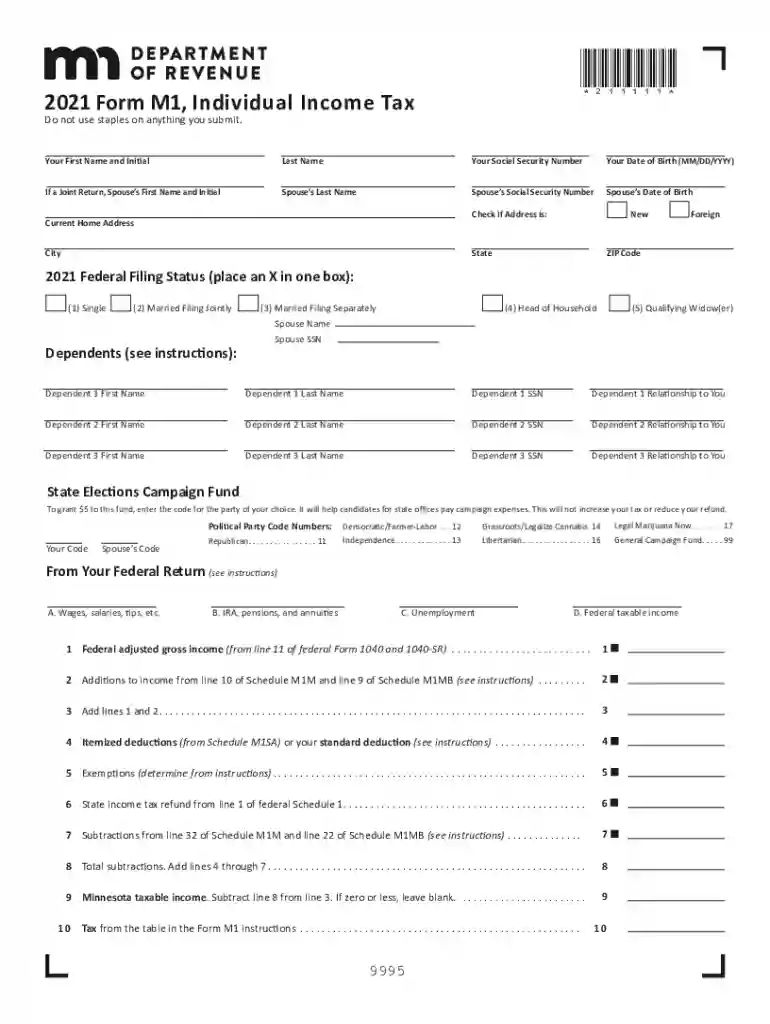
minnesota state tax form Preview on Page 1

Here's how it works

01. Edit your minnesota state tax form online
Type text, add images, blackout confidential details, add comments, highlights and more.

02. Sign it in a few clicks
Draw your signature, type it, upload its image, or use your mobile device as a signature pad.

03. Share your form with others
Send printable minnesota tax forms via email, link, or fax. You can also download it, export it or print it out.

Definition and Purpose of the Minnesota Individual Income Tax Form

The Minnesota Individual Income Tax form, often referred to as Form M1, is a crucial document used for filing state income tax in Minnesota. It collects personal financial information to determine the tax obligations of individuals residing in the state. The form requires data such as personal details, filing status, dependency claims, income sources, and applicable deductions. With detailed instructions, Form M1 guides taxpayers on accurately reporting their income, ensuring compliance with Minnesota state tax laws. Every taxpayer and jointly filing couple needs to sign the form, affirming the accuracy of their reported information.

Steps to Complete Form M1

Filing the Minnesota Individual Income Tax form requires careful attention to detail. Follow these steps to ensure completeness:

  1. Gather Necessary Documents: Collect your W-2s, 1099s, and any supplemental income records. You'll need documentation for deductions, such as mortgage interest statements and charitable contributions.
  2. Determine Filing Status: Choose from options like single, married filing jointly, or head of household. Your status impacts your tax bracket and exemptions.
  3. Calculate Deductions: Identify itemized and standard deductions applicable to your situation. For many, standard deductions streamline the process.
  4. Complete Income Sections: Input all income details, including employment wages, self-employment earnings, and dividend or interest income.
  5. Review and Adjustments: Ensure accuracy of entries and adjustments for specific taxes paid, such as property taxes or educational credits.
  6. Sign and Submit: Once verified, both you and your spouse must sign if filing jointly. Submit as instructed, either electronically, by mail, or in person.

Required Documents for Filing

Preparing a complete and error-free tax return starts with organizing the necessary documents. Taxpayers should ensure they have these essentials:

  • Income Statements: This includes W-2s for employee wages, 1099s for contract work or investment income, and K-1s for partnership earnings.
  • Deduction Proofs: Include receipts or statements for mortgage interest, student loan interest, and deductible medical expenses.
  • Credit and Adjustment Documents: Gather records supporting tax credits or adjustments, such as child care expenses and retirement contributions.
  • Last Year's Tax Return: Have a copy on hand to reference any carryover deductions or credits.

Filing Deadlines and Important Dates

The Minnesota Department of Revenue sets specific deadlines for filing state taxes to ensure timely processing:

  • Standard Filing Deadline: Usually aligns with the federal deadline on April 15. If this date falls on a weekend or holiday, the deadline moves to the next business day.
  • Extension Requests: Taxpayers can file for an extension, typically giving up to six additional months, but should note this is only an extension to file, not to pay taxes owed.
  • Estimated Payment Deadlines: Quarterly estimated tax payments for self-employed individuals are due typically in April, June, September, and January of the following year.

Obtaining and Accessing Form M1

Acquiring Form M1 is straightforward and supports varied preferences for access:

  • Online Availability: Download the form directly from the Minnesota Department of Revenue's website, where printable versions are available.
  • Local IRS Office: Visit state offices or public libraries offering free printed copies, especially beneficial for those with limited internet access.
  • Tax Software and Services: Many tax preparation software packages automatically provide the form as part of state filing options.

Legal Use and Compliance

Compliance with Minnesota state tax laws through proper use of Form M1 ensures legal obligations are met:

  • Verification of Income and Deductions: Honesty in declaration prevents legal issues or audits. Incorrect filings can result in penalties.
  • Record Retention: Maintain copies of filed forms and supporting documents for at least three years; this aids in resolving potential disputes or audits.

Taxpayer Scenarios and Examples

Different taxpayer scenarios highlight the nuances of using Form M1:

  • Self-Employed Individuals: Must report business income and expenses thoroughly, potentially needing additional schedules for deductions.
  • Retirees: Consider pension income and Social Security when calculating taxable income, with special attention to retirement plan withdrawals.
  • Students: Often qualify for credit like tuition deductions, emphasizing the importance of educational expense documentation.
decoration image ratings of Dochub

Penalties for Non-Compliance

Understanding potential penalties emphasizes the importance of accurate and timely reporting:

  • Late Filing Penalties: Failure to file by the deadline results in financial penalties, with additional interest on any unpaid tax.
  • Filing Errors and Omissions: Incurring charges for misreporting income or omitting necessary information, leading to requests for amended returns.

Digital vs. Paper Filing Options

Filing choices impact convenience and processing times:

  • Electronic Filing: Offers faster processing and quicker refund issuance. Many taxpayers prefer this method, especially when paired with electronic payment of taxes due.
  • Traditional Mail Filing: Ensure the form is postmarked by the deadline. This method suits those who prefer physical documentation and might support additional attachments.

By adhering to these details, Minnesota taxpayers can navigate their state tax obligations with confidence, minimizing errors and enhancing compliance.

See more tax mn versions

We've got more versions of the tax mn form. Select the right tax mn version from the list and start editing it straight away!
Versions Form popularity Fillable & printable
2023 4.4 Satisfied (51 Votes)
2022 4.5 Satisfied (67 Votes)
2021 4.8 Satisfied (90 Votes)
2020 4.4 Satisfied (159 Votes)
2019 4.3 Satisfied (92 Votes)
2018 4.3 Satisfied (99 Votes)
2017 4.2 Satisfied (77 Votes)
2016 4.4 Satisfied (127 Votes)
2015 4.3 Satisfied (48 Votes)
2013 4 Satisfied (21 Votes)
2012 4.2 Satisfied (41 Votes)
2011 4.4 Satisfied (60 Votes)
2010 4.1 Satisfied (54 Votes)
2009 4.4 Satisfied (158 Votes)
2005 4.3 Satisfied (140 Votes)
be ready to get more

Complete this form in 5 minutes or less

Get form

Got questions?

We have answers to the most popular questions from our customers. If you can't find an answer to your question, please contact us.
Contact us
The Minnesota (MN) state sales tax rate is currently 6.875%. Depending on local municipalities, the total tax rate can be as high as 8.375%. Minnesota sales tax may also be levied at the city, county, school, transportation and SPD (special purpose district) levels.
Minneapolis sales tax details The minimum combined 2024 sales tax rate for Minneapolis, Minnesota is 9.03%. This is the total of state, county, and city sales tax rates. The Minnesota sales tax rate is currently 6.88%. The Minneapolis sales tax rate is 0.5%.
Minnesota Tax Rates, Collections, and Burdens Minnesota has a 9.8 percent corporate income tax rate. Minnesota also has a 6.875 percent state sales tax rate and an average combined state and local sales tax rate of 8.04 percent. Minnesota has a 0.98 percent effective property tax rate on owner-occupied housing value.
Tax Rate and Tax Base The state general sales tax rate is 6.5 percent. However, a 2008 voter-approved, state constitutional amendment imposed an additional three-eighth cent general sales tax (0.375 percent), bringing the total sales tax rate to 6.875 percent.
Items Exempt by Law Common examples include: Clothing for general use, see Clothing. Food (grocery items), see Food and Food Ingredients. Prescription and over-the-counter drugs for humans, see Drugs.

Security and compliance

At DocHub, your data security is our priority. We follow HIPAA, SOC2, GDPR, and other standards, so you can work on your documents with confidence.

Learn more
ccpa2
pci-dss
gdpr-compliance
hipaa
soc-compliance
be ready to get more

Complete this form in 5 minutes or less

Get form

People also ask

Calculating Sales Tax To figure the sales tax rate, combine the state general tax rate (6.875%) and all applicable local tax rates (local taxes, special local taxes, and special taxes). Apply the total rate to the taxable sales price.
Sales Tax Rate Changes in Major Cities Paul itself increased its own city sales tax rate by another percentage point in April 2024, with St. Pauls new combined rate docHubing 9.975 percent.
The State of Minnesota sends out income tax refunds very quickly. Sometimes, it can take as little as 2-3 days. Property tax refunds are normally sent in July for renters and in September for home owners. Click here to go to Wheres My Refund? at the Minnesota Department of Revenues website.

minnesota tax forms