




01. Edit your form online
Type text, add images, blackout confidential details, add comments, highlights and more.

Type text, add images, blackout confidential details, add comments, highlights and more.

Draw your signature, type it, upload its image, or use your mobile device as a signature pad.

Send it via email, link, or fax. You can also download it, export it or print it out.
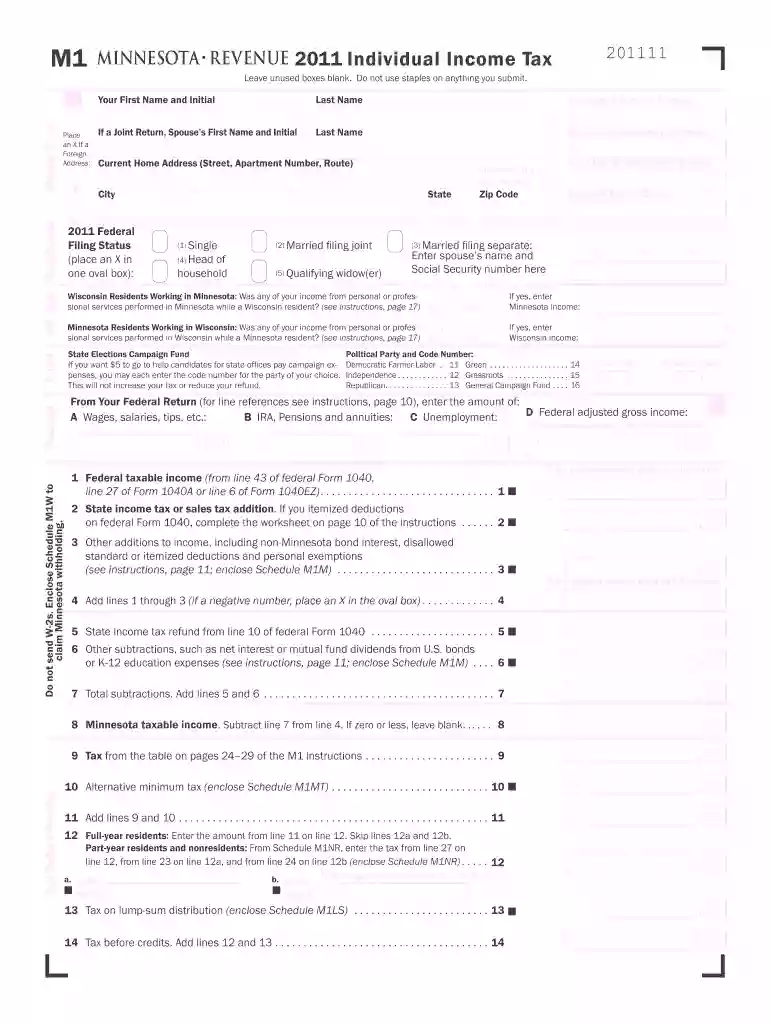
The 2011 Minnesota Individual Income Tax Form is designed for residents to file their state tax returns. This document captures necessary information, such as personal details, income, tax liabilities, and any applicable deductions or credits. Its primary purpose is to ensure that individuals accurately report their state income and determine their tax obligations or refunds for the 2011 tax year. The form supports compliance with Minnesota state tax laws and provides instructions for specific cases, such as joint filings or residency issues occurring between Minnesota and neighboring states like Wisconsin.
Understanding the terminology used in the 2011 Minnesota form can facilitate accurate completion:
The 2011 Minnesota tax form must be used legally by individuals residing in Minnesota. It is essential for reporting annual earnings to the state accurately. Legal compliance requires truthful representation of income and adherence to filing guidelines. Retain copies of filed forms and related documents for at least three years, as Minnesota law mandates the possibility of audits within this timeframe.
The 2011 Minnesota tax form includes sections specific to the state’s tax regulations, such as:
The standard deadline for submitting the 2011 Minnesota tax form was April 15, 2012. Extensions for filing were available under certain conditions but required submission by August 15, with proper extension requests submitted before the original deadline. Late filing could incur penalties unless a valid reason for delay was provided and accepted.
The form could be submitted through several channels:
Many Minnesotans used tax software like TurboTax or QuickBooks to complete and file their state returns. These programs offered guidelines specific to Minnesota tax law, integrated directly with state submission processes, and ensured compliance with the state’s requirements by way of timely updates reflecting tax law changes and new precedents.
We've got more versions of the 2011 mn form form. Select the right 2011 mn form version from the list and start editing it straight away!
| Versions | Form popularity | Fillable & printable |
|---|---|---|
| 2025 | 4.1 Satisfied (57 Votes) | |
| 2024 | 4.3 Satisfied (40 Votes) | |
| 2023 | 4.4 Satisfied (51 Votes) | |
| 2022 | 4.5 Satisfied (67 Votes) | |
| 2021 | 4.8 Satisfied (90 Votes) | |
| 2020 | 4.4 Satisfied (159 Votes) | |
| 2019 | 4.3 Satisfied (92 Votes) | |
| 2018 | 4.3 Satisfied (99 Votes) | |
| 2017 | 4.2 Satisfied (77 Votes) | |
| 2016 | 4.4 Satisfied (127 Votes) | |
| 2015 | 4.3 Satisfied (48 Votes) | |
| 2013 | 4 Satisfied (21 Votes) | |
| 2012 | 4.2 Satisfied (41 Votes) | |
| 2011 | 4.4 Satisfied (60 Votes) | |
| 2010 | 4.1 Satisfied (54 Votes) |
At DocHub, your data security is our priority. We follow HIPAA, SOC2, GDPR, and other standards, so you can work on your documents with confidence.
I authorize the Minnesota Department of Revenue to discuss this return with my paid preparer. Checking. Savings. Schedule 1Special refund. To qualify, you mustRead more
Minnesota Uniform Conveyancing Blanks. Form 20.1.1 (2011). MORTGAGE REGISTRY TAX DUE: $. DATE: (month/day/year). 口 CHECK IF APPLICABLE: NOTWITHSTANDINGRead more
Mar 1, 2012 The mineralogy of Mn is complicated by the range in Mn-. O bond lengths resulting from extensive substitution of of. Mn2+ and Mn3+ for Mn(IV).Read more


