




01. Edit your minnesota tax forms online
Type text, add images, blackout confidential details, add comments, highlights and more.

Type text, add images, blackout confidential details, add comments, highlights and more.

Draw your signature, type it, upload its image, or use your mobile device as a signature pad.

Send m1 form via email, link, or fax. You can also download it, export it or print it out.
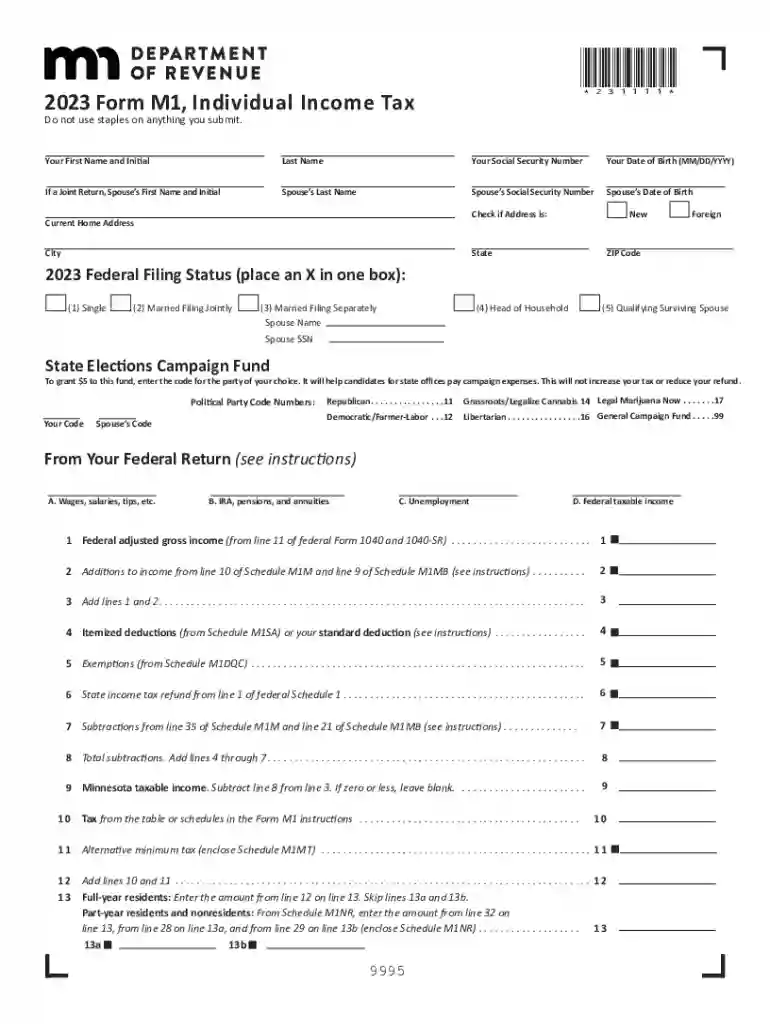
The 2023 Form M1, Individual Income Tax Return, is a tax document used by residents of Minnesota to file their state income taxes. It is essential for taxpayers to report their income, deductions, credits, and other tax-related information accurately. Understanding the purpose of Form M1 helps ensure compliance with state regulations and maximizes potential tax benefits.
Filing the 2023 Form M1 involves several steps to ensure accuracy and compliance.
Familiarity with specific terminology is crucial for correctly completing the form.
Filing Form M1 correctly is a legal obligation for Minnesota residents who meet income thresholds. Non-compliance could result in penalties or legal action. The form ensures taxpayers contribute fairly to state-funded services and programs.
Timely submission of the Form M1 is crucial.
Various submission methods cater to different preferences.
Accurate completion of Form M1 depends on having all necessary documents at hand.
Not all Minnesota residents may need to file Form M1; however, understanding eligibility is critical.


Understanding different versions of the Form M1 or related forms can aid in accurate filing.
Understanding these elements of the 2023 Form M1 aids in accurate tax reporting and ensures compliance with state tax laws. Proper preparation and filing can prevent unnecessary penalties and help take advantage of available deductions and credits.
We've got more versions of the minnesota tax forms form. Select the right minnesota tax forms version from the list and start editing it straight away!
| Versions | Form popularity | Fillable & printable |
|---|---|---|
| 2025 | 4.1 Satisfied (57 Votes) | |
| 2024 | 4.3 Satisfied (40 Votes) | |
| 2023 | 4.4 Satisfied (51 Votes) | |
| 2022 | 4.5 Satisfied (67 Votes) | |
| 2021 | 4.8 Satisfied (90 Votes) | |
| 2020 | 4.4 Satisfied (159 Votes) | |
| 2019 | 4.3 Satisfied (92 Votes) | |
| 2018 | 4.3 Satisfied (99 Votes) | |
| 2017 | 4.2 Satisfied (77 Votes) | |
| 2016 | 4.4 Satisfied (127 Votes) | |
| 2015 | 4.3 Satisfied (48 Votes) | |
| 2013 | 4 Satisfied (21 Votes) | |
| 2012 | 4.2 Satisfied (41 Votes) | |
| 2011 | 4.4 Satisfied (60 Votes) | |
| 2010 | 4.1 Satisfied (54 Votes) |
At DocHub, your data security is our priority. We follow HIPAA, SOC2, GDPR, and other standards, so you can work on your documents with confidence.
Form M1 is the individual income tax form. Download and complete Form M1 , REF , and the new Schedule M1RENT .
Complete this form for your employer to calculate the amount of Minnesota income tax to be withheld from your pay. When must I complete Form W-4MN? CompleteRead more


