




01. Edit your form online
Type text, add images, blackout confidential details, add comments, highlights and more.

Type text, add images, blackout confidential details, add comments, highlights and more.

Draw your signature, type it, upload its image, or use your mobile device as a signature pad.

Send it via email, link, or fax. You can also download it, export it or print it out.
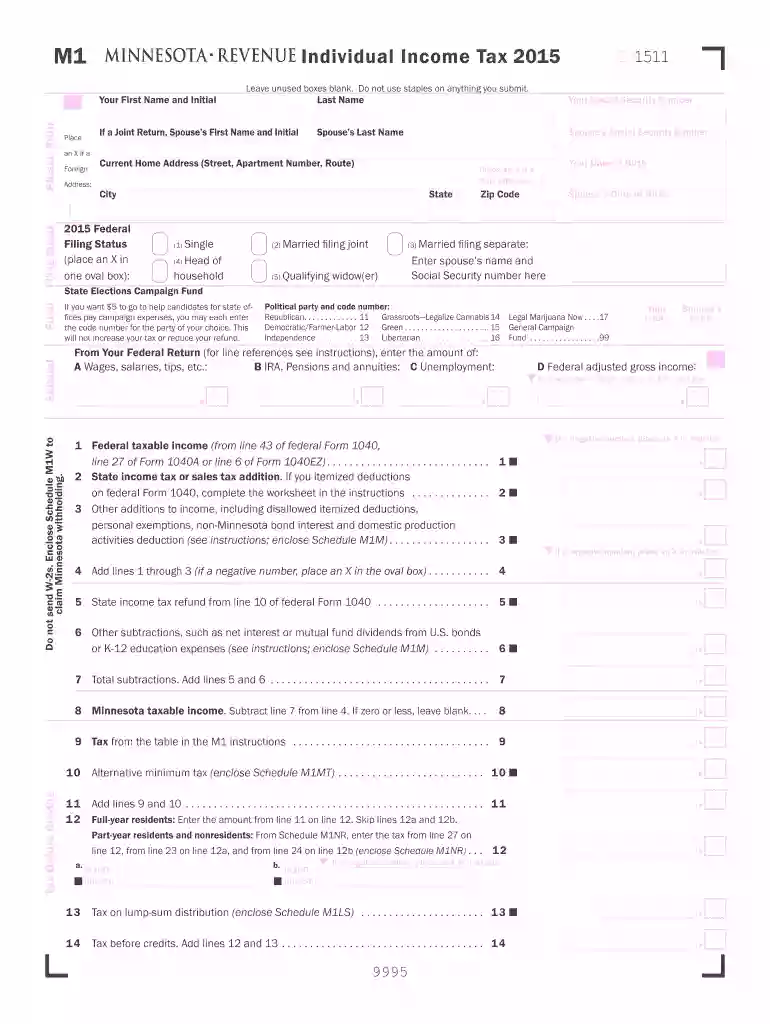
The Minnesota Form 2015 is an official tax form used by individuals to report their income and determine their tax obligations for the year 2015. It includes sections for personal information, income sources, deductions, credits, and calculations for any refund or payment owed. This form was essential for residents of Minnesota who needed to comply with state tax requirements for the 2015 tax year.
The Minnesota Form 2015 could be accessed through several methods to accommodate taxpayer preferences:
Online Access: It was available for download from the official Minnesota Department of Revenue website. Downloading the form allowed taxpayers to print and fill it out manually or complete it electronically.
In-Person Pickup: Taxpayers could also visit local government offices, libraries, or public facilities where physical copies of tax forms were typically available during tax season.
Mail Request: For those who preferred traditional methods, requesting a form via mail was always an option, though it required more time for processing and delivery.
Completing the Minnesota Form 2015 required attention to detail to ensure accuracy:
Personal Information: Begin by entering your name, address, and Social Security number. This section matched your identity with your tax documents.
Income Reporting: Provide details of all income sources, including wages, dividends, self-employment earnings, and other taxable income.
Deductions and Credits: List all applicable deductions and credits for which you qualify, such as charitable contributions or education credits.
Tax Calculations: Calculate your total tax liability based on the income and deductions listed. The instructions provided detailed guidance for computing this.
Refunds or Payments: Determine if you are owed a refund or if you have additional tax due. Include direct deposit instructions for refunds or plan for payment submissions if necessary.
Sign and Date: Ensure to sign and date the form, certifying the information provided is true and accurate.
Filing the Minnesota Form 2015 required supporting documentation for verification and record-keeping:
W-2 Forms: Provided by employers, these forms report annual wages and taxes withheld.
1099 Forms: Used for other sources of income like freelance work or investments.
Receipts for Deductions: Include documentation for deductible expenses such as medical bills, mortgage interest, or educational expenses.
Previous Year’s Tax Return: Having the prior year’s tax return can help ensure consistency and accuracy.
Several crucial components composed the Minnesota Form 2015:
Minnesota’s tax code includes unique aspects that taxpayers must consider:
Resident vs. Non-Resident Filing: Different requirements existed for full-year residents versus part-time or non-residents.
State Tax Credits: Minnesota offered specific credits not available in other states, impacting what taxpayers could claim to reduce their liability.
Special Deductions: Certain state-specific deductions were allowed, such as the K-12 Education Credit and Subtraction.
Although Minnesota Form 2015 is a state form, it needed to align with broader IRS guidelines:
Income Reporting: Ensured compatibility with federal income reporting standards for accuracy across both state and federal obligations.
Deduction Consistency: As Minnesota mirrored some federal deductions, consistency was necessary to avoid discrepancies in reporting and audit flags.
Meeting timelines was crucial when dealing with the Minnesota Form 2015:
Regular Filing Deadline: Generally, the deadline matched the federal tax due date unless specified otherwise.
Extension Requests: Taxpayers could request an extension to file but would need to estimate and pay any taxes owed by the original deadline.
Understanding these elements of the Minnesota Form 2015 helps ensure compliance and accurate tax filings, preventing potential penalties or issues with state tax authorities.
We've got more versions of the minnesota form 2015 form. Select the right minnesota form 2015 version from the list and start editing it straight away!
| Versions | Form popularity | Fillable & printable |
|---|---|---|
| 2025 | 4.1 Satisfied (57 Votes) | |
| 2024 | 4.3 Satisfied (40 Votes) | |
| 2023 | 4.4 Satisfied (51 Votes) | |
| 2022 | 4.5 Satisfied (67 Votes) | |
| 2021 | 4.8 Satisfied (90 Votes) | |
| 2020 | 4.4 Satisfied (159 Votes) | |
| 2019 | 4.3 Satisfied (92 Votes) | |
| 2018 | 4.3 Satisfied (99 Votes) | |
| 2017 | 4.2 Satisfied (77 Votes) | |
| 2016 | 4.4 Satisfied (127 Votes) | |
| 2015 | 4.3 Satisfied (48 Votes) | |
| 2013 | 4 Satisfied (21 Votes) | |
| 2012 | 4.2 Satisfied (41 Votes) | |
| 2011 | 4.4 Satisfied (60 Votes) | |
| 2010 | 4.1 Satisfied (54 Votes) |
At DocHub, your data security is our priority. We follow HIPAA, SOC2, GDPR, and other standards, so you can work on your documents with confidence.
This form is required in addition to a completed Minnesota DER Interconnection Process (MN. DIP) Application form for any DER with an energy storage component.Read more
Find motor vehicle forms, documents and tax manual. Motor vehicle forms, motor vehicle tax manual, motor vehicle documents, general documents, county reports.Read more
MINNESOTA BOARD ON JUDICIAL STANDARDS. Opinion 2015-2. U-Vlsa Certifications. Issue. Does the Code of Judicial Conduct (Code) permit a judge to sign an I


