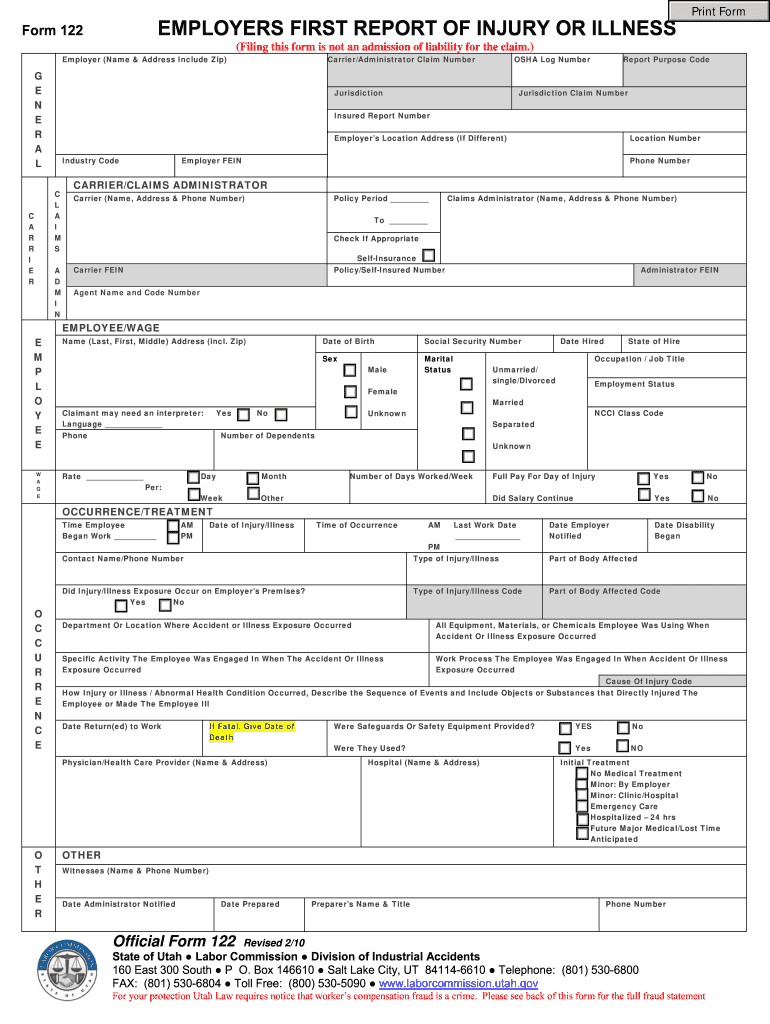
Utah 122 2026

Get Form
utah 122 Preview on Page 1

Here's how it works

01. Edit your form online
Type text, add images, blackout confidential details, add comments, highlights and more.
02. Sign it in a few clicks
Draw your signature, type it, upload its image, or use your mobile device as a signature pad.
03. Share your form with others
Send it via email, link, or fax. You can also download it, export it or print it out.

How to use or fill out utah 122 with our platform

Form edit decoration
9.5
Ease of Setup
DocHub User Ratings on G2
9.0
Ease of Use
DocHub User Ratings on G2
  1. Click ‘Get Form’ to open the Utah 122 in the editor.
  2. Begin by filling in the employer's name and address, including the zip code. Ensure accuracy as this information is crucial for processing.
  3. Complete the OSHA Log Number and Jurisdiction sections. These details help track workplace injuries effectively.
  4. In the Employee section, provide detailed information about the injured employee, including their name, date of birth, social security number, and employment status.
  5. Document the occurrence details such as date of injury, time of occurrence, and a description of how the injury happened. This section is vital for claims processing.
  6. Finally, review all entries for accuracy before submitting. Use our platform’s features to save your progress or share it with relevant parties for collaboration.

Start using our platform today to fill out your Utah 122 form easily and efficiently!

See more utah 122 versions

We've got more versions of the utah 122 form. Select the right utah 122 version from the list and start editing it straight away!
Versions Form popularity Fillable & printable
2017 4.8 Satisfied (137 Votes)
2010 4.2 Satisfied (68 Votes)
2009 4.4 Satisfied (53 Votes)
be ready to get more

Complete this form in 5 minutes or less

Get form

Got questions?

We have answers to the most popular questions from our customers. If you can't find an answer to your question, please contact us.
Contact us
When a worker is injured, each missed day of work represents lost wages. In workers compensation insurance, indemnity benefits are paid to the employee to help them cover their loss of income. Payments are a portion of the workers average weekly wage, and take into consideration the extent of the disability.
In that case, you may qualify for time-loss compensation due to the fact that youre temporarily unable to return to work. Typically, the workers comp system in most states offers 66% of your wages. Depending on the state, you may receive your salary benefits weekly, bi-weekly, or once a month.
What You Shouldnt Tell Your Workers Comp Doctor Never lie about prior injuries, pre-existing conditions, or medical history. Never lie about the extent of your workplace injury or how it happened. Do not exaggerate your symptoms, including pain or functionality.
The maximum duration for temporary total disability compensation is 312 weeks within a 12 year period of time from the date of injury. Permanent Partial Disability Compensation is paid if the injured employees work injury or illness leaves them with a permanent impairment.
Early reporting is the key element to positive claim outcomes. Once an injury or illness has been reported, the employer should report to WCF as soon as possible. Report a claim online here. You can also file a claim by calling (800) 561-8008 or faxing (385) 351-8275.

Security and compliance

At DocHub, your data security is our priority. We follow HIPAA, SOC2, GDPR, and other standards, so you can work on your documents with confidence.

Learn more
ccpa2
pci-dss
gdpr-compliance
hipaa
soc-compliance
be ready to get more

Complete this form in 5 minutes or less

Get form

People also ask

Workers compensation in Utah is a straightforward, no-fault insurance. It helps employees hurt at work, covering their medical bills, lost income, and rehab. Employers must have this insurance. If an injury occurs, employees report it, and employers then handle claims with their insurer.
Medical. Medical care expenses that are reasonable and necessary to treat an employees injury or illness. This includes visits to a treating doctor, hospital bills, medicine and prosthetic devices. It also includes reimbursement for the cost of mileage to travel to receive medical treatment.

Related links