




01. Edit your form online
Type text, add images, blackout confidential details, add comments, highlights and more.

Type text, add images, blackout confidential details, add comments, highlights and more.

Draw your signature, type it, upload its image, or use your mobile device as a signature pad.

Send it via email, link, or fax. You can also download it, export it or print it out.
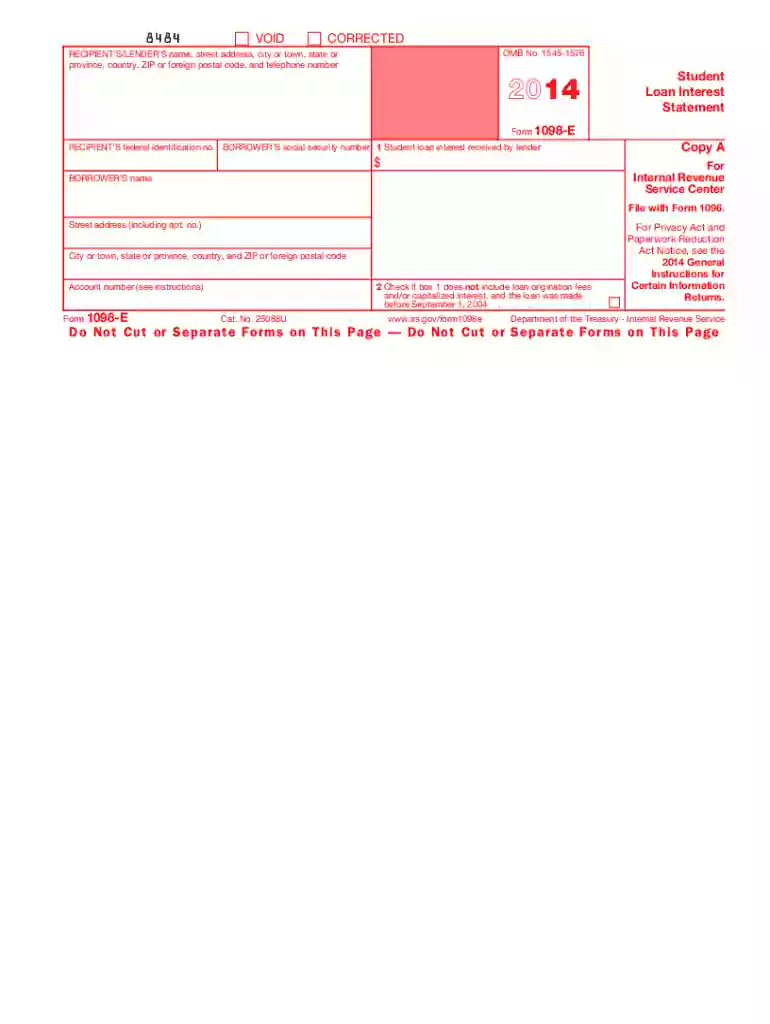
Form 1098-E, the Student Loan Interest Statement, is a tax document used by lenders to report the amount of interest received on student loans during the tax year. This form is a crucial tool for borrowers and the IRS as it provides necessary information for claiming a student loan interest deduction on federal tax returns. It's important to note that while the online version of this form is convenient for viewing and managing, it is not scannable and should not be submitted to the IRS.
Most borrowers receive Form 1098-E from their student loan servicer if they have paid $600 or more in interest during the tax year. Typically, the form is sent via mail or electronically, depending on the borrower’s communication preferences. If you do not receive the form, you can often access it through your loan servicer's online portal or contact them directly to request a copy.
Form 1098-E is essential for eligible taxpayers looking to reduce their taxable income through the student loan interest deduction. Claiming this deduction can lower your federal taxable income by up to $2,500, making it a valuable benefit for those repaying student loans. Accurately filing this form supports compliance with IRS regulations and can result in significant tax savings.
Primarily, borrowers who have made interest payments on qualified student loans will interact with Form 1098-E. Additionally, lenders or loan servicers use this form to report interest payments to both borrowers and the IRS. For students or recent graduates, understanding this form is part of assessing overall financial strategy regarding student loan repayments and related tax benefits.
Failing to file Form 1098-E accurately can lead to penalties for both lenders and borrowers. For lenders, incorrect reporting can result in financial penalties and compliance reviews by the IRS. Borrowers who fail to include accurate information from the form on their tax return may face penalties or interest charges on unpaid taxes.
The IRS provides specific instructions for both borrowers and lenders regarding the completion and submission of Form 1098-E. Borrowers should ensure they understand eligibility criteria for deductions, while lenders must comply with correct reporting methods. Following IRS guidelines is crucial to ensure accurate filing and avoid any potential tax pitfalls.
The deadline for lenders to send Form 1098-E to borrowers is January 31 following the tax year. This aligns with the general IRS tax filing timeline, enabling borrowers to use the form to complete their federal tax returns by the mid-April deadline. Staying aware of these dates is essential for avoiding late fees and ensuring timely tax submissions.
We've got more versions of the gov/form1098e form. Select the right gov/form1098e version from the list and start editing it straight away!
| Versions | Form popularity | Fillable & printable |
|---|---|---|
| 2025 | 4.2 Satisfied (44 Votes) | |
| 2024 | 4.7 Satisfied (41 Votes) | |
| 2023 | 4.6 Satisfied (51 Votes) | |
| 2022 | 4.7 Satisfied (24 Votes) | |
| 2021 | 4.8 Satisfied (60 Votes) | |
| 2020 | 4.3 Satisfied (92 Votes) | |
| 2019 | 4.3 Satisfied (239 Votes) | |
| 2018 | 4.2 Satisfied (43 Votes) | |
| 2017 | 4.4 Satisfied (216 Votes) | |
| 2016 | 4.4 Satisfied (120 Votes) | |
| 2015 | 4 Satisfied (41 Votes) | |
| 2014 | 4 Satisfied (52 Votes) | |
| 2013 | 4 Satisfied (29 Votes) | |
| 2012 | 4.2 Satisfied (35 Votes) | |
| 2011 | 4.2 Satisfied (45 Votes) |
At DocHub, your data security is our priority. We follow HIPAA, SOC2, GDPR, and other standards, so you can work on your documents with confidence.
Jan 23, 2018 See Form 1098-MA, Mortgage Assistance Pay- ments, and its instructions for details. Payments to reduce cost of winter energy use. PaymentsRead more
Form 1098-E is also known as a student loan interest statement. It is an official form provided by the Internal Revenue Service (IRS). Learn more.
Information about Form 1098-E, Student Loan Interest Statement (Info Copy Only), including recent updates, related forms and instructions on how to file.


