




01. Edit your form online
Type text, add images, blackout confidential details, add comments, highlights and more.

Type text, add images, blackout confidential details, add comments, highlights and more.

Draw your signature, type it, upload its image, or use your mobile device as a signature pad.

Send it via email, link, or fax. You can also download it, export it or print it out.
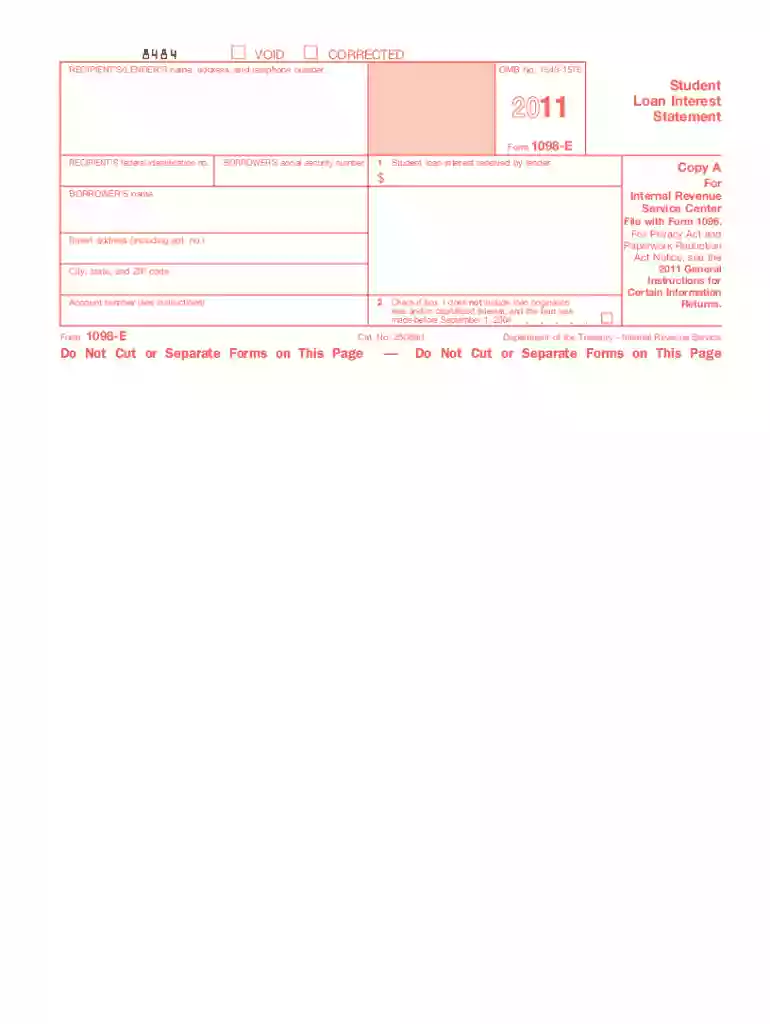
Form 1098-E, officially known as the Student Loan Interest Statement, is specifically used by lenders to report the amount of student loan interest a borrower has paid during the tax year. This form is essential for borrowers because it allows them to report and potentially deduct the student loan interest paid, up to the limit allowed by the IRS, from their taxable income. For the 2011 tax year, borrowers and lenders must ensure accurate reporting to avoid any discrepancies when filing taxes.
Form 1098-E for the tax year 2011 can typically be obtained directly from the lender to whom student loan interest payments were made. Most lenders will automatically send this form to borrowers by mail or make it accessible online, often through the lender’s website or borrower portal, usually by the end of January following the tax year. If you did not receive the form, it is advisable to contact the lender or educational institution directly to request a copy and ensure your records are complete.
Verify the Information Provided: Ensure that the lender's information, including their name, address, and tax identification number, is correctly listed on the form. Your name and address should also be verified for accuracy.
Check the Interest Amount: Box 1 of the form will contain the total amount of student loan interest paid during 2011. This number is critical as it impacts tax deductions.
Include the Form in Your Tax Filing: While the form itself does not need to be filed with your tax return, the information from Box 1 should be used on IRS Form 1040, Schedule 1, for claiming the interest deduction.
Store the Form for Your Records: Keep the form in your tax records for at least seven years as it serves as proof of interest paid if the IRS requests verification.
The primary purpose of Form 1098-E is to allow borrowers to potentially receive a tax deduction for the student loan interest paid, which can lower taxable income and, consequently, the overall tax burden. For 2011, the maximum interest deduction allowed was $2,500, and eligibility was dependent on the borrower's adjusted gross income being within specific limits set by the IRS.
Student Loan Interest: Interest paid on a qualifying student loan used solely for qualified educational expenses.
Adjusted Gross Income (AGI): Your taxable income from all sources, adjusted for specific deductions, which must be below a threshold to qualify for the deduction associated with the form.
Qualified Education Expenses: Costs required for enrollment or attendance at an eligible educational institution, including tuition, fees, books, supplies, and equipment.
The IRS provides specific guidelines regarding the use of Form 1098-E:
Filing Form 1098-E is essential for tax compliance. Failure to report the correct amount of student loan interest or including incorrect information on a tax return may lead to penalties imposed by the IRS. Borrowers could lose eligibility for the deduction or face additional tax liabilities if discrepancies aren't rectified.
Although the borrower uses the form's information for their tax return rather than submitting it, lenders have specific submission requirements. They may file electronically through the IRS’s FIRE system, or by paper mail, though electronic filing is becoming the predominant method due to its efficiency and reduced likelihood of errors.
Traditionally, Form 1098-E was mailed to borrowers, but digital versions are increasingly offered. Accessing the digital format via lender websites often ensures quicker receipt and easy record-keeping, although borrowers should confirm the unique IRS identification and ensure it matches their fiscal records. This transition is also environmentally friendly and aligns with the digital-first strategy of modern financial documentation.
We've got more versions of the form 1098 e 2011 form. Select the right form 1098 e 2011 version from the list and start editing it straight away!
| Versions | Form popularity | Fillable & printable |
|---|---|---|
| 2025 | 4.2 Satisfied (44 Votes) | |
| 2024 | 4.7 Satisfied (41 Votes) | |
| 2023 | 4.6 Satisfied (51 Votes) | |
| 2022 | 4.7 Satisfied (24 Votes) | |
| 2021 | 4.8 Satisfied (60 Votes) | |
| 2020 | 4.3 Satisfied (92 Votes) | |
| 2019 | 4.3 Satisfied (239 Votes) | |
| 2018 | 4.2 Satisfied (43 Votes) | |
| 2017 | 4.4 Satisfied (216 Votes) | |
| 2016 | 4.4 Satisfied (120 Votes) | |
| 2015 | 4 Satisfied (41 Votes) | |
| 2014 | 4 Satisfied (52 Votes) | |
| 2013 | 4 Satisfied (29 Votes) | |
| 2012 | 4.2 Satisfied (35 Votes) | |
| 2011 | 4.2 Satisfied (45 Votes) |
At DocHub, your data security is our priority. We follow HIPAA, SOC2, GDPR, and other standards, so you can work on your documents with confidence.
1098-E. IRS Form 1098-E is the Student Loan Interest Statement sent to the IRS and borrowers by their loan servicer to report student loan interest payments.Read more
However, you may file a separate Form 1098-E for each. Backup withholding. student loan of the borrower, or you may file one Form 1098-E. ElectronicRead more
This Mandatory Initial Self Disclosure Rule applies to all new actions in the family division for divorce, legal separation, annulment, or civil unionRead more


