




01. Edit your 1098 e form online
Type text, add images, blackout confidential details, add comments, highlights and more.

Type text, add images, blackout confidential details, add comments, highlights and more.

Draw your signature, type it, upload its image, or use your mobile device as a signature pad.

Send it via email, link, or fax. You can also download it, export it or print it out.
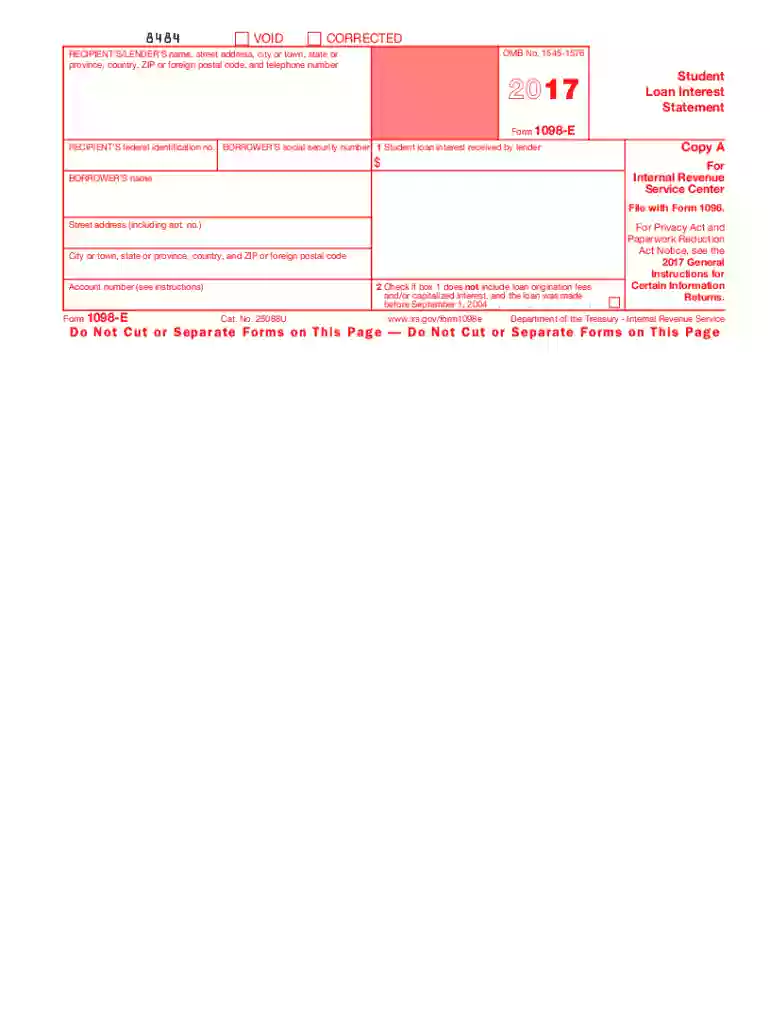
Form 1098-E, also known as the Student Loan Interest Statement, is a vital document in the United States tax system. It is used to report the amount of student loan interest a borrower has paid during the tax year. This form is primarily utilized by individuals who make payments on qualified student loans, as the IRS allows for a potential deduction based on this interest. Lenders, such as banks or financial institutions that receive interest payments above a certain threshold, are required to provide this form to borrowers and the IRS.
The 1098-E form allows taxpayers to claim a student loan interest deduction on their federal income tax returns. Eligible borrowers can deduct up to $2,500 of interest paid on qualified student loans. However, this deduction is an adjustment to income, meaning it can be claimed even if the taxpayer does not itemize deductions.
To utilize the form, taxpayers must include the reported interest on their tax return. This interest figure is usually found in Box 1 of the form. Taxpayers should ensure that the amounts reported and claimed are accurate, as discrepancies could lead to issues with the IRS.
Lenders typically send Form 1098-E to borrowers who have paid $600 or more in student loan interest over the course of the year. Borrowers should check their mail for physical forms or check their email and online accounts with lenders for electronic versions. If you do not automatically receive the form, contact your lender directly to request it.
Borrowers repaying student loans that qualify as education loans under IRS regulations are the primary users of Form 1098-E. These individuals primarily include college graduates and other individuals who have undertaken post-secondary education financing. Additionally, co-signers making payments on such loans may also utilize this form for tax purposes.


The IRS permits a student loan interest deduction subject to income limits. For single filers, the deduction phases out for modified adjusted gross income (MAGI) between $65,000 and $80,000 ($135,000 and $165,000 for joint filers). It is essential for taxpayers to confirm that their income does not exceed these limits to claim the deduction.
Failing to report the interest paid as documented in Form 1098-E, or misreporting amounts, can result in penalties or interest accruing on unpaid tax amounts. Taxpayers should adhere to submission deadlines and ensure accurate reporting to avoid such consequences.
Borrowers often have the option to receive Form 1098-E electronically or in paper form. Many lenders provide digital forms via secure online accounts, which can expedite the form receipt process. Concurrently, paper copies serve those preferring traditional mail receipt or lacking digital access.
By adhering to the above guidance, taxpayers can ensure they accurately utilize the 1098-E form in their tax filings, maximizing their potential deductions and maintaining compliance with IRS regulations.
We've got more versions of the 1098 e form form. Select the right 1098 e form version from the list and start editing it straight away!
| Versions | Form popularity | Fillable & printable |
|---|---|---|
| 2025 | 4.2 Satisfied (44 Votes) | |
| 2024 | 4.7 Satisfied (41 Votes) | |
| 2023 | 4.6 Satisfied (51 Votes) | |
| 2022 | 4.7 Satisfied (24 Votes) | |
| 2021 | 4.8 Satisfied (60 Votes) | |
| 2020 | 4.3 Satisfied (92 Votes) | |
| 2019 | 4.3 Satisfied (239 Votes) | |
| 2018 | 4.2 Satisfied (43 Votes) | |
| 2017 | 4.4 Satisfied (216 Votes) | |
| 2016 | 4.4 Satisfied (120 Votes) | |
| 2015 | 4 Satisfied (41 Votes) | |
| 2014 | 4 Satisfied (52 Votes) | |
| 2013 | 4 Satisfied (29 Votes) | |
| 2012 | 4.2 Satisfied (35 Votes) | |
| 2011 | 4.2 Satisfied (45 Votes) |
At DocHub, your data security is our priority. We follow HIPAA, SOC2, GDPR, and other standards, so you can work on your documents with confidence.
To complete Form 1098-E, use: the 2017 General Instructions for Certain Information. Returns, and. the 2017 Instructions for Forms 1098-E and 1098-T. ToRead more
May 2, 2017 If you have questions about reporting on information returns (Forms 1096, 1097,. -4-. General Instructions for Forms W-2 and W-3 (2017). Page 5Read more
A 1098-E form is a Student Loan Interest Statement issued to the Internal Revenue Service (IRS) and to student loan recipients to report student loan interestRead more


