




01. Edit your student tax form 1098 t online
Type text, add images, blackout confidential details, add comments, highlights and more.

Type text, add images, blackout confidential details, add comments, highlights and more.

Draw your signature, type it, upload its image, or use your mobile device as a signature pad.

Send how do i get a 1098 e via email, link, or fax. You can also download it, export it or print it out.
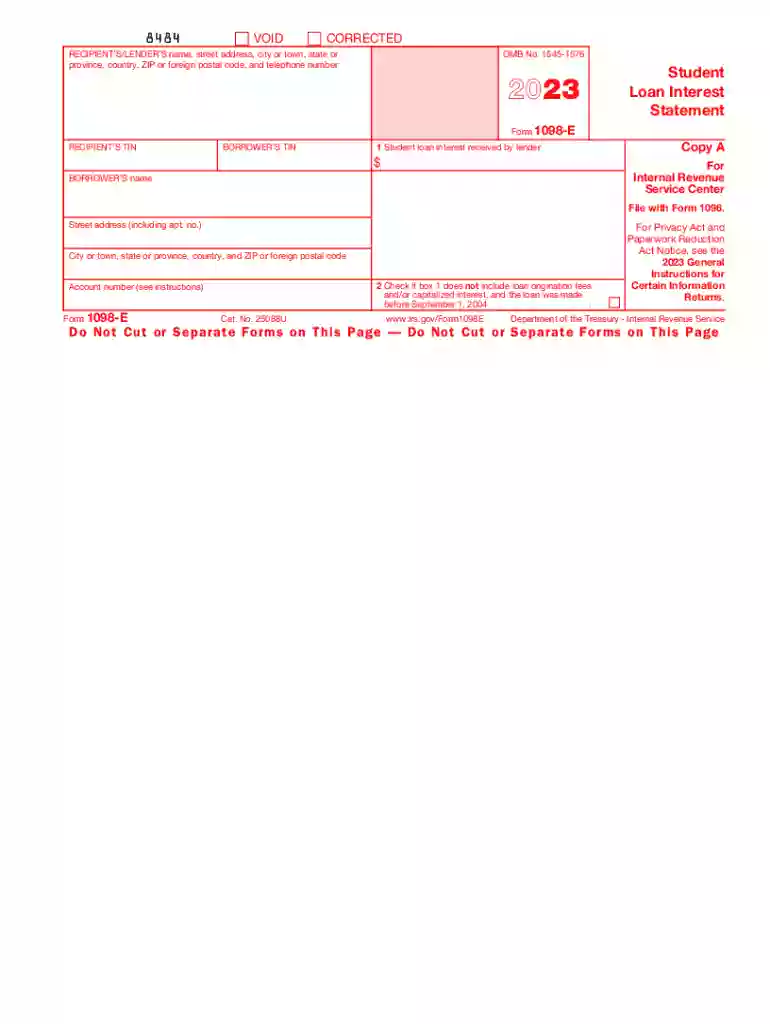
Form 1098-E, commonly referred to as the Student Loan Interest Statement, is a crucial document issued by the Internal Revenue Service (IRS). It provides details on the interest received from borrowers by lenders, which may be deductible on federal income tax returns. This form is typically used by borrowers with qualifying student loans, allowing them to track the amount of interest paid within a given tax year.
For taxpayers in the United States, especially students and recent graduates, the 1098-E is important because it can potentially lower taxable income. When filing federal taxes, individuals can deduct up to $2,500 of paid student loan interest, depending on their income level. It's essential to understand that this deduction is an "above-the-line" deduction, meaning it's available even if a taxpayer does not itemize deductions.
The 1098-E form contains several key components that taxpayers need to be familiar with. These include:
To apply the student loan interest deduction, include the total from Box 1 on your tax return. It's pertinent to use this figure on Schedule 1 of Form 1040 during tax filing. Ensure that the deduction aligns with IRS regulations and personal income limits for eligibility.
Before beginning the process, ensure all financial statements related to your student loan interest are available. This includes monthly payments summaries and the 1098-E form itself. Verify that all information matches your lender's records precisely.
Lenders typically send the 1098-E form by January 31 of the following year. If you've paid $600 or more in interest, the form will be automatically provided. It's commonly sent via mail but may also be accessible online through your loan servicer's portal.
If the form is not received, contact your student loan servicer promptly. Explore options such as downloading a digital copy or requesting a reissue through email or mail.
Filing a 1098-E accurately is crucial for legal compliance. Any errors can lead to tax audits or penalties. The IRS utilizes detailed regulations governing who can claim deductions and how they should be reported. Ensure all documentation aligns with federal requirements.
Failure to correctly report student loan interest could result in financial penalties. It's critical to keep documentation and to double-check all entered information for accuracy.
While the 1098-E is specifically for student loan interest, other forms such as the 1098-T (Tuition Statement) and Schedule 1 of Form 1040 also play roles in educational expenses and deductions. Understanding these relationships helps maximize tax efficiency and compliance.
By ensuring thorough understanding and careful handling of Form 1098-E, taxpayers can optimize their tax filings and benefit from potential deductions associated with student loan interest.
We've got more versions of the student tax form 1098 t form. Select the right student tax form 1098 t version from the list and start editing it straight away!
| Versions | Form popularity | Fillable & printable |
|---|---|---|
| 2025 | 4.2 Satisfied (44 Votes) | |
| 2024 | 4.7 Satisfied (41 Votes) | |
| 2023 | 4.6 Satisfied (51 Votes) | |
| 2022 | 4.7 Satisfied (24 Votes) | |
| 2021 | 4.8 Satisfied (60 Votes) | |
| 2020 | 4.3 Satisfied (92 Votes) | |
| 2019 | 4.3 Satisfied (239 Votes) | |
| 2018 | 4.2 Satisfied (43 Votes) | |
| 2017 | 4.4 Satisfied (216 Votes) | |
| 2016 | 4.4 Satisfied (120 Votes) | |
| 2015 | 4 Satisfied (41 Votes) | |
| 2014 | 4 Satisfied (52 Votes) | |
| 2013 | 4 Satisfied (29 Votes) | |
| 2012 | 4.2 Satisfied (35 Votes) | |
| 2011 | 4.2 Satisfied (45 Votes) |
At DocHub, your data security is our priority. We follow HIPAA, SOC2, GDPR, and other standards, so you can work on your documents with confidence.


