




Definition and Purpose of the National Medical Aid Claim Form
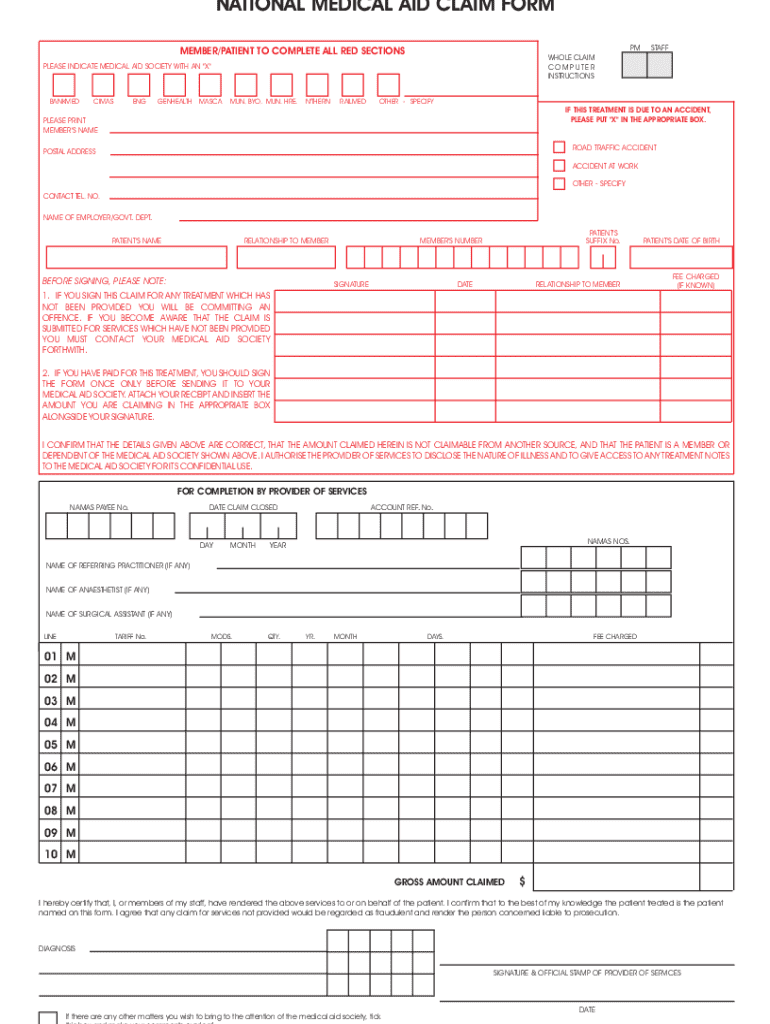
The National Medical Aid Claim Form is a crucial document used to process claims for medical expenses covered by health insurance plans. It serves as a formal request for reimbursement of medical services or treatments provided to an insured individual. This form ensures that the relevant insurance provider or medical aid society receives all necessary information to assess the claim's validity and expedite payment.
Key Components
- Member Information: Personal and policy details of the insured individual.
- Provider Details: Information about the medical service provider, including contact details and services rendered.
- Claim Information: Specific details regarding the medical services, such as dates of treatment, diagnosis codes, and itemized costs.
Importance
Filing this form accurately and promptly can significantly impact the speed and success of receiving insurance reimbursements. It acts as a bridge between patients, healthcare providers, and insurance companies to streamline the financial aspect of healthcare access.
Steps to Complete the National Medical Aid Claim Form
Filling out the National Medical Aid Claim Form requires meticulous attention to detail to ensure all information is precise and complete.
- Gather Required Information: Ensure all personal, policy, and diagnosis details are readily available.
- Fill Out Personal Details: Include the member's name, contact information, and member ID.
- Complete Provider Information: Insert details of the healthcare provider, including name and address.
- Enter Medical Service Details: Record all relevant treatment dates, diagnosis codes, and costs.
- Review and Submit: Double-check all entries for accuracy before submission to avoid processing delays.
Completing these steps ensures that the claim is processed efficiently.
How to Obtain the National Medical Aid Claim Form
Accessing the National Medical Aid Claim Form can vary depending on the specific medical aid society or insurance provider involved.
Common Acquisition Methods
- Online Portals: Many providers offer downloadable forms via their websites.
- Customer Service: Contacting the insurance provider's customer service for a mail-out or electronic version.
- Healthcare Provider's Office: Some clinics maintain copies of the form for patient convenience.
Having multiple acquisition options helps ensure that applicants can obtain the form in a manner that best suits their needs.
Required Documents for the National Medical Aid Claim Form
When submitting the National Medical Aid Claim Form, including appropriate documentation is essential to substantiate the claim.
Supporting Documents
- Medical Receipts: Original copies showing the services provided and costs incurred.
- Doctor's Notes: Documentation of the diagnosis or treatment plan.
- Insurance Cards: Proof of active coverage relevant to the claim.
Supplying these documents alongside the form facilitates a thorough evaluation by the insurance provider.
Methods of Submitting the National Medical Aid Claim Form
Submitting the National Medical Aid Claim Form can be done via several channels, depending on the applicant's preference and the provider's capabilities.
Submission Options
- Online Submission: Uploading forms and documents through a secure portal.
- Mail Submission: Sending physical copies via postal mail to the insurance provider's designated address.
- In-Person Submission: Delivering documents directly to a local insurance office.
Each method has its advantages; choosing the right one depends on urgency and accessibility.
Legal Use of the National Medical Aid Claim Form
Using the National Medical Aid Claim Form appropriately ensures legal compliance and the right to reclaim medical expenses.
Legal Considerations
- Accuracy: Providing truthful and complete information to prevent legal disputes.
- Timeliness: Submitting claims within specified deadlines to avoid forfeiture of reimbursement rights.
Understanding these legal aspects helps in maintaining a seamless claims process.
Examples of Using the National Medical Aid Claim Form
Real-world instances illustrate the practical application and significance of the National Medical Aid Claim Form.
Common Scenarios
- Routine Check-Ups: Regular appointments with general practitioners.
- Specialist Visits: Consultations with specialists requiring pre-approval.
- Emergency Treatments: Hospital admissions due to unforeseen medical emergencies.
These examples underline the form's versatility across various medical scenarios.
Penalties for Non-Compliance
Failure to adhere to the submission requirements for the National Medical Aid Claim Form can lead to penalties or claim denials.
Potential Consequences
- Claim Rejection: Due to incomplete or inaccurate information.
- Financial Penalties: Imposed by the insurance provider for late submissions.
- Loss of Coverage: In extreme cases, non-compliance may impact insurance policy status.
Understanding these penalties underscores the importance of thoroughness and precision when dealing with the form.