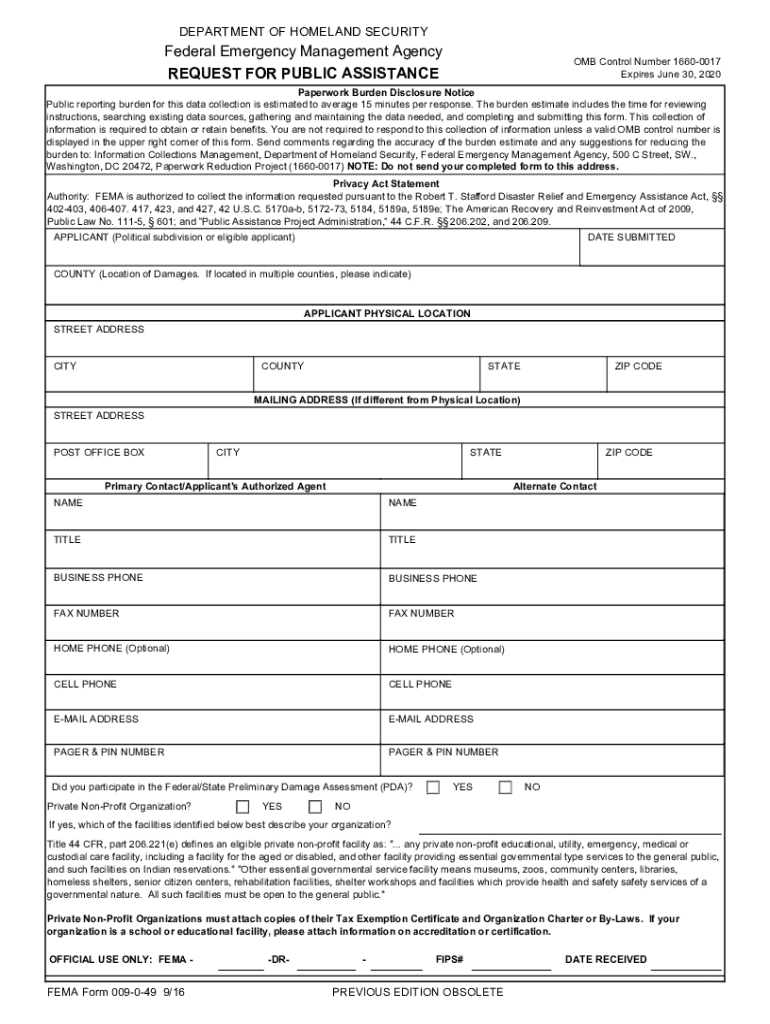







Definition & Meaning
The "FEMA Request for Public Assistance" is a critical document used by state, local, tribal, and territorial governments to apply for federal assistance following a declared disaster. Managed by the Federal Emergency Management Agency (FEMA), this form is essential for initiating the process to receive aid for damages or losses sustained during natural disasters or emergencies. The form initiates a partnership with FEMA, enabling applicants to seek financial support for necessary repairs, rebuilding efforts, and mitigation activities.
How to Use the FEMA Request for Public Assistance
To effectively utilize the FEMA Request for Public Assistance, applicants must complete the form in its entirety, detailing the nature and extent of the disaster-related damages or emergency situations. The form serves as a formal application to request federal assistance, allowing communities to recover from disasters swiftly. Applicants must provide specific information on damages, estimates of repair costs, and any completed or anticipated mitigation efforts. Utilization involves timely submission and coordination with FEMA representatives for further assessment and support.
How to Obtain the FEMA Request for Public Assistance
The FEMA Request for Public Assistance can be accessed through FEMA's official website. Eligible entities can download or request a copy through the appropriate federal or state emergency management agencies. Once obtained, applicants need to follow instructions for completion and submission. Depending on the circumstances, FEMA may provide online portals or mailing addresses for document submission, ensuring all necessary information is conveyed for efficient processing.
Steps to Complete the FEMA Request for Public Assistance
- Eligibility Verification: Confirm eligibility as a governmental entity or eligible nonprofit organization to apply for assistance.
- Documentation Collection: Gather all necessary documents, including proof of disaster declaration, cost estimates, and evidence of damages.
- Form Completion: Fill in all sections of the form with accurate, detailed information, including specific disaster impacts, resource needs, and financial estimates.
- Submission Review: Review the completed form for accuracy and completeness, ensuring compliance with FEMA guidelines.
- Submission: Submit the form through designated FEMA channels, either online or via mail, within specified deadlines to initiate the assistance process.
- Follow-Up: Engage with FEMA representatives to discuss any additional requirements or clarifications and track the application status.
Eligibility Criteria
To be eligible for the FEMA Request for Public Assistance, applicants must be government entities or specific private nonprofit organizations. Eligibility is contingent upon being located in a declared disaster area and having incurred costs or damages related to the event. Entities must demonstrate the necessity of funds to address disaster impacts and submit the form within deadlines outlined by FEMA.


Key Elements of the FEMA Request for Public Assistance
The form captures essential information, including:
- Applicant Information: Includes details such as the name, contact information, and type of entity applying for assistance.
- Disaster-Related Damages: Specifics of the disaster's impact on infrastructure, facilities, and community services.
- Cost Estimates and Repair Plans: Projections for repairing damages and restoring essential services.
- Mitigation Proposals: Plans for reducing future risk through improved building practices or prevention efforts.
These elements ensure FEMA receives a comprehensive overview of the disaster's impact and the necessity for federal aid.
Legal Use of the FEMA Request for Public Assistance
Legally, the form is used to formalize a request for federal disaster assistance under the Robert T. Stafford Disaster Relief and Emergency Assistance Act. It must be completed accurately, with truthful representations of damage and cost estimates, to comply with legal requirements. Misrepresentations can result in penalties or a denial of assistance.
Examples of Using the FEMA Request for Public Assistance
Communities impacted by hurricanes, tornadoes, or wildfires frequently use the FEMA Request for Public Assistance. For example, a coastal city affected by a hurricane may detail widespread infrastructure damage, requesting funds for rebuilding roads, sewage systems, and public schools. Similarly, a region hit by a wildfire might use the form to seek aid for restoring water systems and rebuilding community facilities essential for recovery.
Form Submission Methods (Online / Mail / In-Person)
Applicants have multiple submission options, including:
- Online Portals: Fast and efficient, often preferred for tracking and immediate confirmation of receipt.
- Mail: Traditional submission method, suitable for areas with limited internet accessibility.
- In-Person: On-site submission during immediate post-disaster response phases or where personal coordination is required.
Applicants must select a method that ensures timely and accurate submission, considering their unique circumstances and available resources.
Required Documents
When submitting the FEMA Request for Public Assistance, supporting documents enhance the application, including:
- Damage Assessments: Detailed reports and photographs illustrating the extent of disaster damage.
- Expense Reports: Precise accounting of incurred costs eligible for reimbursement.
- Legal Documents: Proof of ownership or jurisdiction over affected infrastructure or facilities.
Compiling these documents is a critical step in fortifying the application and streamlining the approval process.
Who Issues the Form
The Federal Emergency Management Agency (FEMA), part of the Department of Homeland Security, is responsible for issuing and overseeing the processing of the Request for Public Assistance form. FEMA coordinates with state and local governments to facilitate aid distribution, ensuring a structured and supportive response to disaster impacts.