




01. Edit your form online
Type text, add images, blackout confidential details, add comments, highlights and more.

Type text, add images, blackout confidential details, add comments, highlights and more.

Draw your signature, type it, upload its image, or use your mobile device as a signature pad.

Send it via email, link, or fax. You can also download it, export it or print it out.
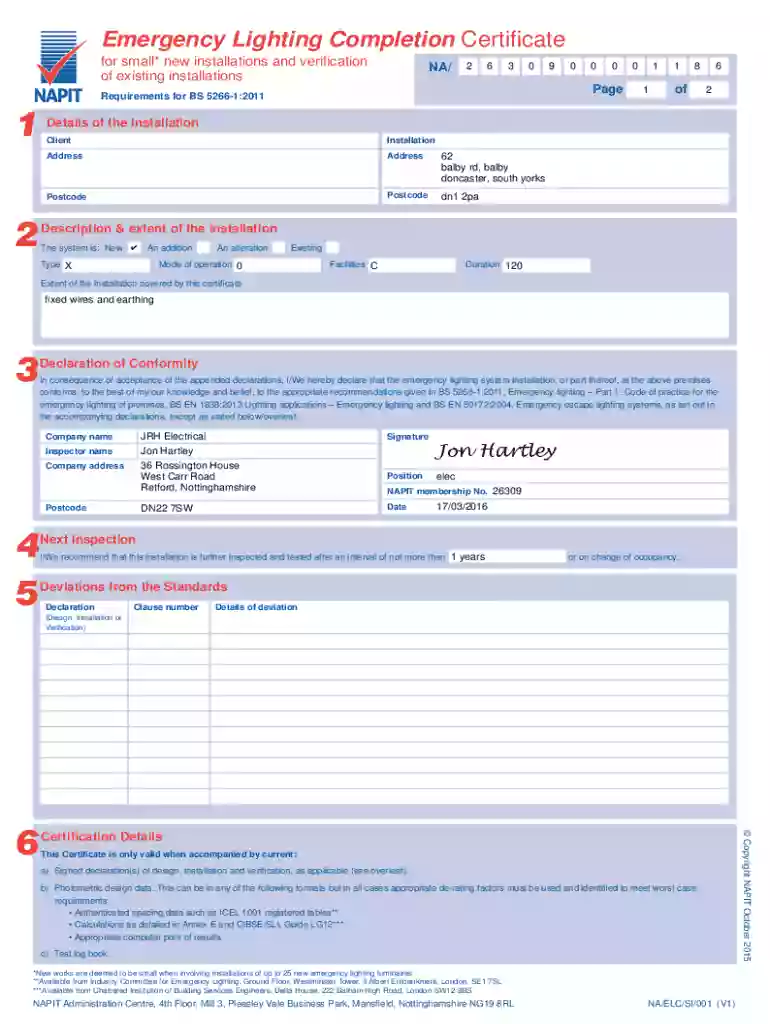
The Emergency Lighting Completion Certificate serves as a formal declaration that an installation of emergency lighting systems has been carried out in accordance with specific technical and safety standards. This certificate is essential for ensuring the compliance of newly constructed buildings or the validation of existing systems that have undergone significant modifications. Proper certification indicates that the lighting system is designed to operate efficiently in emergencies, providing adequate illumination to assist in safe evacuation and emergency management.
Utilizing the Emergency Lighting Completion Certificate is straightforward but requires understanding its role in broader safety and compliance frameworks:
Securing an Emergency Lighting Completion Certificate involves engaging with licensed professionals who are authorized to assess lighting systems against established safety and technical standards:
Completing the Emergency Lighting Completion Certificate requires meticulous attention to detail and adherence to outlined steps:
Obtaining an Emergency Lighting Completion Certificate is crucial for multiple compelling reasons:
The Emergency Lighting Completion Certificate is essential for a variety of stakeholders within different settings:
Building Owners/Managers: Ensure their property meets legal and safety standards, protecting investments and occupants.
Contractors/Developers: Required to verify that installations comply with the relevant safety codes before handing over buildings.
Facilities Managers: Utilize the certificate to manage and maintain building safety systems effectively.
Regulatory Inspectors: Reference certificates during inspections to check for compliance with safety standards.
Insurers: Review certificates to ascertain building safety, assessing risk levels and insurance premiums.
Diverse Stakeholders: Certificates engage multiple roles, serving varied functions from regulatory compliance to facility management.


Understanding the main components of the Emergency Lighting Completion Certificate is crucial for ensuring comprehensive completeness:
System Specifications: Details regarding the system's components, design, type, and power sources.
Installation Details: Information about the installation company/technician, along with dates and inspection logs.
Compliance Statements: Confirmations that installation complies with specified technical standards like BS 5266-1:2011.
Inspection Results: Findings from system performance tests, including pass/fail status, and details of any necessary rectifications.
Certification Signatures: Mandatory endorsements by authorized professionals confirming the accuracy of documented information.
Documentation Integrity: Accurate record-keeping is essential for reliably validating system compliance and performance.
Real-world applications of the Emergency Lighting Completion Certificate illustrate its practical utility:
Newly Constructed Office Building: A developer completes an office complex and secures the certificate to demonstrate compliance before occupation.
School Safety Upgrade: An educational institution upgrades its lighting systems and uses the certificate for regulatory approval during safety inspections.
Retail Store Renovation: A store undergoing renovation updates its emergency lighting and certifies the installation for insurance reassessment.
Diverse Use Cases: From real estate development to educational safety, certificates play crucial roles in wide-ranging scenarios.
Legally, the Emergency Lighting Completion Certificate holds significant importance:
Regulatory Fulfillment: Certifies meeting the statutory obligations under building code enforcement, avoiding penalties.
Dispute Resolution: Acts as proof in legal disputes or claims involving building safety compliance, strengthening defenses.
Contractor Accountability: Provides a record that installation adheres to contractual obligations within building projects.
Legal Safeguard: Ensures that stakeholders have reliable legal documentation supporting safety compliance efforts.
At DocHub, your data security is our priority. We follow HIPAA, SOC2, GDPR, and other standards, so you can work on your documents with confidence.







The Certificate in Theatre Lighting provides non-majors lighting-specific opportunities that are not available in the broader Minor in Design and Production.Read more
This manual provides all the information on the FRENIC-Eco series of inverters including its operating procedure, operation modes, and selection ofRead more


