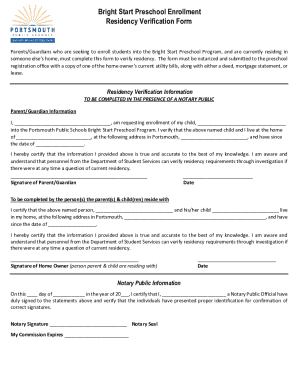
Definition and Purpose of the Residency NEW docx - ccri
The "Residency NEW docx - ccri" is a document utilized by the Community College of Rhode Island (CCRI) to determine the residency status of students for tuition purposes. Residency status affects the tuition fees a student is required to pay. This form is essential as it helps the institution classify students as either in-state or out-of-state residents based on specific criteria. Understanding this classification can significantly affect a student's financial obligations.
Examples of Criteria Included
- Duration of Residence: Students may need to prove that they have lived in Rhode Island for a specific number of months or years.
- Permanent Address Verification: Evidence such as utility bills or lease agreements might be required to establish an address within Rhode Island.
- Other Supporting Documents: Additional documents like driver's licenses, voter registration, or tax returns can further substantiate residency claims.
How to Obtain the Residency NEW docx - ccri
Obtaining the Residency form is a straightforward process for students at CCRI. It can be downloaded from the college's official website or obtained in person at the office of enrollment services. This accessibility ensures all applicants can readily acquire and complete the necessary form to confirm their residency status.
Steps to Complete the Residency NEW docx - ccri
Completing the residency form involves several key steps, each requiring attention to detail to ensure a complete and accurate submission.
- Download or Obtain a Physical Copy: Acquire the form via the internet or in-person visit.
- Gather Required Documentation: Collect all necessary documents that prove residency, such as proof of address and identity.
- Accurately Fill Out the Form: Ensure all information matches supporting documents to avoid discrepancies.
- Review and Verify Information: Double-check all entered details to confirm accuracy and completeness.
- Submit to Designated Office: Submit the completed form to the college’s office of enrollment services.
Special Considerations
- Deadlines: Timely submission is critical, especially for students enrolling for upcoming semesters.
- Verification Interviews: In some cases, an in-person meeting may be required for verification purposes.
Key Elements of the Residency NEW docx - ccri
The form comprises several sections, each requiring specific types of information to establish eligibility for in-state tuition rates.
- Personal Information: Includes the student's full name, current address, and contact details.
- Residence History: Details past addresses and length of stay in each location.
- Supporting Documentation: Lists all documents attached to confirm residency status.
Additional Requirements
- Signatures: Both the student and, if applicable, a guardian must sign the form to validate the information.
Who Typically Uses the Residency NEW docx - ccri
This form is predominantly used by prospective and current students of CCRI who seek to qualify for in-state tuition rates based on residency. Understanding the criteria set by the college, students can determine whether they meet the residency requirements necessary for tuition adjustment.


Examples of Typical Users
- First-Year Students: New enrollees need to establish residency to decrease tuition costs.
- Transfer Students: Students moving from another state to Rhode Island for their studies.
- Current Students Changing Residency: Individuals whose residency status has changed since their initial enrollment.
State-Specific Rules for the Residency NEW docx - ccri
Residency requirements for tuition purposes are dictated by state-specific legislation and institutional policies, which must be adhered to by students seeking favorable tuition rates.
Rhode Island Residency Rules
- Minimum Duration of Residency: Rhode Island typically requires proof of a continuous 12-month residency to qualify for in-state tuition.
- Financial Independence: Students over a certain age may need to demonstrate financial independence to be considered Rhode Island residents.
Examples of Using the Residency NEW docx - ccri
Real-world scenarios alleviating the significance of the residency form illustrate its utility.
- Case Study of a Transfer Student: A student relocating from Massachusetts to Rhode Island can save a substantial amount by establishing residency through the form.
- Returning Resident Scenario: A former Rhode Island resident returning after several years can reestablish in-state residency to lower educational costs.
Legal Use of the Residency NEW docx - ccri
The form carries legal implications as it is used to determine financial commitments based on residency status. Inaccurate or fraudulent claims can lead to penalties or revocation of in-state tuition benefits.
Legal Implications
- Verification Requirements: Students might be subject to periodic checks to ensure continued eligibility.
- Consequences of Misrepresentation: Providing false information can lead to suspension of residency status and financial repercussions.
Software Compatibility and Digital Variants
The Residency form is compatible with various document editing and signing platforms, such as DocHub. These platforms simplify the process of completing, signing, and submitting the form electronically.
Benefits of Digital Usage
- Convenience: Allows students to complete and submit forms online, reducing the need for physical paperwork.
- Efficiency: Electronic forms can be processed more quickly than their paper counterparts.
Understanding these aspects of the "Residency NEW docx - ccri" allows students to navigate their path from potential to actual enrollment seamlessly by meeting all residency requirements.