






Definition and Purpose of the Field Training Officer (FTO) Program
The Field Training Officer (FTO) Program of the San Jose Police Department serves as a critical component in preparing new recruits for the practical challenges of police work. This program, essential for the professional development of officers, blends classroom training with hands-on field experience. Its primary aim is to bridge the gap between academic knowledge acquired during initial police training and the practical application of skills in real-world situations.
- Conceptual Framework: The FTO Program focuses on transitioning recruits from a controlled learning environment to unpredictable street-level policing. It emphasizes situational awareness, decision-making, and public interaction.
- Objective Alignment: Aligns the department's operational goals with officer performance, ensuring that trainees deliver community-focused service consistent with departmental standards.
- Performance Metrics: Evaluates trainees based on both technical proficiency and soft skills such as communication and conflict resolution.
How to Use the San Jose Police Department FTO Program
Understanding how to leverage the FTO Program effectively is vital for both trainees and training officers. The structured approach ensures that all participants gain maximum value from the process.
- For Trainees: Engage actively with your Field Training Officer to discuss observations and feedback. Track progress through daily observation reports and self-assessment.
- For FTOs: Provide balanced and constructive feedback. Customize training approaches based on individual trainee needs to ensure comprehensive skill development.
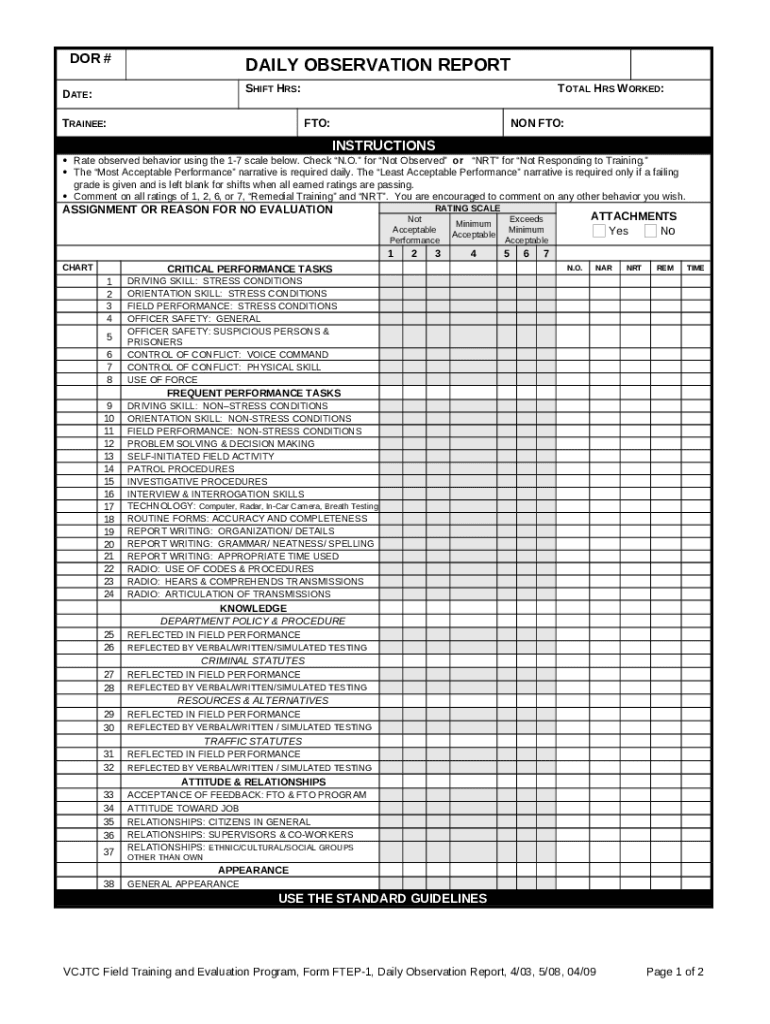
- Daily Analysis: Utilize the Daily Observation Report to reflect on tasks performed, identify areas for improvement, and acknowledge successful endeavors.
Steps to Complete the Field Training Officer (FTO) Program
Completion of the FTO Program involves a series of carefully structured steps designed to ensure that new officers meet departmental competency standards.
- Instructor Assignment: Each recruit is paired with a seasoned officer designated as their Field Training Officer.
- Phase-Based Training: The program is divided into multiple phases, each with specific learning objectives and skills assessments.
- Field Evaluations: Performance reviews are conducted regularly to document progress, using standard forms to record strengths and areas for development.
- Final Assessment: At the end of the program, a comprehensive evaluation determines the readiness of the trainee to function independently.
Key Elements of the FTO Program
The San Jose FTO Program includes several critical components that contribute to its success.
- Daily Observation Reports: Essential for recording trainee performance and providing a basis for feedback.
- Rating Scale: A standardized rating system aids in assessing various performance tasks, assisting in objectivity.
- Narrative Feedback: Required for detailed commentary on specific performance metrics, providing qualitative insight.
Detailed Breakdown of Observation Reports
Observation reports capture both quantitative and qualitative data. Trainees receive scores from one to seven on various tasks, with additional narrative feedback offering context.
- Quantitative Ratings: These scores reflect objective measures of a trainee’s performance across different competencies, including decision-making and procedural knowledge.
- Qualitative Commentary: Provides deeper insights into the trainee's adaptability, communication skills, and critical thinking.
Examples of Using the FTO Program
Real-world application of the FTO Program includes numerous scenarios:
- Traffic Stops: Trainees practice de-escalation techniques during routine traffic stops under the supervision of their FTO.
- Community Engagement: Engagements with community members are documented, allowing insights into public interaction skills.
- Incident Response: Field exercises typically include simulated emergency responses to test situational appropriateness and tactical responses.
Edge Cases and Variations
The program accommodates diverse situations, providing case studies and scenarios that require adaptive strategies from both trainees and trainers.
- Uncommon Incidents: Training includes handling non-standard incidents such as cultural clashes or language barriers.
- Different Policing Areas: Trainees experience work in varied neighborhoods to understand community-specific policing tactics.
State-Specific Rules and Legal Considerations
Ensuring adherence to state laws and regulations is essential in the San Jose FTO Program. It ensures compliance with California-specific legal standards for police conduct and training requirements.
- Regulatory Compliance: Operates under guidelines set forth by the California Commission on Peace Officer Standards and Training (POST).
- Legal Education: Trainees receive supplemental instruction on state laws, including search and seizure, and use-of-force policies.
Eligibility Criteria for Participating in the FTO Program
Certain prerequisites must be met for recruits to participate in the San Jose Police Department's FTO Program.
- Basic Training: Completion of police academy training is required before enrolling in the FTO Program.
- Background Checks: A thorough background investigation ensures recruits meet the ethical and professional standards expected of law enforcement personnel.


Form Submission Methods and Compliance
While the FTO Program itself is experiential, compliance documentation and reports are submitted in various forms.
- Digital Submission: Reports are often completed and archived electronically for convenience and accessibility.
- Paper Version: Some records might still be maintained in print for legal or archival purposes, especially in scenarios requiring official documentation.
Important Dates and Deadlines
Staying informed of all relevant deadlines is crucial for ensuring the smooth progress and timely completion of the program.
- Progress Reports: Regular due dates for submitting evaluation reports ensure that all stakeholders are informed of trainee advancements.
- Final Review: The final evaluation typically concludes within a fixed period after the program's official end date.