







Definition & Meaning
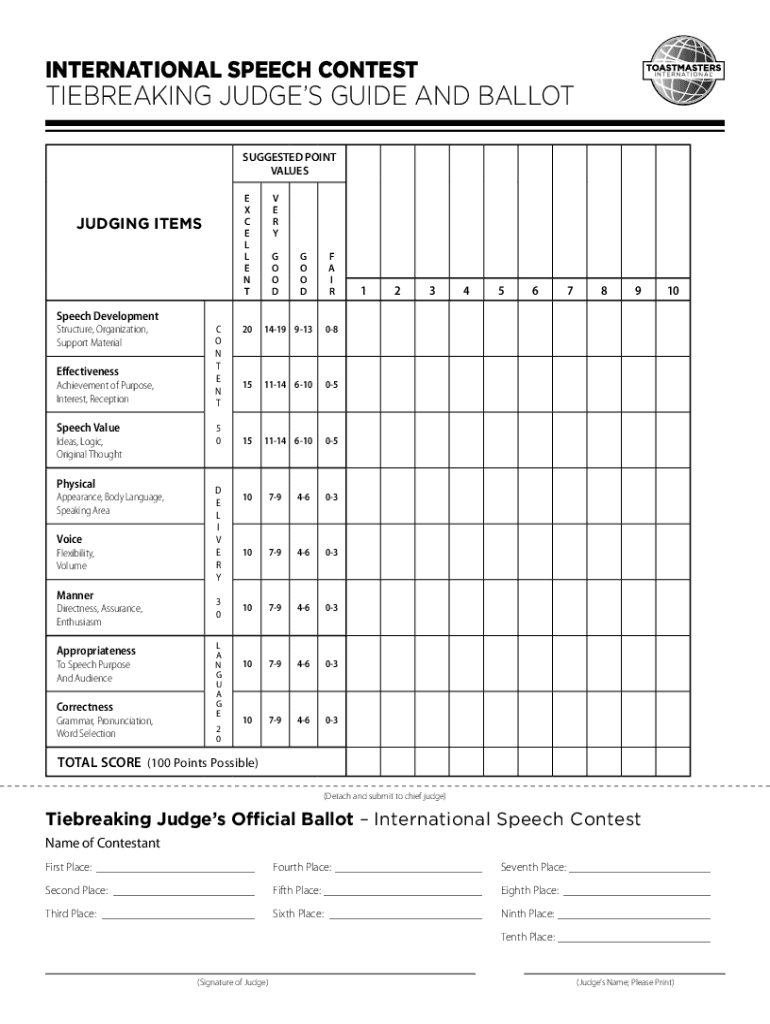
The International Speech Contest Judge's Guide and Ballot serve as a critical tool for evaluating participants in speech contests. It includes detailed guidelines that judges must follow to assess contestants objectively and impartially. This form ensures consistency in scoring by outlining specific criteria such as Content, Delivery, and Language, each with designated point values. The use of this guide promotes fairness, accuracy, and uniformity across different judging panels, contributing to a transparent and equitable contest environment.
Key Elements of the International Speech Contest Judge's Guide and Ballot
A comprehensive breakdown of the guide and ballot reveals various components:
- Content: Judges evaluate the quality and relevance of the speech material.
- Delivery: This includes the speaker’s body language, voice modulation, and overall presentation.
- Language: Proper grammar, vocabulary, and speech clarity are assessed.
- Judge's Code of Ethics: Ensures judges maintain impartiality and objectivity.
These elements form the basis for a standardized scoring system that facilitators and participants rely upon to understand performance metrics.
How to Use the International Speech Contest Judge's Guide and Ballot
Utilizing the guide and ballot effectively involves several steps:
- Review the Criteria: Judges should familiarize themselves with the detailed criteria outlined in the form.
- Attend Training: Participating in judiciary training sessions can provide deeper insights into using the guide efficiently.
- Practice Judging: Conduct mock evaluations to understand how to apply scoring accurately.
- Record Scores Promptly: Ensure timely documentation of scores to prevent bias or omission.
Consistency in following these steps helps maintain the integrity of the judging process.
Steps to Complete the International Speech Contest Judge's Guide and Ballot
Accurate completion of the form requires attention to detail:
- Fill in Judge Information: Include name, contact information, and signature.
- Assess Each Criterion: Assign points according to the speech’s alignment with the outlined criteria.
- Justify Scores: Optional notes can provide context for the scores assigned.
By following these steps, judges can contribute to a fair and balanced contest evaluation.
Why Should You Use the International Speech Contest Judge's Guide and Ballot
Using this guide is essential for:
- Ensuring Fairness: Standardized criteria help prevent biases in evaluating contestants.
- Facilitating Transparent Evaluation: Contestants receive clear, constructive feedback based on structured assessments.
- Promoting Credibility: Enhances the reputation of the contest by ensuring that judging is conducted with integrity and professionalism.
By adhering to the guide, contest organizers uphold the principles of fairness and objectivity.
Who Typically Uses the International Speech Contest Judge's Guide and Ballot
This guide and ballot are primarily used by:
- Judges: To evaluate participants systematically according to standardized criteria.
- Speech Contest Organizers: To ensure consistency and prevent discrepancies in scoring.
- Participants and Coaches: To understand the standards they are judged against, aiding in preparation and improvement.
These users rely on the guide to maintain contest fairness and transparency.

Important Terms Related to the International Speech Contest Judge's Guide and Ballot
Understanding key terms enhances clarity:
- Criteria: The specific standards or benchmarks used for judging.
- Point System: The numerical scale employed to quantify performance levels.
- Impartiality: The objective stance that judges are expected to maintain.
Clarifying these terms helps users navigate the guide more effectively and guarantees a consistent application.
Legal Use of the International Speech Contest Judge's Guide and Ballot
The legal framework surrounding the use of this guide includes:
- Adhering to Organizational Policies: Ensuring the form aligns with contest regulations and bylaws.
- Ethical Standards: Observing principles of fairness and impartiality in judging.
- Confidentiality: Protecting the integrity of the scoring process and maintaining contestant privacy.
These legal considerations are critical for maintaining the legitimacy and professionalism of speech contests.




