Chain Of Custody Form - Water Integrated Treatment Systems 2026

Get Form
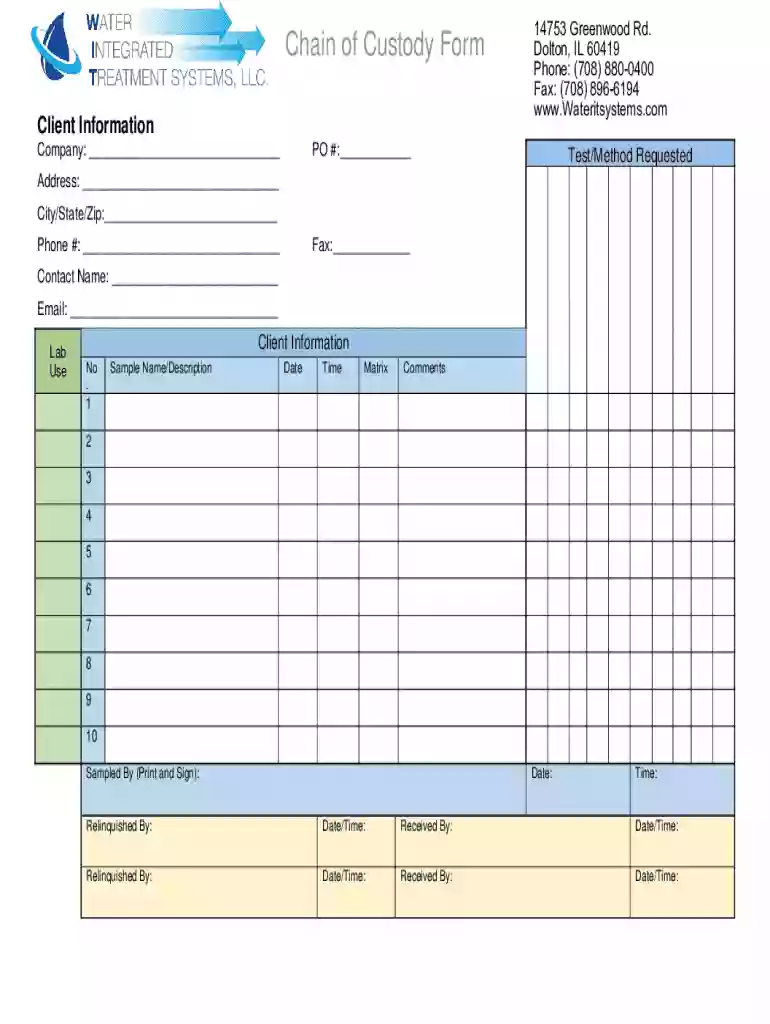
Chain Of Custody Form - Water Integrated Treatment Systems Preview on Page 1

Here's how it works

01. Edit your form online
Type text, add images, blackout confidential details, add comments, highlights and more.

02. Sign it in a few clicks
Draw your signature, type it, upload its image, or use your mobile device as a signature pad.

03. Share your form with others
Send it via email, link, or fax. You can also download it, export it or print it out.

Definition and Purpose of the Chain of Custody Form for Water Integrated Treatment Systems

The Chain of Custody Form used in water integrated treatment systems serves as a critical document for tracking the collection, handling, and analysis of water samples. The form ensures that all samples are accounted for throughout the analysis process, providing a reliable history that safeguards against data tampering or loss. This document is pivotal in maintaining the integrity of water testing results, which is essential for environmental monitoring, compliance with regulatory standards, and various research purposes.

How to Use the Chain of Custody Form for Water Integrated Treatment Systems

Using the Chain of Custody Form involves several detailed steps:

  1. Sample Collection: Accurately record the sample's origin, collection date, and time.
  2. Sample Identification: Label each sample with a unique identifier.
  3. Transport Details: Document the conditions under which the sample is transported, including temperature and handling procedures.
  4. Transfer of Custody: Note each instance of sample transfer, including personnel involved and timestamps.
  5. Final Destination: Record the recipient laboratory and analysis details.

Detailed Steps for Transferring Custody

  • Ensure that each person in custody signs off on the sample time and date.
  • Check and update the sample's condition upon each transfer.
  • Use tamper-proof seals to prevent unauthorized access.

Steps to Complete the Chain of Custody Form for Water Integrated Treatment Systems

Here's a step-by-step guide to completing the form efficiently:

  1. Client Information: Fill in the client's name, address, and contact details.
  2. Sample Information: Detail sample type, origin, and any specific characteristics.
  3. Custody Details: Include each handler's information and the time of transfer.
  4. Signatures: Obtain signatures from all parties involved at each custody stage.
  5. Review and Verification: Double-check form entries for accuracy and completeness before submission.

Who Typically Uses the Chain of Custody Form for Water Integrated Treatment Systems

The form is widely utilized by:

  • Environmental Scientists: Monitoring water quality and environmental impacts.
  • Laboratory Technicians: Ensuring accurate analysis and data recording.
  • Regulatory Inspectors: Verifying compliance with state and federal water standards.
  • Water Treatment Facilities: Managing internal quality control and external reporting.
decoration image ratings of Dochub

Use Cases in Specific Industries

  • Agriculture: Tracking groundwater samples for pesticide contamination.
  • Manufacturing: Monitoring effluent discharges to maintain compliance with environmental regulations.

Key Elements of the Chain of Custody Form for Water Integrated Treatment Systems

The form is composed of several critical sections:

  • Client and Sample Information: Ensures traceability from collection to analysis.
  • Chain of Custody Log: Documents every handler and transfer to maintain sample integrity.
  • Signatures/Initials: Acts as legal verification of each custody change.
  • Comments Section: Allows additional details about sample handling and anomalies.

Legal Use of the Chain of Custody Form for Water Integrated Treatment Systems

The Chain of Custody Form is a legal document that supports compliance with both state and federal environmental laws. Properly completed forms can act as evidence in legal proceedings related to environmental violations or disputes. The documentation assists in demonstrating that samples have been handled according to official guidelines, ensuring the credibility and reliability of results.

Important Terms Related to the Chain of Custody Form for Water Integrated Treatment Systems

Understanding key terminologies is crucial:

  • Custodian: An individual responsible for a sample at any point in time.
  • Sample Integrity: Maintaining the original state of the sample through controlled handling.
  • Transfer of Custody: The formal passing of responsibility for a sample.
  • Analytical Batch: A set of samples tested together under the same conditions.

State-Specific Rules for the Chain of Custody Form for Water Integrated Treatment Systems

Rules can vary by state in terms of:

  • Reporting Requirements: Varying documentation levels for regulatory compliance.
  • Interstate Transfers: Specific protocols for sample transfer across state lines.
  • State-specific Environmental Standards: Additional requirements tied to local environmental laws.

Understanding these nuances helps ensure compliance and correct reporting irrespective of location.

be ready to get more

Complete this form in 5 minutes or less

Get form

Security and compliance

At DocHub, your data security is our priority. We follow HIPAA, SOC2, GDPR, and other standards, so you can work on your documents with confidence.
Learn more