




01. Edit your confidential litigant information sheet online
Type text, add images, blackout confidential details, add comments, highlights and more.

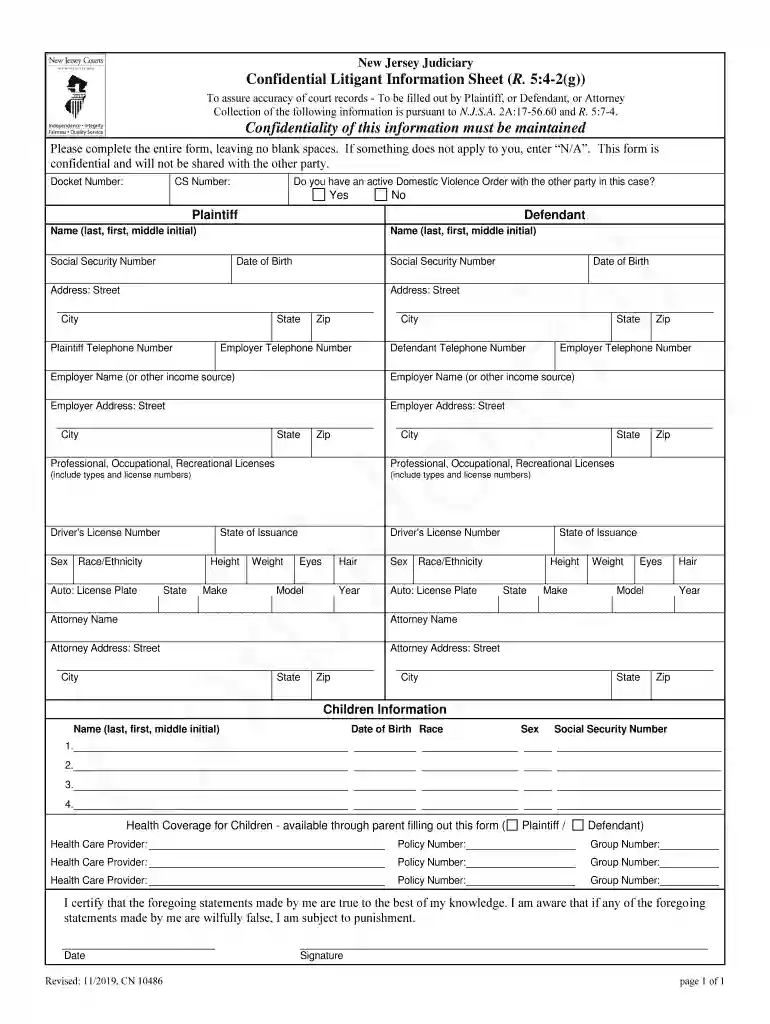
Type text, add images, blackout confidential details, add comments, highlights and more.

Draw your signature, type it, upload its image, or use your mobile device as a signature pad.

Send it via email, link, or fax. You can also download it, export it or print it out.
The Confidential Litigant Information Sheet is a critical form used by the New Jersey Judiciary to collect sensitive personal information for court records. It is designed to securely gather details from plaintiffs, defendants, or their attorneys to ensure accurate identification and processing within the legal system. This form plays an essential role in maintaining confidentiality and trust, focusing on the accuracy of data and the protection of personal information under legal protocols. It includes sections such as personal details, contact information, employment data, and health coverage for children to support any legal proceedings effectively.
Using the Confidential Litigant Information Sheet involves a series of steps to ensure the information collected is accurate and comprehensive. Firstly, individuals must carefully read each section to understand the type of details required. For individuals filling out the form themselves, it's crucial to provide complete and truthful information. For legal representatives, ensuring that clients understand what information is needed can prevent mistakes or omissions. This form should be used in compliance with legal standards, ensuring it accompanies any related legal documents to enhance the integrity of court records.
The Confidential Litigant Information Sheet serves as a foundation for maintaining an organized and thorough legal process. It ensures that personal data is accurately represented and securely stored in accordance with legal statutes. In legal proceedings, this form guarantees the privacy of the involved parties while allowing the judiciary system to access necessary information efficiently. Accurate and complete information on this form helps streamline legal processes, making it easier for courts to make informed decisions based on reliable data.
This form is primarily used by individuals involved in legal proceedings in New Jersey, including plaintiffs, defendants, and their attorneys. Legal professionals who represent clients in court use this form to collect the essential data needed to support their cases effectively. While the primary users are parties directly involved in litigation, court clerks and administrative staff may also handle these forms to manage case files and documents securely.


Obtaining a Confidential Litigant Information Sheet can be done through the specific court where the litigation is taking place. Participants can request it from court clerks or download it directly from the official New Jersey Judiciary website. With advancements in online accessibility, many legal forms, including this sheet, are available for download, ensuring that participants can access them conveniently without visiting a courthouse in person.
New Jersey-specific protocols govern the use and submission of the Confidential Litigant Information Sheet. Participants must adhere to these regulations to ensure their data is handled correctly. Depending on the nature of the case, there may be additional requirements or variations in how the form is filled out or submitted. Understanding these state-specific guidelines is crucial for ensuring compliance and avoiding unnecessary delays in legal proceedings.
Consider a scenario where a couple is going through a divorce, and the form is required to provide accurate data on custody and financial support. Another example is in employment-based litigation, where an employee's job status and earnings might be pertinent to the case. In these contexts, the form serves as an essential tool for capturing information that supports judicial decision-making, demonstrating the form's role in a fair and efficient legal process.
At DocHub, your data security is our priority. We follow HIPAA, SOC2, GDPR, and other standards, so you can work on your documents with confidence.
This confidential form must be completed by both parties when filing a dissolution or non-dissolution complaint, and is not shared with the other party.
Apr 15, 2023 Classification as confidential is an internal procedure and cannot be used to deny information, since the RTI Act has exempted thisthis


