Interrogatories 2026

Get Form
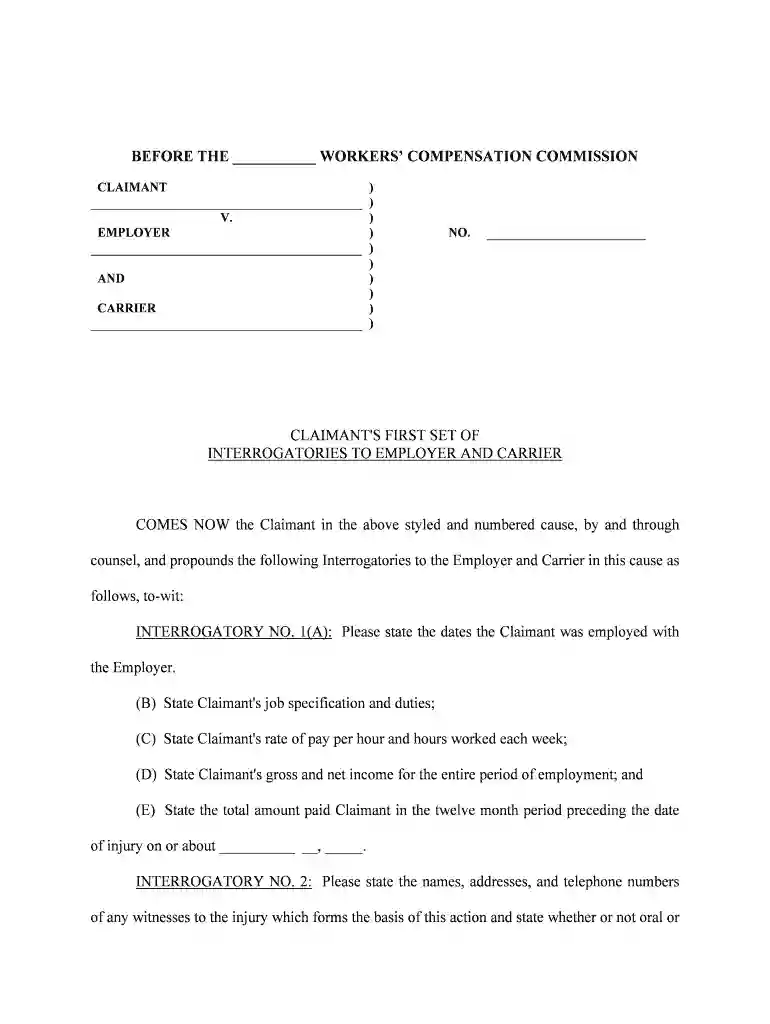
interrogatories Preview on Page 1

Here's how it works

01. Edit your interrogatories online
Type text, add images, blackout confidential details, add comments, highlights and more.

02. Sign it in a few clicks
Draw your signature, type it, upload its image, or use your mobile device as a signature pad.

03. Share your form with others
Send it via email, link, or fax. You can also download it, export it or print it out.

How to use or fill out interrogatories with our platform

Form edit decoration
9.5
Ease of Setup
DocHub User Ratings on G2
9.0
Ease of Use
DocHub User Ratings on G2
  1. Click ‘Get Form’ to open the interrogatories document in the editor.
  2. Begin with INTERROGATORY NO. 1. Fill in the dates of employment, job specifications, pay rate, and income details as requested. Ensure accuracy for each field.
  3. Proceed to INTERROGATORY NO. 2. List any witnesses to the injury, including their contact information and details about any statements obtained.
  4. Continue through each interrogatory systematically, providing detailed responses for medical disbursements, expert witnesses, and any claims made by the claimant.
  5. Review your entries for completeness and clarity before finalizing your document. Utilize our platform's editing tools to make adjustments as needed.

Start using our platform today to efficiently complete your interrogatories online for free!

be ready to get more

Complete this form in 5 minutes or less

Get form

Got questions?

We have answers to the most popular questions from our customers. If you can't find an answer to your question, please contact us.
Contact us
In California, you have 30 days to respond to an interrogatory. If you do not respond within this time, the opposing side can file a motion to compel with the court. The court may require them to first consult with you about your failure to respond before officially filing a motion to compel.
An interrogatory is a set of written questions sent to the other side. You typically have a few weeks to respond to interrogatories in writing. A deposition, by contrast, takes place in person, where youre asked questions aloud and a court reporter documents your answers. Interrogatories vs. Depositions: Whats the Difference? justice4you.com blog depositions-vs-inte justice4you.com blog depositions-vs-inte
However, you can object to interrogatories that call for legal conclusions. You can also object to questions if they are not at all related to the court case. To object, you need to write out the reasons for the objection instead of answering the question.
If you do not answer the questions by the deadline, which is usually about a month, the other side could ask the judge to order you to respond to the interrogatories. If you miss the second deadline, the judge could impose a fine against you or strike your pleadings.
Limitations and Challenges In some cases, a party might object to certain interrogatories, arguing they are too broad, irrelevant, or burdensome. The court may have to intervene to resolve such disputes.

Security and compliance

At DocHub, your data security is our priority. We follow HIPAA, SOC2, GDPR, and other standards, so you can work on your documents with confidence.

Learn more
ccpa2
pci-dss
gdpr-compliance
hipaa
soc-compliance
be ready to get more

Complete this form in 5 minutes or less

Get form

People also ask

Each interrogatory must be answered separately and fully in writing under oath or affirmation, unless it is objected to. If the answering party objects to any interrogatory, the party must state the reasons for the objection in lieu of an answer. The answers and objections must be signed by the person making them. 5.2 - Written Interrogatories - Department of Justice justice.gov eoir ocaho chapter-5 justice.gov eoir ocaho chapter-5
If you are unable to answer an interrogatory because it is too vague, ambiguous, or somehow objectionable, you can state an objection and the reason for your objection. You must then answer to the extent the interrogatory is not objectionable.
You use different types of discovery requests to get different kinds of information: To ask the other side to answer a set of questions, you can use Interrogatories. To ask the other side to admit that certain facts are true or certain items are authentic, you can use Request for Admission.

Related links