







Definition & Meaning
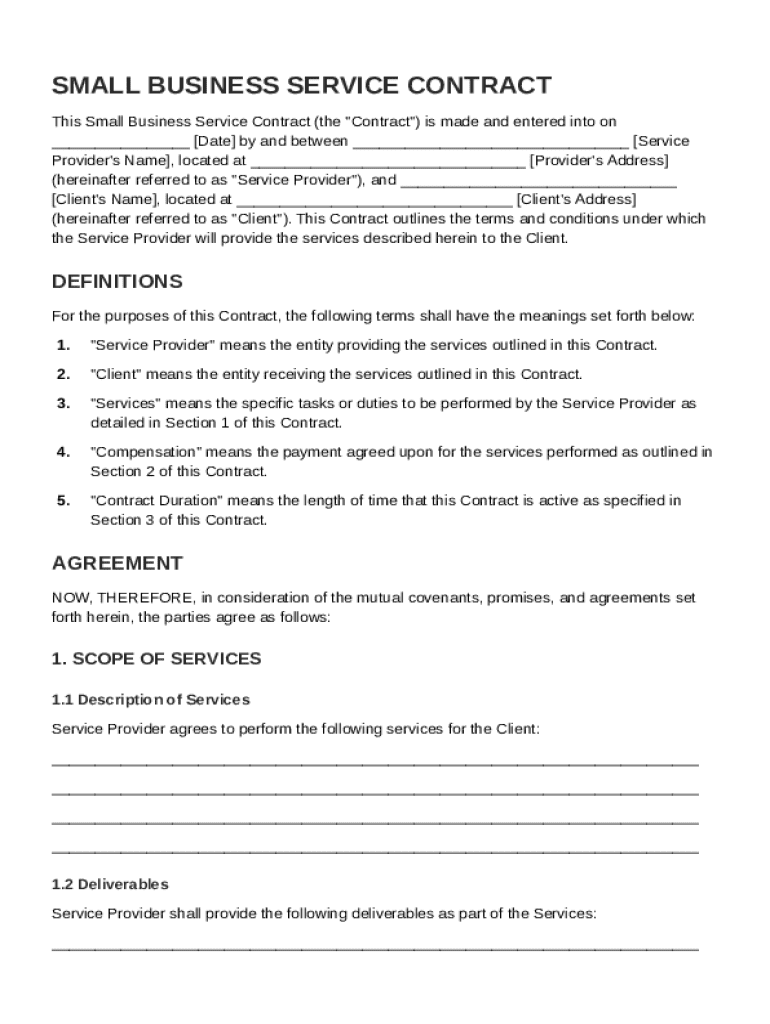
The Small Business Service Contract Template is a formal agreement that outlines the terms and conditions under which a service provider agrees to deliver specific services to a client. This document is crucial for establishing mutual understanding and expectations between both parties. It typically includes sections on the scope of services, compensation, duration of the contract, and other critical components like confidentiality and liability clauses. This contract serves to protect the interests of both the service provider and the client by clearly defining each party's responsibilities and the agreed-upon deliverables.
How to Use the Small Business Service Contract Template
Using this template effectively involves customizing it to fit the particular needs of your business relationship. Begin by inserting the names and contact information of both parties involved—the service provider and the client. Next, fill in the details regarding the service scope, including specific tasks to be performed and any limitations. It's also important to define the compensation structure, such as hourly rates or fixed fees. Always review key clauses like confidentiality and dispute resolution to ensure they align with both parties' expectations. Lastly, both parties should review and sign the document to ensure mutual consent.
Key Elements of the Small Business Service Contract Template
- Scope of Services: Details the specific services to be provided, including the tasks and any limitations.
- Compensation: Outlines the payment terms, whether hourly, fixed rate, or milestone-based.
- Duration: States the contract's starting and ending date, as well as provisions for renewal.
- Confidentiality: Protects sensitive information and establishes the obligations to maintain privacy.
- Liability and Indemnification: Defines the extents of liability and indemnity between the parties.
- Governing Law: Specifies the jurisdiction whose laws will govern the contract.
- Termination Conditions: Describes how either party can terminate the contract before its natural end.
Legal Use of the Small Business Service Contract Template
This template is designed to comply with standard legal requirements, ensuring its validity in business dealings. It conforms to U.S. laws under the Uniform Commercial Code (UCC), which governs commercial transactions. When completing this template, parties should verify that all contractual terms abide by state-specific regulations where they do business. For legally binding agreements, each section must be clear and agreed upon by both parties, with signatures required to formalize the document. Consulting with a legal professional can provide additional assurance that the contract meets all applicable legal standards.
Steps to Complete the Small Business Service Contract Template
- Identification: Enter names and details of the client and service provider.
- Service Description: Specify the services to be delivered, including scope and limitations.
- Payment Terms: Define how and when the service provider will be compensated.
- Contract Duration: Indicate start and end dates, plus any renewal terms.
- Compliance and Legal Clauses: Review confidentiality, liability, and governing law sections.
- Final Review and Signatures: Ensure both parties review the entire contract and sign to confirm agreement.
Why Use the Small Business Service Contract Template
This template provides a structured approach for documenting business agreements, reducing misunderstandings and potential disputes. By clearly detailing service expectations and financial arrangements, the template helps build trust between parties. It ensures that both the service provider and the client have a shared understanding of their obligations and rights. Moreover, having a standardized template simplifies the process of contract creation, saving time and resources for small businesses.
State-Specific Rules for the Small Business Service Contract Template
Different states might impose varying requirements on business contracts, especially concerning termination rights, non-compete clauses, and dispute resolution. For instance, California has specific restrictions on non-compete clauses, making them largely unenforceable. Meanwhile, New York requires specific disclosure for automatic renewal clauses. Businesses should adapt the template to comply with the state laws applicable to their operations, considering potential legal nuances.
Digital vs. Paper Version
The Small Business Service Contract Template can be prepared and executed in both digital and paper formats. A digital version offers the advantage of easy editing and sharing, plus the convenience of electronic signatures, which are legally binding under the ESIGN Act. This method enhances workflow efficiency, particularly for businesses operating remotely or across different locations. However, a paper version might still be preferred in more traditional industries where digital acceptance is limited. The choice between these formats should consider practicality, security preferences, and industry norms.




