






Key Elements of the Probationary Contract Template
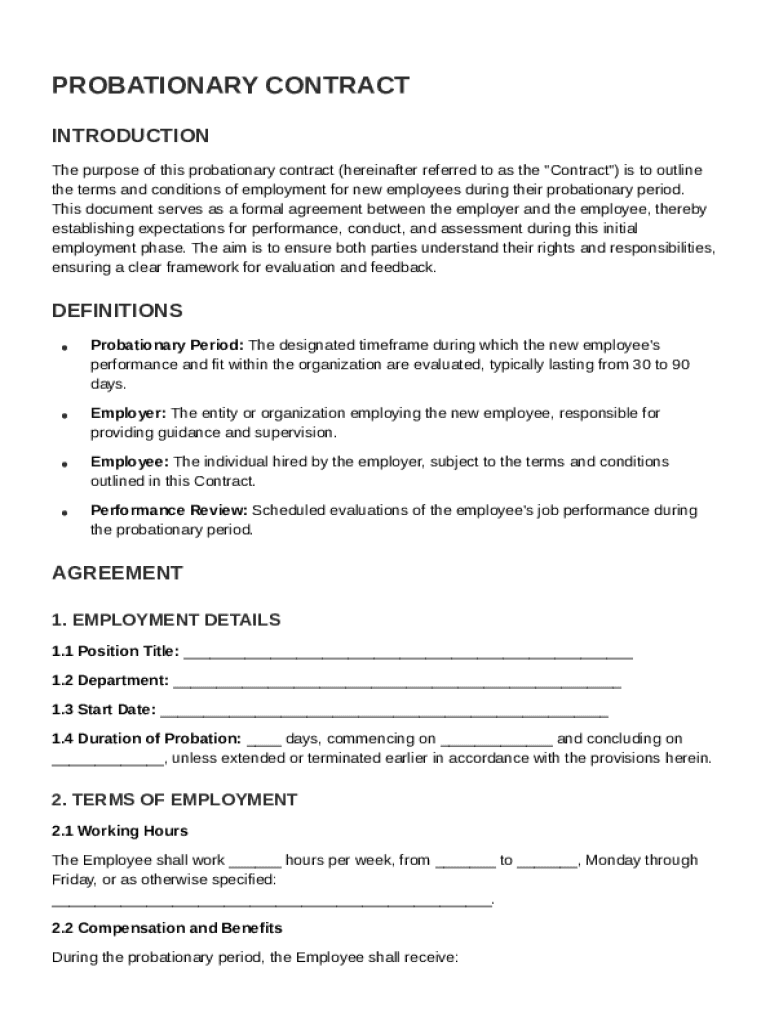
The Probationary Contract Template is designed to outline the terms and conditions of employment during a trial period for new employees. It includes several critical elements that ensure both parties—employer and employee—understand their roles and responsibilities.
-
Probationary Period: This section specifies the duration of the probationary period, which is typically a set time, such as three or six months. It outlines the expectations for the employee during this period and may detail the criteria for successful completion.
-
Employment Details: This part provides essential information about the employee's position, including job title, department, and reporting lines. It also indicates whether the position is full-time or part-time.
-
Working Hours: The contract defines the regular working hours and any expectations for overtime. It provides details about breaks, flexible working arrangements, or specific shift patterns that may apply.
-
Compensation: It includes all details related to salary or hourly wage, payment schedule, and any additional benefits such as health insurance, retirement plans, or bonuses applicable during the probationary period.
-
Confidentiality Obligations: Employees are often required to maintain confidentiality regarding company information. This section describes the scope of such obligations and the potential consequences of violations.
-
Performance Expectations: This involves setting measurable goals and objectives that the employee is expected to meet during the probationary period. It often includes periodic performance reviews and feedback mechanisms.
-
Evaluation Process: Details how the employee's performance will be assessed, the criteria used, and the role of supervisors or managers in this process. It may include timelines for evaluations and feedback sessions.
-
Termination Conditions: This section outlines the conditions under which the employment may be terminated during the probationary period, including insufficient performance or breach of contract, and the notice period required by both parties.
Legal Use of the Probationary Contract Template
The legal use of a Probationary Contract Template ensures that it complies with employment laws and regulations, safeguarding both the employer and employee.
-
Compliance with Employment Laws: It is crucial that the contract adheres to local labor laws, which may dictate minimum wage requirements, working hour regulations, and employee rights during the probationary period.
-
Equal Employment Opportunity: The template must be free of discriminatory clauses related to race, gender, age, or other protected characteristics, ensuring equal treatment for all employees.
-
Enforcement of Terms: Clear terms help avoid disputes. In legal proceedings, a well-drafted contract aids in clarifying intentions and responsibilities, supporting the enforceability of the terms outlined.
-
Signatures and Binding Agreement: For a contract to be legally binding, it typically requires the signatures of both parties involved. This demonstrates mutual consent and acknowledgment of the conditions.
How to Use the Probationary Contract Template
Utilizing the Probationary Contract Template involves several steps that ensure it meets the needs of the specific employment relationship.
-
Customizing the Template: Tailor the contract to fit the specifics of the job role, company policies, and individual arrangements. This may involve adjusting working hours, role descriptions, or compensation details.
-
Consulting Legal Experts: Engaging with legal advisors can ensure the contract complies with relevant laws and accurately reflects the intended terms, reducing the risk of disputes.
-
Communication with the Employee: Before finalizing, discuss the terms with the employee, addressing any concerns or questions they may have to prevent misunderstandings.
-
Finalizing and Signing: Once both parties are satisfied with the terms, ensure that the contract is signed. Retain copies for both the employer and the employee for their records.
Steps to Complete the Probationary Contract Template
Completing the Probationary Contract Template involves a structured process to ensure accuracy and compliance.
-
Gathering Employee Information: Collect necessary personal details from the employee, such as full name, address, and contact information, to include in the contract.
-
Detailing Job Specifications: Clearly define the job title, department, responsibilities, and any specific job duties or expectations during the probationary period.
-
Setting Compensation Terms: Include the agreed salary or wage and any applicable benefits, ensuring that the compensation package complies with legal standards.
-
Defining the Probationary Period: Explicitly state the start and end dates of the probationary period, along with the terms for extensions or early completion if applicable.
-
Completing Legal Provisions: Ensure that the contract includes necessary legal disclaimers and confidentiality clauses to protect both the business and the employee.
-
Review and Revise: Before obtaining signatures, review the contract with the employee, allowing them to suggest revisions for clarity or additional terms.
Important Terms Related to the Probationary Contract Template
Understanding key terminology related to the Probationary Contract Template enhances comprehension and ensures both parties are informed.
-
Probationary Period: A defined timeframe in which a new employee's performance and suitability for a position are evaluated.
-
Performance Review: Regular assessments conducted to measure the employee's performance, providing opportunities for feedback and development.
-
Confidential Information: Proprietary data or knowledge that the employee is prohibited from disclosing to unauthorized parties.
-
At-Will Employment: A term indicating that the employment relationship can be terminated by either the employer or employee with or without cause, typically with specified notice.
-
Non-Disclosure Agreement (NDA): A clause within the contract or a separate agreement ensuring that employees maintain confidentiality about sensitive company information.
Who Typically Uses the Probationary Contract Template
Various entities and personnel utilize the Probationary Contract Template in different organizational contexts.
-
Human Resources Departments: HR teams commonly use the template to onboard new hires, ensuring that employment conditions are clearly articulated and agreed upon.
-
Small Businesses: Smaller companies often rely on such templates to streamline the hiring process, ensuring a consistent approach to new employee induction.
-
Managers and Team Leaders: Those responsible for overseeing new employees may use the template to establish clear benchmarks and expectations for probationary team members.
-
Legal Advisors: Lawyers may review and adapt templates to ensure compliance with specific legal requirements and integrate company-specific terms.

State-Specific Rules for the Probationary Contract Template
State-specific rules can impact the execution and enforceability of probationary contracts, necessitating adjustments based on location.
-
Minimum Wage Laws: Different states have varying minimum wage laws, which must be reflected in the salary or wage stipulations within the contract.
-
Employment-at-Will Exceptions: While most states follow employment-at-will doctrines, specific states have exceptions that protect employees from unjust termination during probation.
-
Notice Requirements: States may impose distinct notice periods required for termination during a probationary period, influencing contract terms.
-
Industry-Specific Regulations: Certain states have additional regulations for specific industries, such as health, construction, or education, that must be incorporated into the contract.
Examples of Using the Probationary Contract Template
Real-world applications of the Probationary Contract Template illustrate its versatility and utility across various employment scenarios.
-
Corporate Environments: In large corporations, the template ensures new hires understand their roles and are evaluated systematically during initial employment phases.
-
Healthcare Facilities: Medical practices use the contract to evaluate new healthcare providers' compatibility with organizational standards and patient care expectations.
-
Education Sector: Schools and universities apply probationary contracts for instructors and non-teaching staff to assess pedagogical skills and adherence to institutional policies.
-
Technology Companies: Tech firms employ the template to set clear performance metrics for developers or engineers, aligning probation completion with project contributions.
By addressing these comprehensive aspects of the Probationary Contract Template, the content thoroughly informs and equips users to apply this tool effectively in varied employment contexts.