Park Contract Template 2026

Get Form
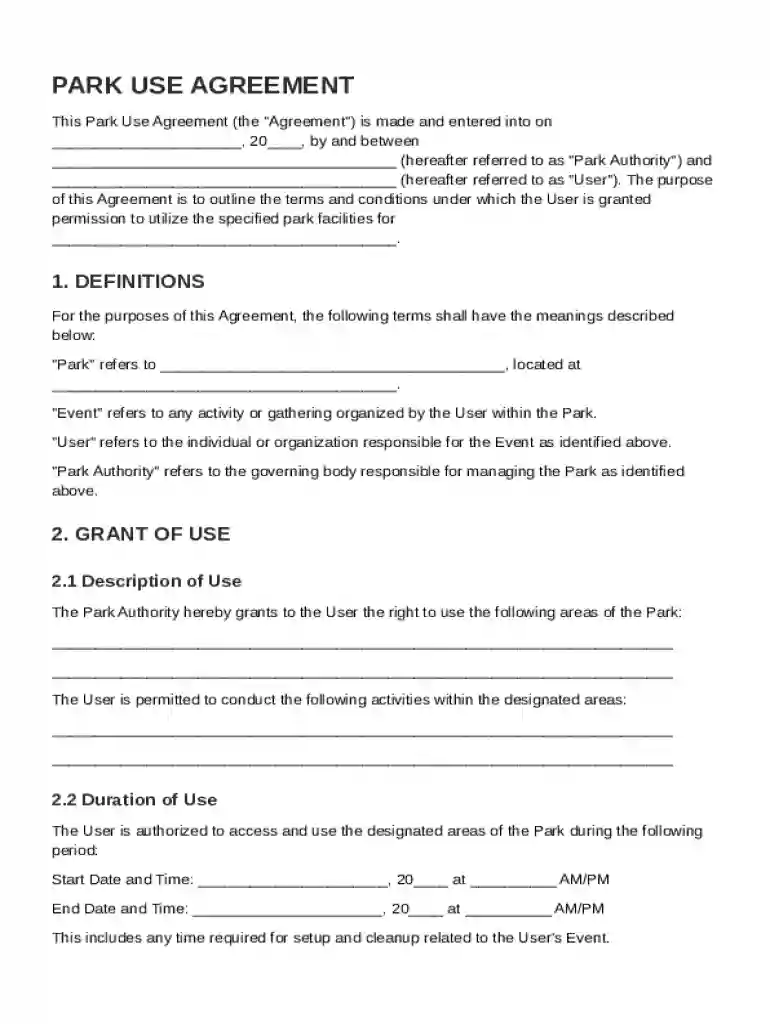
Park Contract Template Preview on Page 1

Here's how it works

01. Edit your form online
Type text, add images, blackout confidential details, add comments, highlights and more.

02. Sign it in a few clicks
Draw your signature, type it, upload its image, or use your mobile device as a signature pad.

03. Share your form with others
Send it via email, link, or fax. You can also download it, export it or print it out.

Definition & Meaning

A Park Contract Template serves as a formal written agreement that outlines the terms and conditions under which a user, often referred to as the "User," is granted access to utilize park facilities for specific events or activities. This document is crucial as it sets clear expectations for both the User and the Park Authority, detailing aspects such as allowable use, fee structures, liability concerns, and cancellation policies. It ensures that both parties are legally protected and understand their responsibilities. A well-defined Park Contract Template also helps prevent potential disputes by providing transparent guidelines that all involved parties must adhere to.

Essential Components of a Park Contract Template

  • Grant of Use: Specifies the permissions granted to the User, including the specific areas of the park they are allowed to access.
  • Fee Details: Outlines the costs associated with the park's use, such as rental fees or security deposits.
  • User Responsibilities: Details the obligations of the User, such as cleaning up the area after use or adhering to park rules.
  • Park Authority Responsibilities: Lists the duties of the Park Authority, including maintenance of the facilities or provision of necessary utilities.

Steps to Complete the Park Contract Template

Completing a Park Contract Template involves several vital steps to ensure it is thorough and legally sound. Here is a detailed guide to help you efficiently finalize the document.

  1. Identify Parties: Begin by listing the full legal names of both the User and the Park Authority. Ensure all names match legal identification to avoid discrepancies.

  2. Specify Event Details: Clearly articulate the purpose of the park use, including date, time, and type of event. Precision in these details helps in defining boundaries and responsibilities.

  3. Outline Terms and Conditions: Detail all terms, including grant of use, fees, cancellation policies, and liability clauses. Be explicit to avoid potential misunderstandings.

  4. Review Required Signatures: Ensure all necessary parties sign the document. This includes stakeholders from both the User and Park Authority.

  5. Final Review and Submission: Double-check the document for accuracy and completeness before submitting it to all relevant parties for review and acceptance.

Tips for Effective Completion

  • Consistency: Ensure all terms used in the document are consistent and clearly defined.
  • Legal Review: Consider having a legal professional review the contract for compliance with local regulations.

Key Elements of the Park Contract Template

A comprehensive Park Contract Template comprises several key elements that ensure the document is robust and covers all necessary legal bases. Understanding these elements is critical for anyone involved in drafting or reviewing the contract.

  • Definitions: Start with a section that provides clear definitions of all terms used in the document. This includes defining what constitutes the "park facilities" and clarifying who the "User" and "Park Authority" are.

  • Indemnification Clause: This section protects both parties by stipulating who is responsible for damages or legal issues arising from the park's use.

  • Cancellation Policy: Clearly outline the conditions under which the contract can be voided, including any fees payable for cancellations.

  • Governing Law: Indicate the jurisdiction that will govern the terms of the contract to resolve any potential disputes.

Enhancements for Legal Soundness

  • Include Appendices: Attach any relevant maps or diagrams of the park facilities to provide clarity.
  • Detail Payment Schedules: Clearly mention when and how payments should be made, preventing potential disputes.

Legal Use of the Park Contract Template

Utilizing a Park Contract Template legally involves understanding the relevant laws and ensuring all contract terms comply with these regulations. This document is legally binding once signed by all parties and should be treated with the gravity it demands.

Compliance Considerations

  • Adherence to Local Laws: Ensure the contract aligns with state-specific regulations concerning public property use.
  • Insurance Requirements: The template should specify necessary insurance coverage to mitigate risks associated with public events.

Real-world Example

A community group using a city park for a summer event must first complete the Park Contract Template, ensuring compliance with local laws and securing necessary permits. This legal use ensures their event runs smoothly without legal interruptions.

State-Specific Rules for the Park Contract Template

Different states may have distinctive rules surrounding park use, which must be reflected in the Park Contract Template. Understanding these differences is essential for ensuring the legitimacy and effectiveness of the contract.

  • California: Requires environmental impact consideration for large gatherings in state parks.
  • New York: Involves specific noise restrictions that must be adhered to when using public parks.

Considerations for Each State

  • Evaluate local bylaws or municipal ordinances.
  • Incorporate any state-mandated fees or taxes into the contract terms.

Importing and Accessing the Park Contract Template

Accessing the Park Contract Template can be streamlined through digital platforms like DocHub, which offer flexibility and convenience. This section outlines the steps for obtaining and using the template effectively.

Methods of Access

  • Online Platforms: Utilize document management services to easily download and fill out the template, such as through DocHub's user-friendly interface.
  • Direct Download: Access pre-formatted templates from official park authority websites or government portals.

Streamlining with Technology

  • Integration with Cloud Services: Leverage platforms that integrate with cloud storage solutions for easy access and sharing.
  • Digital Completion: Use digital signature services for efficient and legally binding contract execution.

Benefits of Using the Park Contract Template

Employing a Park Contract Template provides several advantages that facilitate smooth operations and mitigate potential conflicts.

  • Consistent Framework: Ensures all necessary legal and logistical elements are consistently addressed.
  • Risk Management: Reduces the likelihood of disputes or misunderstandings by clarifying responsibilities and expectations upfront.

Practical Scenario

A non-profit planning an annual fundraiser can significantly benefit by using a Park Contract Template to streamline approvals and focus on event logistics rather than getting bogged down by legal issues.

Important Terms Related to Park Contract Template

Understanding the terminology used in a Park Contract Template is vital for both drafting and interpreting the document. This section provides insights into critical terms commonly encountered.

  • Grant of Use: Refers to the permission granted by the Park Authority for the User to occupy and utilize specific facilities.
  • Indemnification: This term describes the obligation of one party to compensate for losses incurred by another party due to specified circumstances.

Expanding Your Understanding

  • User: The individual or organization granted the right to use the park facilities.
  • Park Authority: The governing body responsible for maintaining and overseeing the park's operations.

Detailed comprehension of these terms ensures that all parties involved have a clear understanding of their roles and obligations, thereby preventing future conflicts and enhancing mutual cooperation.

be ready to get more

Complete this form in 5 minutes or less

Get form

Got questions?

We have answers to the most popular questions from our customers. If you can't find an answer to your question, please contact us.
Contact us
Write the contract in six steps Start with a contract template. Open with the basic information. Describe in detail what you have agreed to. Describe how the contract will end. Say which laws apply and how disputes will be resolved. Include space for signatures.
There are five elements which, taken together, make a contract valid: offer; acceptance; consideration; capacity; and. intention to create legal relations.
How to Write a Lease/Rental Agreement Step 1 Name the Parties. Step 2 Describe the Premises. Step 3 Define the Lease Term. Step 4 Set Rent Payment Details. Step 5 Assign a Security Deposit Amount. Step 6 Set Property Rules. Step 7 Mention Right of Entry. Step 8 Establish Guidelines for Early Termination.
Seamless Document Creation and Editing Through integration, users can open pre-written contract templates within Word. The template contains placeholders for essential information, such as names, dates, terms, and conditions.
Today, were diving into the core components that make up a legally binding contract, often referred to as the 3 Cs: Capacity, Consent, and Consideration. Understanding these key elements can help you navigate legal agreements with confidence and clarity.

Security and compliance

At DocHub, your data security is our priority. We follow HIPAA, SOC2, GDPR, and other standards, so you can work on your documents with confidence.
Learn more
ccpa2
pci-dss
gdpr-compliance
hipaa
soc-compliance

People also ask

A parking lease is an agreement structure that allows a parking operator (lessee) to manage a parking facility for a defined period of time in exchange for paying rent.
Provided the terms dont prevent it, your landlord agrees, and its your own space (ie, not communal) you should be fine to rent out your parking space if you wish.
Some examples of simple contracts are common types of contracts like service agreements (e.g., hiring a freelancer), NDAs, loan agreements, sales agreements (e.g., vendor/supplier deals), and rental agreements (e.g., camera rental terms).

Related links