
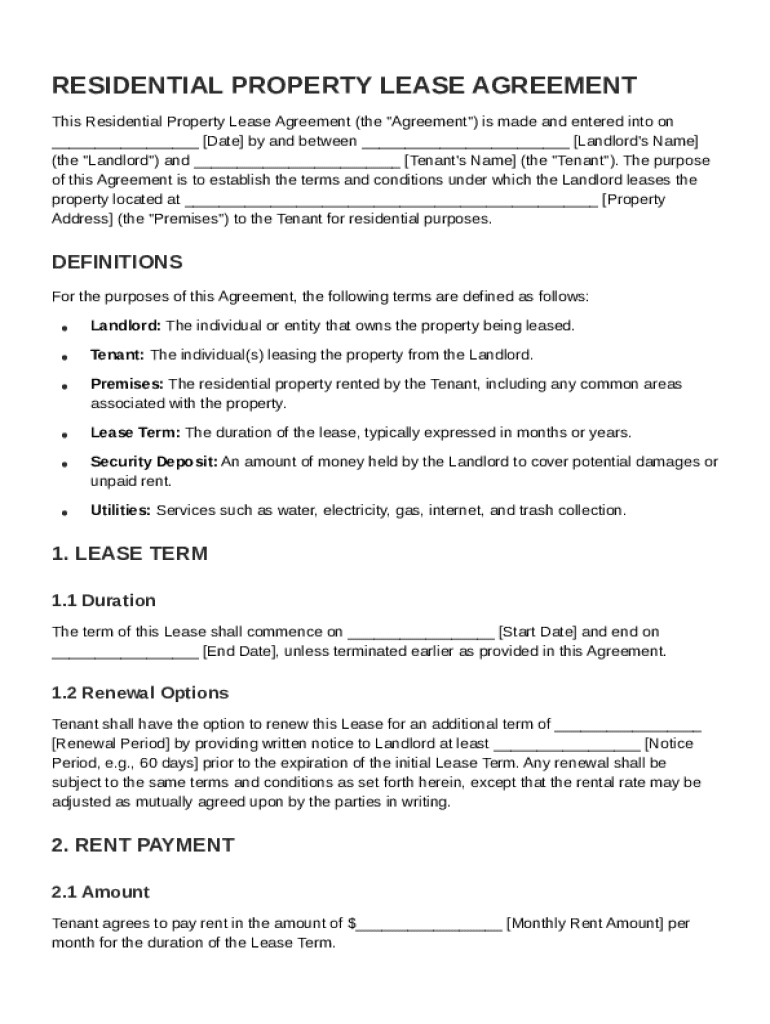







Key Elements of the Residential Property Lease Agreement Template
The Residential Property Lease Agreement Template is a comprehensive framework designed to outline the critical components of a leasing contract between a landlord and tenant. Key elements integral to this template ensure comprehensive coverage of obligations, rights, and details pertinent to the rental arrangement:
-
Identifying Information: Includes the names of the landlord and tenant, along with the contact details and the address of the property being leased.
-
Lease Term: Clearly specifies the lease duration, including the start and end dates, along with any provisions for renewal or early termination.
-
Rent Details: Provides details on the rent amount, due dates, acceptable payment methods, and any late payment penalties or fees.
-
Security Deposit: Outlines the security deposit amount, conditions for its return, and what constitutes grounds for deductions.
-
Maintenance Responsibilities: Clarifies the responsibilities for maintaining the property, including which party is responsible for repairs and general upkeep.
-
Utilities and Services: Specifies which utilities and services are included in the rent and which are to be paid by the tenant.
-
Legal and Miscellaneous Provisions: Includes governing laws, dispute resolution processes, and clauses for modifying the agreement.
By incorporating these elements, the template ensures that all parties involved have a clear understanding of the terms and conditions of the lease, minimizing potential disputes and misunderstandings.
How to Use the Residential Property Lease Agreement Template
Using the Residential Property Lease Agreement Template involves several systematic steps to ensure it meets the needs of both the landlord and tenant effectively:
-
Review the Template: Begin by thoroughly reviewing the entire template to familiarize yourself with its structure and content.
-
Customize the Information: Edit the template to include specific details pertinent to the property, including rent specifics, lease term, and identifying information of the involved parties.
-
Determine Responsibilities: Clearly outline specific responsibilities such as maintenance duties and utility payments by editing the sections dedicated to these areas.
-
Legal Compliance: Verify that the agreement complies with state and local laws, which may necessitate consulting a legal professional to ensure all legal requirements are satisfied.
-
Final Review and Agreement: Conduct a comprehensive review with all involved parties to ensure mutual understanding and agreement on all terms before signing the document.
By following these steps, landlords and tenants can ensure the lease agreement is legally robust, clear, and equitable, fostering a positive rental experience.
Legal Use of the Residential Property Lease Agreement Template
The Residential Property Lease Agreement Template serves as a legally recognized document when completed correctly, providing protection to both landlords and tenants. Key legal considerations include:
-
Adherence to Regulations: Ensure the template aligns with federal, state, and local rental laws, covering tenant rights and landlord obligations.
-
Inclusion of Legally Required Clauses: Incorporate clauses related to habitability, non-discrimination, and lead-based paint (for properties built before 1978) per legal requirements.
-
Signature and Date Lines: The template must have spaces for both parties to sign and date the document, rendering it legally binding once signed.
-
Security Deposit Clauses: Legally define terms regarding the amount and return conditions for the security deposit, complying with state laws.
Using the template legally ensures it faithfully protects all parties' interests, reducing the risk of legal disputes and fostering a compliant leasing arrangement.
Important Terms Related to the Residential Property Lease Agreement Template
Understanding the terminology affiliated with the Residential Property Lease Agreement Template is crucial for all parties involved. Important terms include:
-
Lessee: Also known as the tenant, this is the person or entity renting the property.
-
Lessor: Also referred to as the landlord, this is the property owner leasing out the property.
-
Premises: Legal term for the property being rented, which must be clearly identified in the agreement.
-
Rent Escalation Clause: A provision that outlines any potential increases in rent during the lease term.
-
Force Majeure: Covers circumstances beyond control that may prevent either party from fulfilling parts of the agreement.
These terms offer clarity and a better understanding of the obligations and expectations within the lease agreement, aiding in the resolution of potential misunderstandings.
State-Specific Rules for the Residential Property Lease Agreement Template
When using the Residential Property Lease Agreement Template, it is vital to consider state-specific differences that may impact the lease's legality and enforceability:
-
Rent Control Regulations: Some states have specific laws governing rent control and must be adhered to within the agreement.
-
Security Deposit Maximums: Many states dictate the maximum amount for security deposits and required return timeframes.
-
Notice Requirements: The template must reflect the appropriate notice period for terminating the lease, which varies by state.
-
Tenant Privacy Rights: States have distinct rules on how landlords can enter the leased property, often requiring advance notice.
Understanding and adapting the template to meet state-specific requirements ensures the agreement is compliant with local laws, further safeguarding both landlords' and tenants' interests.
Real-World Examples of Using the Residential Property Lease Agreement Template
Practical scenarios highlight how a Residential Property Lease Agreement Template functions in real-world applications:
-
Scenario 1: Urban Apartment Lease
A couple leasing an apartment in a metropolitan area uses the template to formalize their one-year lease, covering rent specifics, amenities, and maintenance roles. -
Scenario 2: Single-Family Home Rental
A family renting a suburban home follows the template to establish a long-term lease agreement, delineating gardening responsibilities and utility payments. -
Scenario 3: Corporate Housing
A company providing temporary housing for a relocating employee uses the template to establish terms regarding the company's payment of rent and additional services.
In each case, the template provides a structured approach to capture essential agreement terms, ensuring clarity and legal protection for all involved parties.
Steps to Complete the Residential Property Lease Agreement Template
Completing the Residential Property Lease Agreement Template involves a sequence of methodical steps to ensure precision and clarity in the document:
-
Gather Necessary Information: Include all relevant details such as tenant and landlord information, lease term, and rent particulars.
-
Detail Property-Specific Considerations: Explicitly address any particular provisions related to the rented property like pet policies or use of communal spaces.
-
Include Legal Clauses: Draft clauses that align with pertinent laws, and review them to ensure they meet legal standards.
-
Review and Edit: Assess the template for any necessary edits to better reflect the terms agreed upon by the tenant and landlord.
-
Sign and Finalize: After agreement, both parties should sign and date the document, making it legally binding.
Following these steps to complete the template ensures a comprehensive and legally sound agreement that suits all parties involved.
Software Compatibility with the Residential Property Lease Agreement Template
The Residential Property Lease Agreement Template is designed to be compatible with modern digital tools and software solutions to facilitate a seamless document workflow:
-
Document Editing Software: Compatible with platforms like Microsoft Word and Google Docs, allowing for straightforward customization and editing.
-
DocHub Platform: Facilitates editing, signing, and exporting of the lease agreement, streamlining the document workflow with an intuitive interface.
-
Cloud Storage Integration: Supports saving and sharing agreements via Google Drive or Dropbox, ensuring secure, accessible storage.
Utilizing these software capabilities allows users to efficiently manage the lease process, ensuring the document remains a practical, flexible tool in modern real estate transactions.




