Definition & Meaning
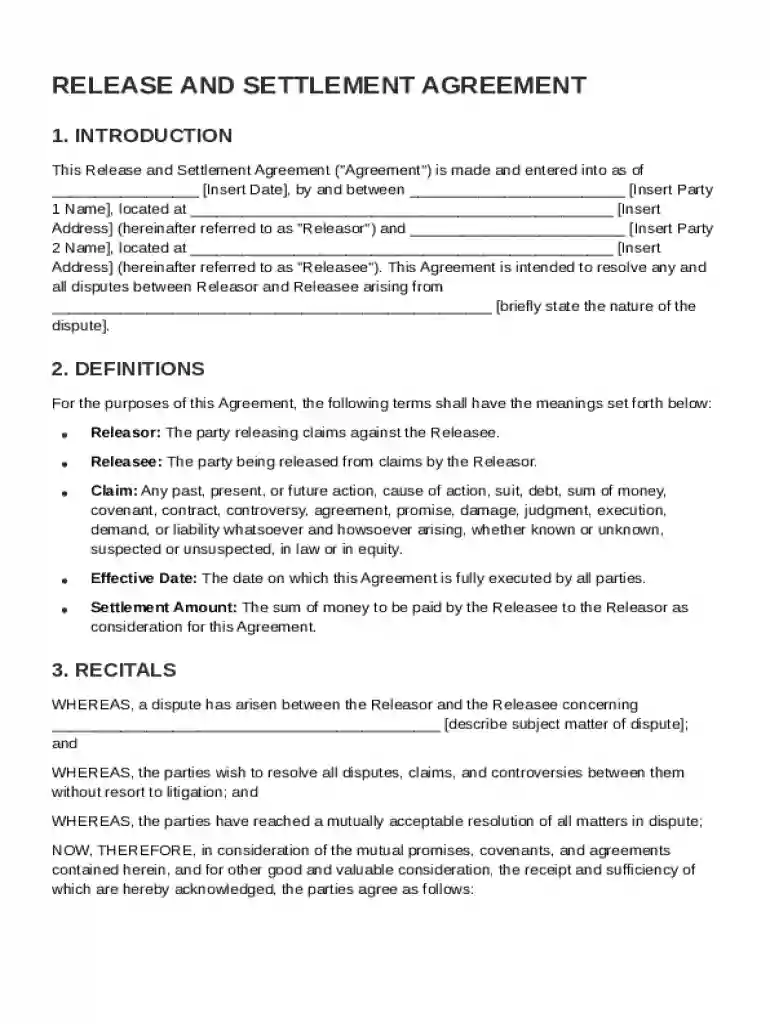
A Release and Settlement Agreement Template is a legal document used to resolve disputes between two parties without proceeding to litigation. It is designed to ensure that both parties, referred to as the Releasor and Releasee, agree to terms that resolve any outstanding issues. This agreement typically includes a release of claims where the Releasor agrees not to pursue further legal action related to the subject of the agreement. Such agreements are commonly used in business contexts or personal injury claims to settle matters amicably and avoid the cost and time of a court process.
Key Components
- Parties Involved: Clearly identifies the Releasor and Releasee.
- Release of Claims: Details what claims are being waived.
- Settlement Terms: Specifies the agreed-upon compensation or actions to be taken.
- Confidentiality Clause: Determines the confidentiality level attached to the agreement.
- Non-Admission of Liability: States that the agreement does not imply any admission of fault.
Steps to Complete the Release and Settlement Agreement Template
Completing a Release and Settlement Agreement involves several key steps to ensure all parties are in agreement and the document is legally sound. Here's a breakdown of the process:
Identify the Parties:
- Clearly list the Releasor and Releasee with accurate contact information.
- Define their relationship or dispute context.
Outline the Dispute:
- Provide a concise summary of the issue or dispute the agreement aims to resolve.
- Include relevant dates and actions that are central to the dispute.
Release of Claims:
- Detail precisely which claims are being released, ensuring all are covered.
- Include any exceptions, if applicable.
Settlement Terms:
- Clearly state any payments, transfers, or actions involved in resolving the dispute.
- Include payment schedule or deadlines for actions to be completed.
Confidentiality Provisions:
- Define the extent of confidentiality both parties agree to uphold.
- Specify consequences of breaching these terms.
Key Elements of the Release and Settlement Agreement Template
Understanding the essential components of this agreement enhances its effectiveness and enforceability. Here are the main elements to include:
- Definitions: Clear definitions of terms used throughout the document ensure mutual understanding.
- Payment Details: Includes how and when payments will be made.
- Governing Law: Specifies which state's laws will govern the agreement.
- Indemnity Clause: Provides protection against any claims from third parties related to the agreement.
- Miscellaneous Provisions: Can include procedures for amendments, counterparts, and electronic signatures.
Legal Use of the Release and Settlement Agreement Template
From a legal standpoint, this document serves as a tool to conclusively settle disputes. It's essential that it is drafted accurately to ensure enforceability in court, if necessary. Here’s how it legally functions:
- Ensures that both parties willingly agree to the terms set out.
- Protects both parties from future claims related to the resolved dispute.
- Legally documents the resolution process, which can be critical if disputes arise later.
- Must be signed by both parties to be legally binding.
Examples of Using the Release and Settlement Agreement Template
Various scenarios illustrate how this agreement is implemented in real-world contexts:
- Workplace Dispute: An employee alleging wrongful termination agrees to a financial settlement and waives the right to sue the employer.
- Personal Injury Claim: A victim agrees to a compensation payout in exchange for not pursuing further legal action against a company.
- Property Damage: Neighbors resolve damage claims from construction work by reaching a financial settlement.
Important Terms Related to the Release and Settlement Agreement Template
Several specific terms are crucial within these agreements:
- Consideration: The settlement amount or action each party agrees to provide.
- Waiver of Claims: Agreement not to pursue legal action on the matters specified.
- Non-Compete Clause: Occasionally included to prevent competing actions post-agreement.
- Mutual Release: Where both parties release each other from claims, rather than just one party.
State-Specific Rules for the Release and Settlement Agreement Template
Regulations affecting this agreement can vary by state:
- State Laws: They can dictate what must be included for the agreement to be valid.
- Notarization Requirements: Some states may require notarizing the document.
- Filing Requirements: Depending on the legal action involved, some settlements might need to be filed with state authorities.
- Enforceability: Conditions under which an agreement is enforceable can differ, making compliance with state-specific rules crucial.