
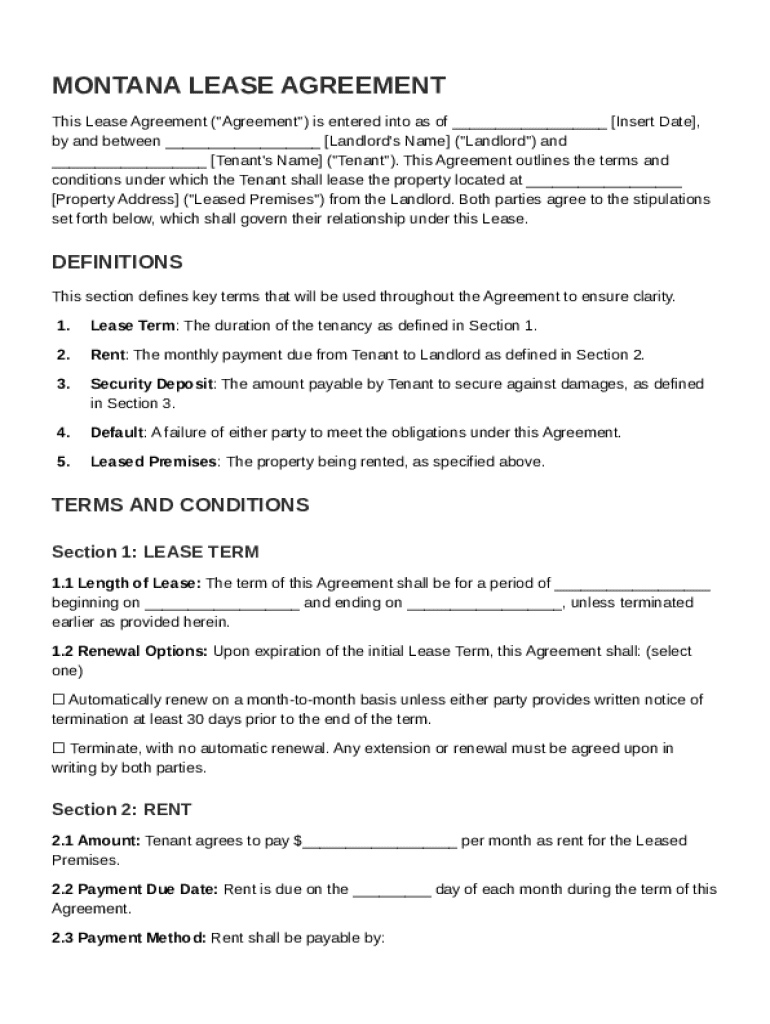







Definition and Purpose of Montana Lease Agreement Template
The Montana Lease Agreement Template is a legal document that provides a structured framework for outlining the terms and conditions between a landlord and tenant. This template ensures clarity in various aspects, such as rental obligations, duration, and responsibilities, mitigating potential disputes. Key terms are explicitly defined, providing a comprehensive reference for both parties.
In practical terms, the lease agreement includes essential details about rent payment schedules, security deposit requirements, tenant responsibilities regarding maintenance, and the permitted use of the property. Because this document is a legally binding agreement, it serves to protect the interests of both parties and establishes clear expectations from the start of the tenancy.
How to Obtain the Montana Lease Agreement Template
Obtaining a Montana Lease Agreement Template is a straightforward process. This template can be found on various legal websites and online platforms specializing in legal documents, such as DocHub. Here's how you can access it:
-
Visit a legal document platform: Websites like DocHub offer a variety of templates, including lease agreements, that you can modify to suit your specific needs.
-
Search for the template: Use the search functionality on the platform to locate the Montana Lease Agreement Template.
-
Download or edit online: Once you have found the template, you can either download it for offline use or edit it directly on the platform if it supports online editing.
-
Review and customize: Ensure that you customize the template to meet the specific needs of your lease agreement, including adding any unique stipulations relevant to your rental property.
How to Use the Montana Lease Agreement Template
Utilizing the Montana Lease Agreement Template involves several steps to ensure that the lease is tailored to the specific arrangement between the landlord and tenant:
-
Input basic information: Begin by filling in the standard fields, such as the names of the landlord and tenant, property address, and term of the lease.
-
Specify rent details: Clearly outline the rental payment amount, due date, and acceptable payment methods. Include details about late fees and grace periods if applicable.
-
Define security deposit terms: Indicate the amount of the security deposit, the conditions under which it may be withheld, and the process for returning it once the lease ends.
-
Outline responsibilities and maintenance: State the tenant's responsibilities regarding property maintenance and any obligations the landlord has for repairs and upkeep.
-
Include additional clauses: Add any special conditions or rules, such as pet policies, smoking policies, or subletting restrictions, ensuring compliance with state laws.
-
Review and finalize the document: Both parties should carefully review the document to confirm all terms are acceptable and understood before signing.
Legal Use of the Montana Lease Agreement Template
The Montana Lease Agreement Template must comply with state laws to be legally enforceable. This involves several considerations:
-
Adherence to Montana state law: The agreement should align with Montana's legal requirements for lease agreements, including rules on security deposits, eviction procedures, and tenant rights.
-
Clarity and fairness: The terms should be explicit, equitable to both parties, and free from any language that could be construed as unfair or discriminatory.
-
Governing law provisions: Include a clause specifying that the lease is governed by the laws of Montana, which clarifies jurisdiction and applicable legal standards.
Using this template legally ensures that the landlord and tenant are both protected by a clear and enforceable agreement.
Key Elements of the Montana Lease Agreement Template
The Montana Lease Agreement Template comprises several key elements designed to address the primary concerns and needs of both landlords and tenants:
-
Premises description: A detailed description of the leased property, including its address and any included fixtures or amenities.
-
Rent payment terms: Explicit details about the rental rate, payment due dates, and acceptable forms of payment, as well as any penalties for late payments.
-
Security deposit clause: Information about the required security deposit, including the amount, conditions for refund, and allowable uses for damages or unpaid rent.
-
Lease duration and renewal: Terms specifying the start and end date of the lease, along with any provisions for renewal or extension.
-
Termination conditions: Guidelines for terminating the lease, including notice requirements and conditions under which the lease can be prematurely ended.
-
Maintenance and repair obligations: Assignment of responsibilities for property maintenance and repairs, indicating tenant and landlord duties.
-
Prohibited activities: Any activities or actions that are not allowed on the premises, such as smoking restrictions or noise control policies.
Each of these elements plays a critical role in defining the relationship and expectations between the landlord and tenant.
Important Terms Related to the Montana Lease Agreement Template
Understanding the terminology used in the Montana Lease Agreement Template is crucial for both parties involved:
-
Lease term: The length of time the rental agreement is set to last, typically expressed in months or years.
-
Security deposit: A sum of money held by the landlord as assurance for tenant compliance with the lease terms.
-
Default: A failure by either party to fulfill an obligation stipulated in the lease agreement.
-
Sublet: Allowing another party to rent the dwelling during the tenant's lease term, subject to the landlord's approval.
-
Eviction: The legal process by which a tenant is removed from the property for non-compliance with lease terms or other legal reasons.
These terms help both parties fully understand their rights and obligations under the lease agreement.
State-Specific Rules for the Montana Lease Agreement Template
Montana has specific rules and regulations that impact lease agreements, making it essential to tailor the document accordingly:
-
Maximum security deposit: Although Montana does not set a maximum amount for security deposits, the terms should be clearly defined within the lease agreement.
-
Notice for non-renewal: Montana law requires that landlords provide at least a 30-day written notice prior to terminating a month-to-month rental agreement.
-
Required disclosures: Landlords must disclose the existence of any known lead-based paint hazards in pre-1978 units.
Adhering to these and other state-specific rules ensures the lease agreement's enforceability and reduces the potential for legal challenges.
Examples of Using the Montana Lease Agreement Template
In various scenarios, the Montana Lease Agreement Template provides essential structure and clarity:
-
First-time landlords: Individuals new to property leasing can utilize this template to ensure all legal aspects are covered and expectations are clearly set.
-
Professional property managers: For those managing multiple properties, the template offers a consistent framework that can be easily adapted to different rental units.
-
Tenants seeking clear guidelines: Renters benefit from the clearly defined terms, ensuring they understand their obligations and rights.
These examples highlight the flexibility and utility of the template in different leasing situations.
Steps to Complete the Montana Lease Agreement Template
The following is a step-by-step guide to completing the Montana Lease Agreement Template:
-
Gather necessary information: Collect details pertinent to the lease, such as tenant information, property address, and rental terms.
-
Fill in standard sections: Complete sections on parties involved, property details, and basic rental terms.
-
Detail payment terms and deposits: Clearly state security deposit amounts and rent payment specifics.
-
Outline obligations and policies: Add tenant and landlord responsibilities, and include any rules or policies.
-
Review with both parties: Ensure both the landlord and tenant review the details for accuracy and clarity.
-
Sign the agreement: After all revisions, both parties should sign the document for it to take legal effect.
-
Distribute copies: Ensure each party retains a signed copy for their records.
Adhering to these steps ensures the lease agreement is comprehensive and enforceable.




