






Definition and Meaning of Kid Allowance Contract Template
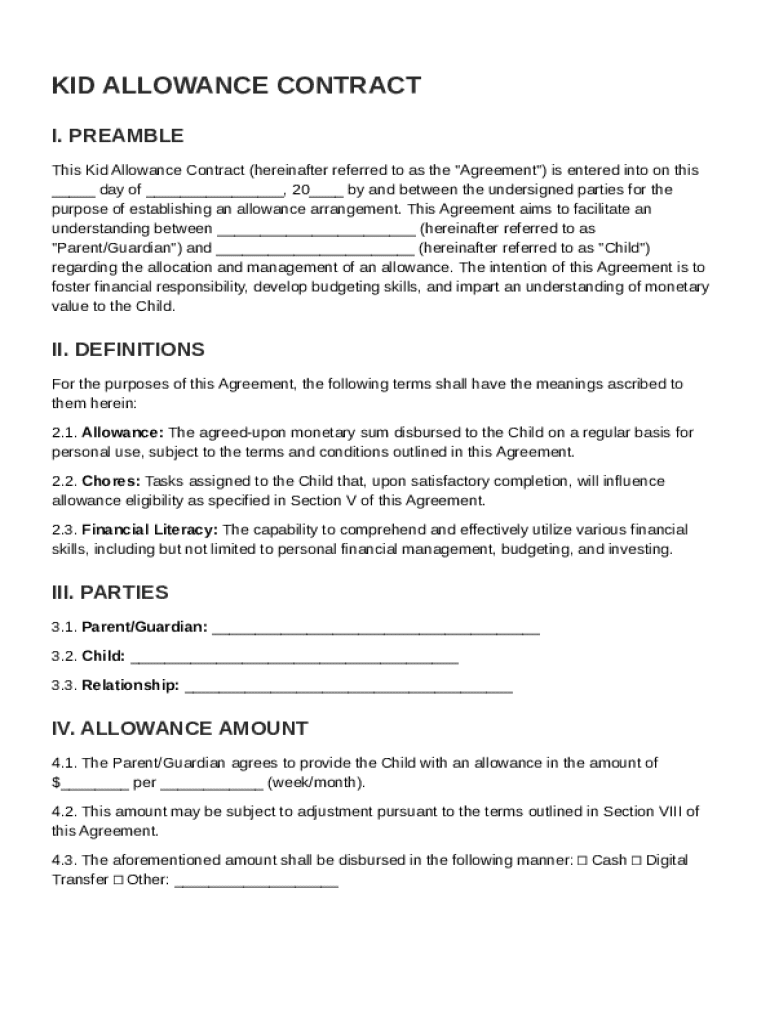
The Kid Allowance Contract Template is a formal document crafted to establish a clear and systematic process for providing an allowance to a child. This agreement is designed to promote financial responsibility and instill budgeting skills in children. It outlines essential elements such as the amount of allowance, the frequency of payments, and tasks or chores that must be completed by the child to qualify for the allowance. This template serves as a foundational tool for parents and guardians to educate children on money management and financial literacy, thereby encouraging responsible financial habits from a young age.
Purpose and Benefits
- Financial Literacy: Introduces children to basic financial concepts, such as savings, expenses, and budgeting.
- Clear Expectations: Sets specific guidelines for chores and behavior tied to allowance eligibility, fostering accountability in children.
- Educational Tool: Provides a practical framework for discussions about money and value.
- Conflict Resolution: Offers a structured approach to handle disputes regarding allowance, reducing potential conflicts.
How to Use the Kid Allowance Contract Template
Using the Kid Allowance Contract Template involves a few straightforward steps to ensure clarity and mutual understanding between parents and children.
-
Identify Essential Components:
- Decide the allowance amount and frequency.
- List required chores or tasks.
- Define savings and spending parameters.
-
Discuss with Your Child: Engage your child in open discussions about the terms outlined in the contract to ensure they comprehend their responsibilities and the benefits their fulfillment will bring.
-
Customize the Template: Tailor the template to meet the specific needs and circumstances of your family, considering factors such as age-appropriateness and the child’s current understanding of money management.
-
Formalize the Contract: Once everything is agreed upon, formalize the understanding by signing the document. This may include both the parent’s and child’s signatures to symbolize mutual agreement.
-
Review Regularly: Schedule periodic reviews of the contract to assess its effectiveness and to make any necessary adjustments. This can also act as a check-in to discuss your child's progress in learning financial management.
Key Elements of the Kid Allowance Contract Template
A comprehensive Kid Allowance Contract Template generally includes several crucial sections to provide structure and clarity:
-
Allowance Amount and Schedule: Specifies the precise amount of money to be allocated and the frequency of the allowance.
-
Chores and Responsibilities: Clearly delineates the specific tasks the child is expected to complete to earn their allowance, often tailored to the child’s age and abilities.
-
Savings and Spending Guidelines: Establishes rules around how the allowance should be managed, possibly mandating a percentage to be saved or setting boundaries on permissible expenses.
-
Review and Amendments: Details how and when the contract will be reviewed, including provisions for making changes as the child grows or if circumstances change.
-
Dispute Resolution Steps: Provides a formal process for resolving any disputes or misunderstandings that may arise in relation to the allowance procedures.
Steps to Complete the Kid Allowance Contract Template
Completing the Kid Allowance Contract Template is a systematic process that ensures transparency and understanding:
-
Gather Required Information: Compile all necessary details, such as the child’s name, the tasks to be assigned, and the agreed-upon allowance terms.
-
Fill Out Basic Details: Enter information such as the designated allowance amount and the payment schedule at the top of the template.
-
Specify Chores and Responsibilities: Clearly list each chore or responsibility required for allowance eligibility. Be specific to remove ambiguity.
-
Define Financial Terms: Include sections on savings and permissible spending, including any rules that apply to when and how money can be used.
-
Set a Parent-Child Agreement: Both parties should read the completed agreement and then sign to confirm understanding and agreement to the terms outlined.
Important Terms in the Kid Allowance Contract Template
Understanding the terminology used in the Kid Allowance Contract Template is crucial for effective implementation:
- Allowance: The regular sum of money given to the child, usually contingent on the completion of specified chores.
- Chores: Assigned tasks or duties that the child is responsible for completing.
- Savings: Part of the allowance that is reserved or put away for future use.
- Spending Guidelines: Rules that govern how the child is permitted to use or spend their allowance.
Examples of Using the Kid Allowance Contract Template
Implementing the Kid Allowance Contract Template can vary widely depending on individual family dynamics and goals:
-
Scenario 1: Young Child Learning Basics: Parents might focus on simple chores and small allowances, emphasizing saving for a toy or activity.
-
Scenario 2: Pre-Teen Preparing for Major Purchases: Chores might become more complex, and discussions on financial goals like saving for a video game console could be introduced.
-
Scenario 3: Teaching Value of Hard Work: The template might emphasize a direct correlation between effort in chores and the allowance received, underscoring the importance of earning money.
Legal Use of the Kid Allowance Contract Template
While primarily an educational tool, the Kid Allowance Contract Template can hold informal legal weight by acting as a written agreement that clarifies duties and rewards concerning household chores and allowance. However, as it’s not legally binding in the formal sense, its primary use is to guide behavior and set expectations rather than serve as a legally enforced document.
- Non-binding Agreement: Serves as a guideline rather than a legally enforceable contract.
- Structured Framework: By being in writing, it lays out a clear and shared understanding of the terms agreed upon by the parent and child.
Considering these perspectives allows families to utilize the Kid Allowance Contract Template effectively, supporting both financial learning and the development of responsible habits.