




01. Edit your form online
Type text, add images, blackout confidential details, add comments, highlights and more.

Type text, add images, blackout confidential details, add comments, highlights and more.

Draw your signature, type it, upload its image, or use your mobile device as a signature pad.

Send it via email, link, or fax. You can also download it, export it or print it out.
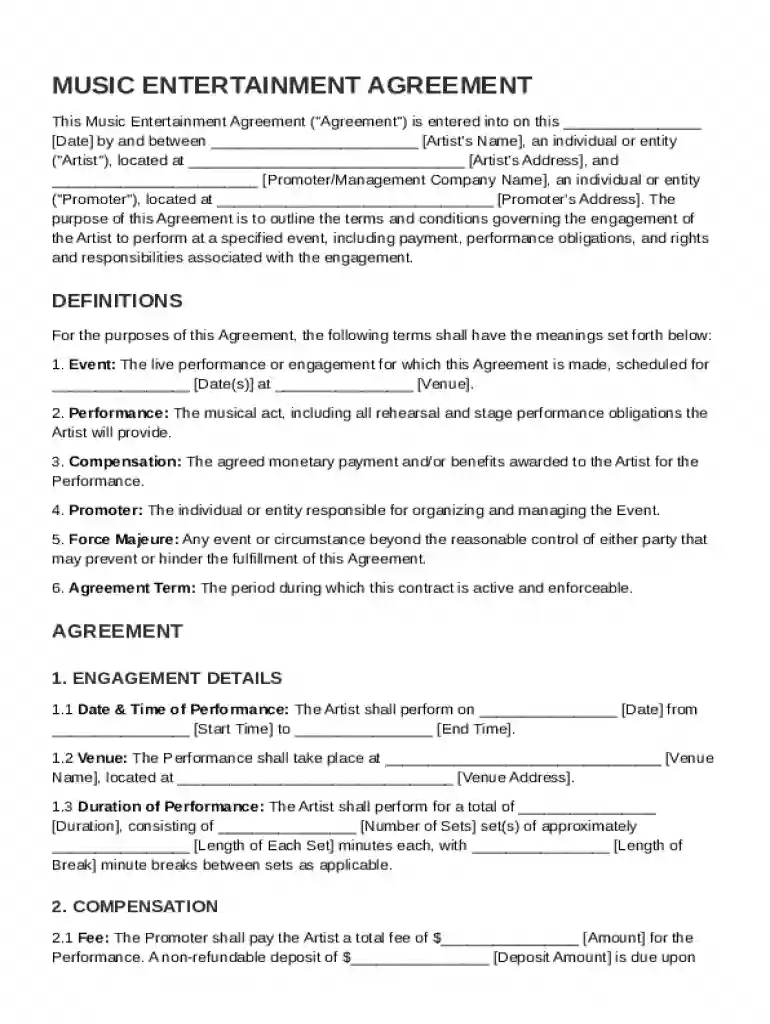
The Music Entertainment Contract Template serves as a formal agreement between an artist and a promoter, delineating the specifics of an artist's performance at an event. This legal document encapsulates the crucial components of the engagement, including payment terms, the obligations and expectations of both parties, cancellation policies, liability clauses, and dispute resolution protocols. Using this template ensures that both the artist and promoter have a clear understanding of their roles and responsibilities, fostering a professional relationship and minimizing potential conflicts. Real-world examples include contracts for concerts, festivals, and private performances where an artist is engaged to perform specific acts or sets.
A well-structured Music Entertainment Contract Template comprises several fundamental components:
Each of these elements is essential to avoid ambiguities and ensure all parties are aligned with the contract's requirements.
Completing a Music Entertainment Contract Template involves a series of meticulous steps, each crucial to the document's validity:
These steps form a robust process for creating a binding and effective contract, mitigating the chances of misinterpretation or disputes.
Several key terms frequently appear in a Music Entertainment Contract Template, each carrying specific implications:
Understanding these terms is crucial for both artists and promoters, ensuring that the contract fulfills its purpose without ambiguity.
The Music Entertainment Contract Template is legally enforceable when it meets all necessary requirements. To ensure legality:
A legal professional's review can further ensure that the contract complies with applicable laws and regulations, reducing the risk of legal challenges.
This contract template is utilized by a variety of stakeholders within the music and entertainment industry:
The template's adaptability allows it to serve different contractual needs across diverse segments of the entertainment industry.


The template finds application in numerous scenarios, each showcasing its versatility:
In each case, the contract ensures clear communication and predefined expectations, promoting professional relationships.
State regulations can impact the provisions included in a Music Entertainment Contract:
Customizing contracts to reflect these rules is essential for maintaining their legality and enforceability, emphasizing the importance of state-specific considerations in these agreements.
At DocHub, your data security is our priority. We follow HIPAA, SOC2, GDPR, and other standards, so you can work on your documents with confidence.




Dec 16, 2020 Music Industry Workforce Assessment. Workforce Category #1: Studio / Performing Musicians, Recording. Artists, Vocalists, Producers, DJs.
THIS CONTRACT SHOULD BE USED FOR LIVE ENTERTAINERS WHO PROVIDE SUCH SERVICES ON THE RIT CAMPUS. THIS CONTRACT CAN BE ISSUED TO AN AGENCY AS WELL AS AN
This is a standard, basic booking agreement meant to offer a structure for a booking contract based on various booking contracts that the FMC have devised.


