




01. Edit your form online
Type text, add images, blackout confidential details, add comments, highlights and more.

Type text, add images, blackout confidential details, add comments, highlights and more.

Draw your signature, type it, upload its image, or use your mobile device as a signature pad.

Send it via email, link, or fax. You can also download it, export it or print it out.
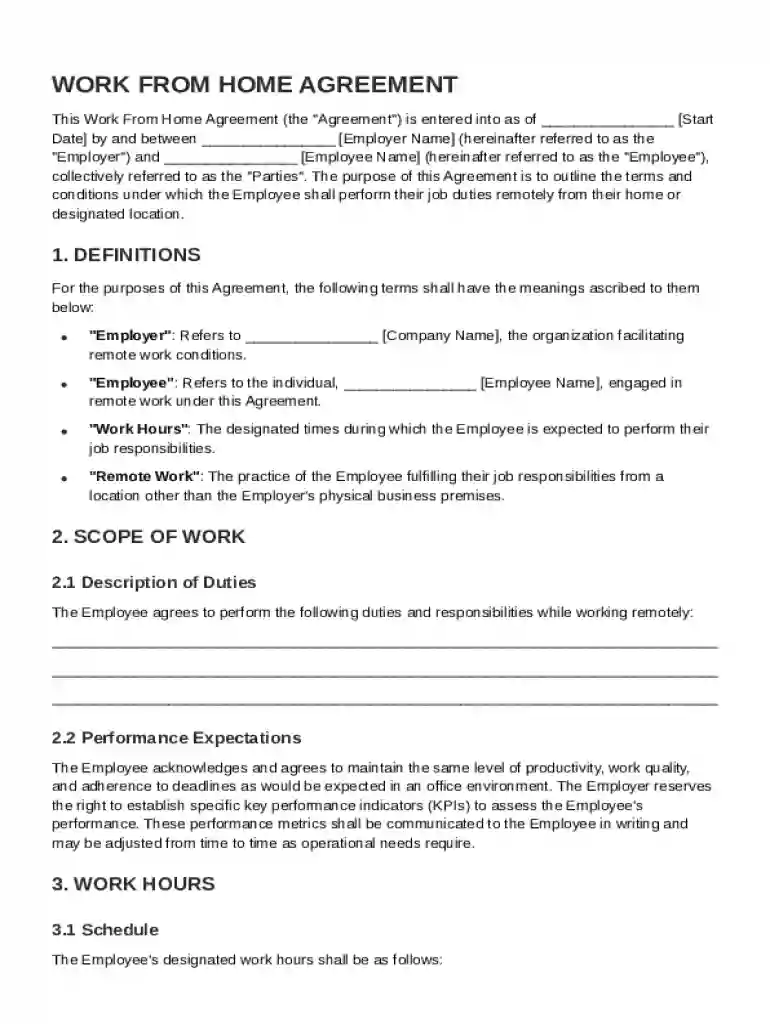
The Work From Home Contract Template serves as a formal agreement outlining the rights and responsibilities of both employers and employees when working remotely. This document is essential for establishing clear expectations regarding job duties, work hours, and performance evaluation in a virtual environment. It includes key elements such as equipment responsibilities, confidentiality obligations, and legal jurisdictions to protect both parties involved. Employers use the template to ensure compliance with company policies while maintaining productivity and security standards. Employees can benefit from this template by understanding their roles and the resources available to support their remote work experience.
The Work From Home Contract Template is comprehensive, encompassing several critical sections to define the terms of remote work. Each section serves a specific purpose in ensuring a seamless transition from in-office to remote work setups.
Scope of Work: Details the tasks and duties expected from the employee, including project deadlines and performance metrics.
Work Hours: Specifies the required hours of availability, including breaks and flexibility guidelines, to maintain consistent communication and productivity.
Compensation: Outlines the salary or hourly wages, payment schedules, and any additional benefits or allowances applicable for remote workers.
Equipment and Resources: Describes the tools and technology that the employer will provide, such as laptops, software, or ergonomic equipment, and the employee's responsibility for maintaining them.
Confidentiality and Security: Establishes protocols for handling sensitive company data and necessary measures to prevent unauthorized access or data breaches.
Utilizing the Work From Home Contract Template efficiently involves a few key steps that both employers and employees should follow.
Review the Template: Both parties should carefully review each section to ensure mutual understanding of all terms and conditions.
Customize the Document: Modify the template to suit the specific needs of the business and the role of the employee. This includes adjusting terms related to work hours, compensation, and equipment.
Consult Legal Advisors: Engage with legal professionals to confirm that the contract complies with relevant laws and regulations, and includes necessary clauses for legal protection.
Finalize and Sign: Once all parties agree on the terms, sign the document digitally or physically to make it legally binding. Keep a copy for personal records.
Completing the Work From Home Contract Template is a structured process aimed at ensuring accuracy and mutual agreement.
Initiate the Process: Start by collecting relevant information about the employee's role, responsibilities, and any specific requirements related to remote work.
Fill in the Details: Enter specifics such as employee name, job title, department, and start date. Clearly outline work expectations, schedules, and deliverables.
Cross-Reference Policies: Ensure alignment with existing company policies on remote work, data security, and performance assessment.
Obtain Feedback: Share the draft contract with the employee and optionally other stakeholders to gather feedback and address any concerns.
Finalize: Make necessary adjustments based on feedback and finalize the document for signatures.
Ensuring that the Work From Home Contract Template is legally compliant involves several critical considerations.
Federal and State Regulations: The template must adhere to both federal and state employment laws, including labor standards and employee rights.
Privacy Laws: It should incorporate clauses compliant with privacy regulations such as the General Data Protection Regulation (GDPR) and the California Consumer Privacy Act (CCPA), where applicable.
State-specific regulations can significantly impact the structure and enforceability of the Work From Home Contract Template.
Wage and Hour Laws: States may have different minimum wage standards and overtime regulations that need to be reflected in the template.
Worker's Compensation: Differences in worker's compensation rules across states may require adjustments in the coverage described in the contract.
Tax Implications: State tax requirements for remote workers, such as withholding taxes, can vary and need precise inclusion.


Corporate Companies: Large organizations often use this template to manage remote employees across various departments.
Small Businesses: Small enterprises benefit from the clarity this template offers in defining terms with their remote workforce.
Freelancers and Consultants: Individuals offering their services remotely can use a modified version of the template to define terms with their clients.
Tech Industry: A software development company uses the template to ensure all developers understand project responsibilities and data security protocols while working from home.
Education Sector: An online tutoring company employs the template to set performance benchmarks and schedule flexibility for its teachers.
Healthcare Field: Medical transcription companies use the template to ensure confidentiality agreements and compliance with health data regulations are maintained.
Understanding specific terminology is crucial for interpreting and drafting the Work From Home Contract Template.
Remote Work Policy: Document detailing the overarching rules and guidelines for telecommuting within an organization.
Flex Time: A workplace practice allowing employees to adjust their start and end times of working hours, within limits set by management.
BYOD (Bring Your Own Device): Policy that permits employees to use their personal devices for work purposes, often relevant in remote work settings.
VPN (Virtual Private Network): Technology that allows workers to securely access company networks over the internet, commonly a requirement in remote work agreements.
At DocHub, your data security is our priority. We follow HIPAA, SOC2, GDPR, and other standards, so you can work on your documents with confidence.



1. The University of Maine System) and I agree I may work remotely to perform portions of my assigned duties at home.
Communication: The employee must keep their supervisor informed of progress on assignments worked on at home, including any problems they may experience.
May 8, 2021 Staff.Wiki comes with a number of sample policies and procedures. Weve compiled a list below of some of the useful ones.


