



Definition and Purpose of Matrimonial Agreement Template
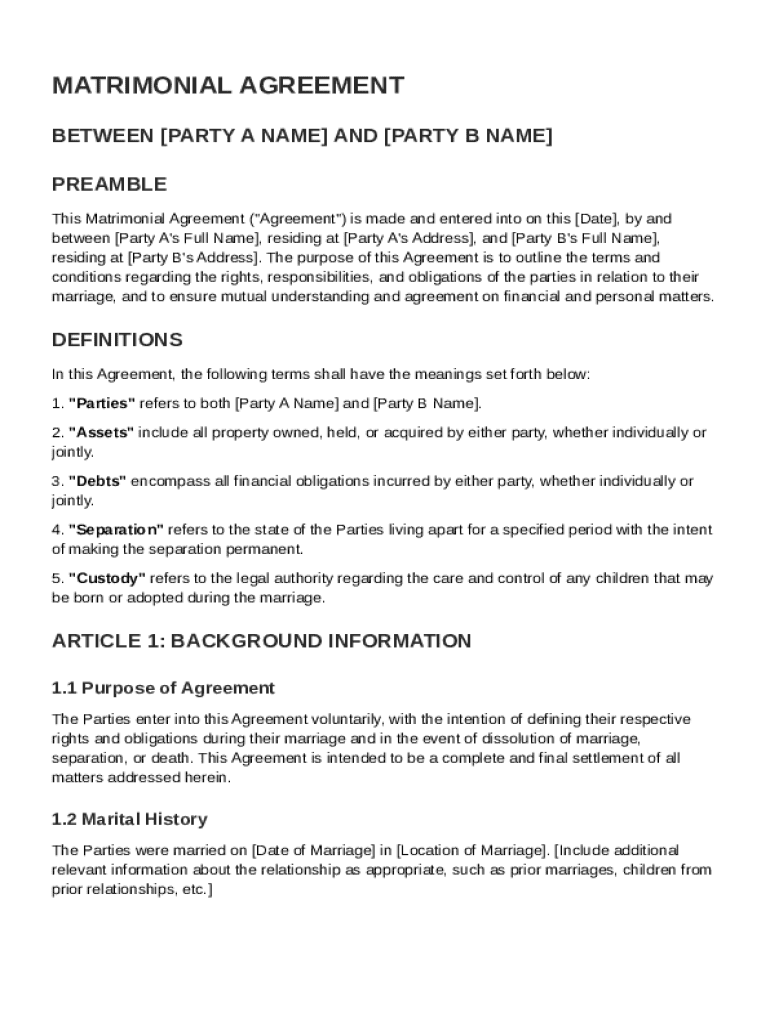
A Matrimonial Agreement, often referred to as a prenuptial or postnuptial agreement, outlines the rights and responsibilities of two parties in a marriage. It typically includes financial disclosures, property rights, spousal support, child custody arrangements, and dispute resolution procedures. The primary function is to ensure mutual understanding regarding personal and financial matters both during the marriage and in the event of separation or dissolution.
Key Components
- Financial Disclosures: Each party's assets, debts, and income are transparently listed to prevent future disputes.
- Property Rights: Specifies how property acquired before and during the marriage will be divided.
- Spousal Support: Details any agreements regarding alimony or financial support post-divorce.
- Child Custody: Plans for custody and visitation rights if applicable.
- Dispute Resolution: Mechanisms for resolving disagreements, such as mediation or arbitration.
How to Use the Matrimonial Agreement Template
Completing a Matrimonial Agreement Template requires careful consideration and discussion between the parties involved.
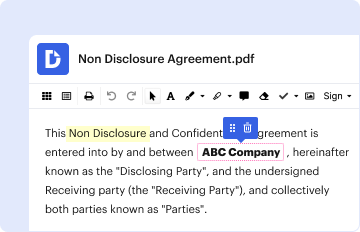
- Download the Template: Use DocHub to access, edit, and store the agreement securely.
- Gather Financial Information: Collect detailed financial information for both parties, including income, assets, and liabilities.
- Discuss Terms: Both parties should openly discuss and agree on the terms of the agreement.
- Draft the Agreement: Use the template to fill in personal information and agreed terms.
- Review by Legal Counsel: Have the draft reviewed by independent attorneys for each party to ensure it meets legal standards.
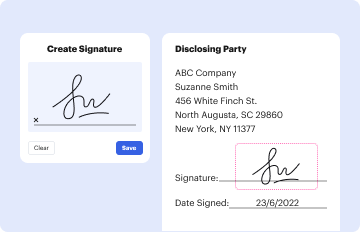
- Sign and Notarize: Use DocHub's electronic signature feature to sign the document legally, and consider notarizing it for further validity.
Steps to Complete the Matrimonial Agreement Template
To effectively complete the agreement, follow these steps:
- Input Basic Information: Start by filling in the personal details of both parties, such as names, addresses, and the date of the agreement.
- Detail Financial Statements: Accurately document each party's financial situation, including assets, debts, and income sources.
- Outline Property and Support Arrangements: Clearly define how property and spousal support will be handled before, during, and after the marriage.
- Add Child-Related Provisions: If children are involved, include custody arrangements and support obligations.
- Set Dispute Resolution Terms: Decide on preferred methods for resolving potential disputes.
- Finalize the Document: Ensure both parties agree on all terms and conditions before finalizing the agreement.
- Execution: Sign and notarize the agreement, ensuring it is legally binding.
Important Terms Related to Matrimonial Agreement Template
Understanding critical terms within the agreement ensures clarity and legality.
- Premarital Property: Property owned by either party prior to the marriage, often remains individual property unless stated otherwise.
- Community Property: In some states, property acquired during the marriage is considered jointly owned.
- Separate Property: Property explicitly designated to remain with one spouse.
- Alimony: Payments from one spouse to another for financial support post-divorce.
- Custodial Parent: The parent awarded primary custody of children.
Legal Use of the Matrimonial Agreement Template
Matrimonial agreements are legally recognized in the United States and generally enforceable if properly executed. Legal validity depends on:
- Voluntary Agreement: It must be entered willingly by both parties.
- Full Disclosure: Both parties must honestly disclose all financial information.
- Fair Terms: The agreement should not unduly favor one party over the other.
- Commonsense Enforcement: Courts may not enforce clauses that are illegal, against public policy, or unconscionable.
Key Elements of the Matrimonial Agreement Template
Several essential elements ensure the effectiveness and enforceability of the agreement:
- Identification of Parties: Full names and personal details of both parties involved.
- Date and Place of Marriage: Contextualizes the timing and location pertinent to the agreement.
- Financial and Property Listings: A thorough inventory of assets, liabilities, income, and property.
- Spousal Support Conditions: If applicable, outlines terms of alimony or support.
- Child Custody Plans: Provisions related to existing or potential children.
- Dispute Resolution Clauses: Agreed methods such as arbitration or mediation should disputes arise.
State-Specific Rules for Matrimonial Agreements
Laws regarding matrimonial agreements can vary significantly by state in the U.S.
- Community Property States: States like California and Texas have specific rules about marital property division.
- Equitable Distribution States: Most states distribute property fairly, but not necessarily equally.
- Child-Related Provisions: Some states have stringent rules governing child custody and support agreements.
- Statute of Limitations: Some states may have time limits for challenging the validity of an agreement.
Examples of Using the Matrimonial Agreement Template
Real-world scenarios often demonstrate the practical utility of these agreements.
- Business Owners: Protect business interests by predetermining ownership and operational rights.
- Blended Families: Establish clear guidelines for inheritance and custody matters.
- High-Net-Worth Individuals: Safeguard individual wealth and avoid costly divorce settlements.
- Second Marriages: Clearly outline financial responsibilities and property rights to avoid disputes.
By understanding these components and considerations, individuals can utilize the Matrimonial Agreement Template effectively to safeguard their rights and responsibilities within a marriage.