




01. Edit your form online
Type text, add images, blackout confidential details, add comments, highlights and more.

Type text, add images, blackout confidential details, add comments, highlights and more.

Draw your signature, type it, upload its image, or use your mobile device as a signature pad.

Send it via email, link, or fax. You can also download it, export it or print it out.
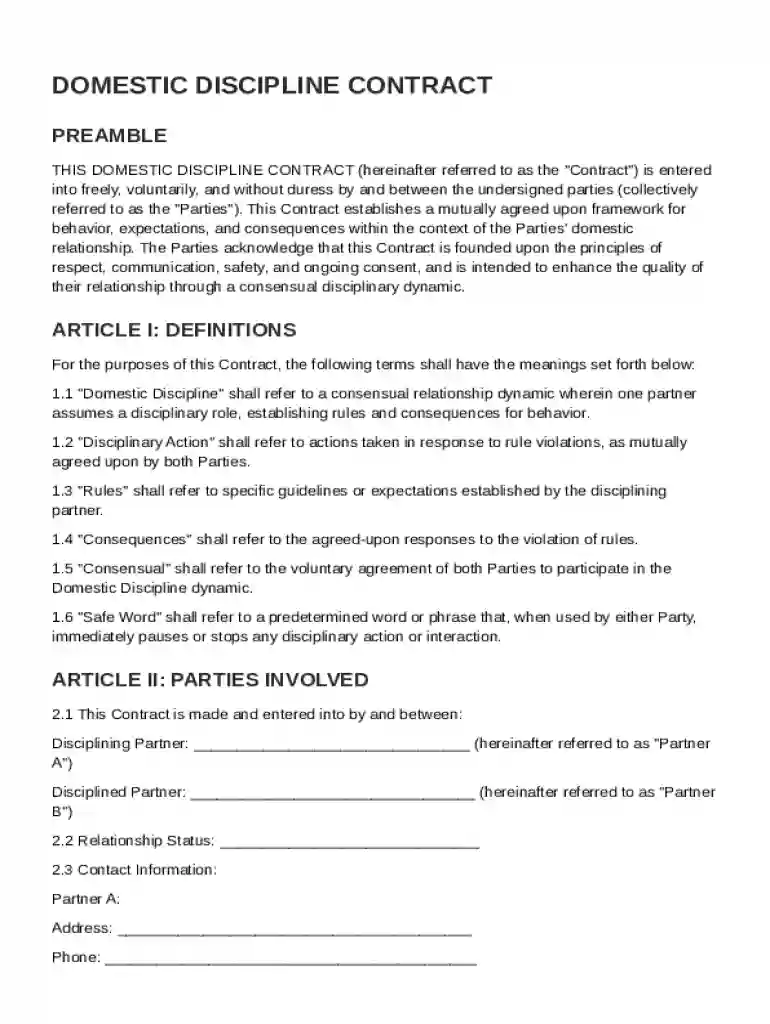
The Domestic Discipline Contract Template is a written agreement designed for consensual use within domestic relationships. It establishes clear guidelines for behavior and outlines the commitments and responsibilities of both partners. This template delineates specific rules, expectations, and the consequences of failing to adhere to them. By doing so, it emphasizes open communication, mutual consent, and the safeguarding of both parties involved. This contract aids in maintaining harmony and accountability within the relationship, providing a structured approach to resolving disagreements and clarifying roles in a collaborative environment.
When crafting a Domestic Discipline Contract, several essential components should be included to ensure its effectiveness and clarity:
Roles and Responsibilities: Clearly define the roles each partner will play within the relationship. This section should outline what is expected of each participant in terms of behavior and duties.
Rules and Expectations: Detail the specific rules each partner agrees to follow. This can cover a range of topics from daily chores to broader behavioral guidelines.
Disciplinary Actions: Specify the consequences that will be enacted if the agreed-upon rules are broken. This should be a mutually agreed-upon aspect of the contract to ensure fairness and consent.
Communication: Address the importance of ongoing dialogue, making provisions for partners to express concerns and renegotiate terms if necessary.
Consent Clause: Reaffirm that the agreement is entered voluntarily, ensuring that all parties are comfortable with the terms and can withdraw their consent at any time.
Filling out a Domestic Discipline Contract Template involves several steps to ensure both partners agree on all terms:
Review and Discussion: Partners should begin by discussing the terms they want to include. Open communication during this step is crucial to achieving a mutually satisfactory agreement.
Drafting the Contract: Using the template, both partners should collaboratively draft the contract, detailing roles, rules, consequences, and any other specifics.
Consultation with a Third Party (Optional): To ensure fairness and clarity, it might be beneficial to consult with a mediator or counselor. This step helps both partners gain perspective on the terms set forth.
Finalize and Sign: Once both parties agree on the terms, the contract should be signed to indicate understanding and acceptance. It is advisable to keep a copy of the signed contract in a secure location accessible to both partners.
Utilizing a Domestic Discipline Contract Template effectively involves understanding its purpose and application within a relationship:
Customization: Adjust the template to cater to the unique dynamics of your relationship. This may involve adding or removing clauses based on individual needs and circumstances.
Periodic Review: Regularly review the contract terms to ensure they remain relevant and mutually acceptable. Situations and dynamics might change, necessitating updates to the contract.
Conflict Resolution: Use the contract as a framework for mediating disputes, referring back to the agreed-upon rules and consequences for guidance in navigating disagreements.
The legal standing of a Domestic Discipline Contract can be complex and varies depending on jurisdiction. Although these contracts aim to set boundaries and ensure mutual consent within a relationship:
Enforceability: Such contracts may not be legally enforceable in a court of law due to their personal and private nature.
Consent and Safety: The primary legal focus is ensuring that both parties enter into the agreement willingly and understand the terms, prioritizing safety and voluntariness.
Confidentiality: Provisions can be included to enhance privacy, preventing the disclosure of contract details without consent from all involved parties.
This type of contract is typically used by individuals in domestic partnerships who wish to maintain a structured approach to their relationship dynamics:
Committed Couples: Partners looking to define roles and responsibilities while fostering accountability and trust.
Communicative Relationships: Those who prioritize understanding and communication in their partnership, using the contract as a tool to support these values.
Relationships Seeking Egalitarian Agreements: Couples aiming to establish fair and balanced agreements that acknowledge the nuances of their partnership.


State laws may impact the use and recognition of Domestic Discipline Contracts:
Variability by State: Different states have varying laws regarding personal agreements and the extent to which they can be upheld.
Legal Advice: Consulting a legal expert can provide insights into state-specific nuances that might affect the validity and enforceability of the contract.
Jurisdictional Considerations: Ensure awareness of any local legislation that might influence the terms of the agreement, especially in regard to protection orders and rights.
Real-world scenarios illustrate how the Domestic Discipline Contract Template can be applied effectively:
Case Study 1: A couple establishes a contract to manage household chores and finances, agreeing on shared responsibilities and setting clear expectations to prevent disputes.
Case Study 2: Partners agree on behavior expectations and stipulate specific consequences in their contract, using it as a guide to resolve conflicts amicably.
Case Study 3: A long-term relationship employs the contract as a living document to periodically update and reaffirm their mutual commitments, enhancing their communication and understanding over time.
At DocHub, your data security is our priority. We follow HIPAA, SOC2, GDPR, and other standards, so you can work on your documents with confidence.
The document is divided into ten Parts, and within seven of these Parts there are several sub-headings (Parts and sub-headings are listed in the Table of
Apr 1, 2025 The College reviews each incident of inappropriate behavior or conduct on a case-by-case basis and reserves the right to impose appropriate.
The EMPLOYEE is limited to working only for the EMPLOYER while in the USA. The EMPLOYERs name will be printed on the EMPLOYEES visa.


