
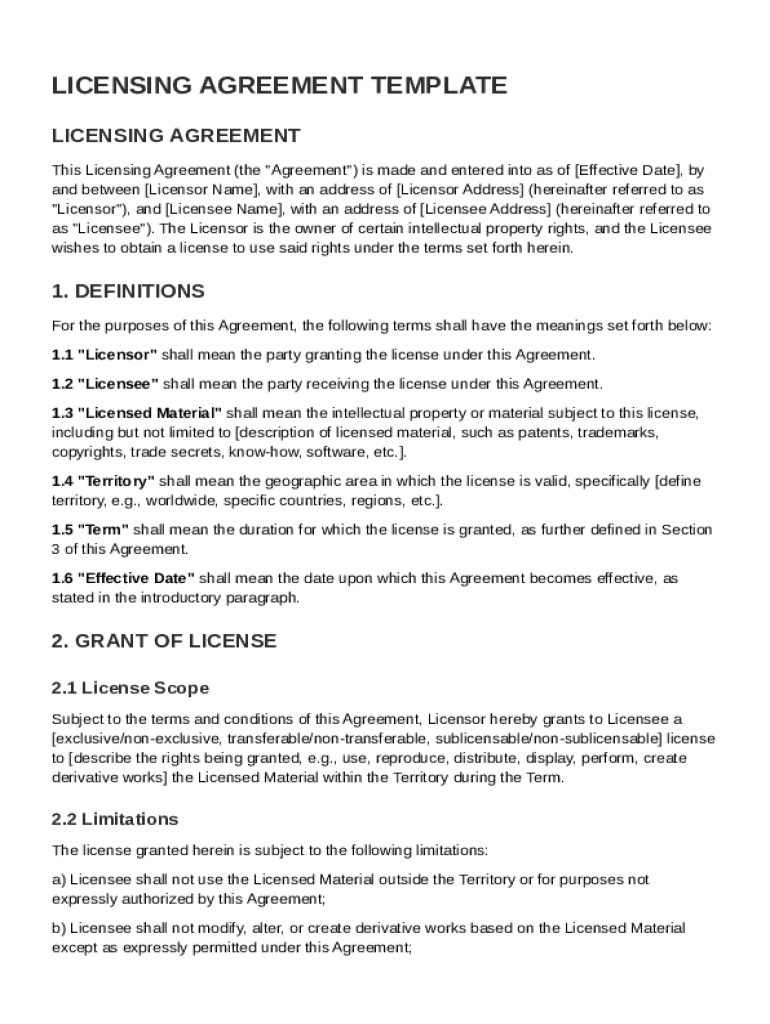







Definition and Purpose of a Licensing Agreement Template
A licensing agreement template is a standardized document outlining the terms under which one party, the Licensor, grants permission to another party, the Licensee, to use certain intellectual property (IP). This template serves as a foundational framework to define the nature and scope of the agreement, including the specific rights being licensed, any restrictions, and the duration of the license. It includes key sections such as definitions, compensation details, confidentiality obligations, and governing law, aiming to protect the interests of both parties while facilitating legal usage of the licensed materials.
How to Use the Licensing Agreement Template
To effectively utilize the licensing agreement template, follow these steps:
- Review the Template: Begin by thoroughly reading through the template to understand its sections and the standard terms used.
- Customize the Document: Modify the template to fit the specifics of your agreement. This includes detailing the intellectual property being licensed, defining the scope and limitations, and specifying the rights and responsibilities of each party.
- Consult a Legal Professional: Before finalizing, it is advisable to consult with an attorney to ensure that the terms adequately protect your interests and comply with U.S. intellectual property laws.
- Agree and Sign: Once both parties have agreed to the customized terms, the document should be signed to make it legally binding.
Customization Tips
- Clearly specify the exact intellectual property being licensed, using precise descriptions or identifiers.
- Define the geographic territory and duration of the license.
- Consider future scenarios, such as sublicensing or assignment rights, and address them accordingly.
Steps to Complete the Licensing Agreement Template
Completing a licensing agreement involves a few critical steps to ensure its legality and effectiveness:
- Prepare the Necessary Information: Gather all details about the intellectual property, the parties involved, and the specific terms you wish to include.
- Fill Out Identifying Details: Enter the names, addresses, and contact information of both the Licensor and Licensee.
- Specify License Details: Clearly outline the scope of the license, including any limitations on use and geographic or time constraints.
- Detail Compensation Arrangements: Clearly state the financial terms, such as royalty rates, payment schedules, and any additional fees.
- Include Legal Provisions: Ensure sections on confidentiality, indemnification, dispute resolution, and governing law are appropriately filled out.
Key Elements of the Licensing Agreement Template
The licensing agreement template is composed of several crucial sections that you must not overlook:
- Definitions: Clarifies key terms used throughout the document, ensuring both parties have a mutual understanding.
- Scope and Grant of License: Details what rights are being granted, the uses permitted, and any exclusions.
- Payment and Royalties: Outlines how the Licensee will compensate the Licensor for the use of the licensed material.
- Intellectual Property Rights: Ensures the Licensor retains ownership of the intellectual property while granting usage rights.
- Confidentiality and Non-Disclosure: Protects sensitive information exchanged between parties.
- Indemnification: Establishes each party's responsibility for any potential legal claims.
- Termination Conditions: Defines circumstances under which the agreement can be terminated prematurely.
Practical Examples
- A software company licensing its software for international use might define territories and specify that sublicensing requires approval.
- An artist licensing their artwork for merchandising might include terms around the reproduction quality and permissible formats.
Important Terms Related to the Licensing Agreement Template
Certain terms are integral to understanding and implementing a licensing agreement:
- Licensor: The owner or controller of the intellectual property granting the license.
- Licensee: The party receiving the rights to use the intellectual property.
- Sublicense: Permission granted by the Licensee to a third party to use the licensed rights.
- Royalty: Ongoing compensation paid by the Licensee to the Licensor, usually calculated as a percentage of revenue from products or services using the licensed IP.
- Territory: The geographical area where the licensed rights can be used.
Legal Considerations and Compliance
Ensuring that the licensing agreement template complies with legal standards is essential:
- Governing Law: Specify the jurisdiction that will govern any legal disputes, usually based on the location of the Licensor.
- Compliance with the ESIGN Act: Ensure electronic signatures are legally binding under the Electronic Signatures in Global and National Commerce Act.
- Confidentiality Obligations: Include specific language to protect trade secrets and sensitive information during and after the term of the agreement.
Legal Scenarios
- A U.S. company might encounter state-specific laws that require additional clauses to meet local legal standards.
- International licensing agreements may require provisions that address varying copyright laws across countries.
State-Specific Rules and Variations
While a licensing agreement template provides a general framework, state-specific laws can impact the enforcement and terms of these agreements.
- California: Has unique laws surrounding non-compete clauses that might affect licensing terms, especially in technology sectors.
- New York: Demands precise language for royalty and payment terms to avoid later disputes.
Considerations for Businesses
- Small businesses should be particularly vigilant of state laws that affect sublicensing rights.
- Corporations with multi-state operations should ensure their agreement references relevant state laws where their intellectual property will be used.
Who Typically Uses the Licensing Agreement Template
A variety of entities can benefit from using a licensing agreement template:
- Software Developers: Grant licenses to use software while retaining ownership of the code.
- Publishing Houses: Use to license book and manuscript rights to international markets.
- Manufacturers: License patented production methods or technologies to third parties.
- Artists and Musicians: Protect creative works while allowing their distribution and commercialization through licensing.


Example Scenarios
- An independent musician granting streaming rights to an online platform.
- A pharmaceutical company licensing a patented drug formulation for production in a different country.




