




01. Edit your form online
Type text, add images, blackout confidential details, add comments, highlights and more.

Type text, add images, blackout confidential details, add comments, highlights and more.

Draw your signature, type it, upload its image, or use your mobile device as a signature pad.

Send it via email, link, or fax. You can also download it, export it or print it out.
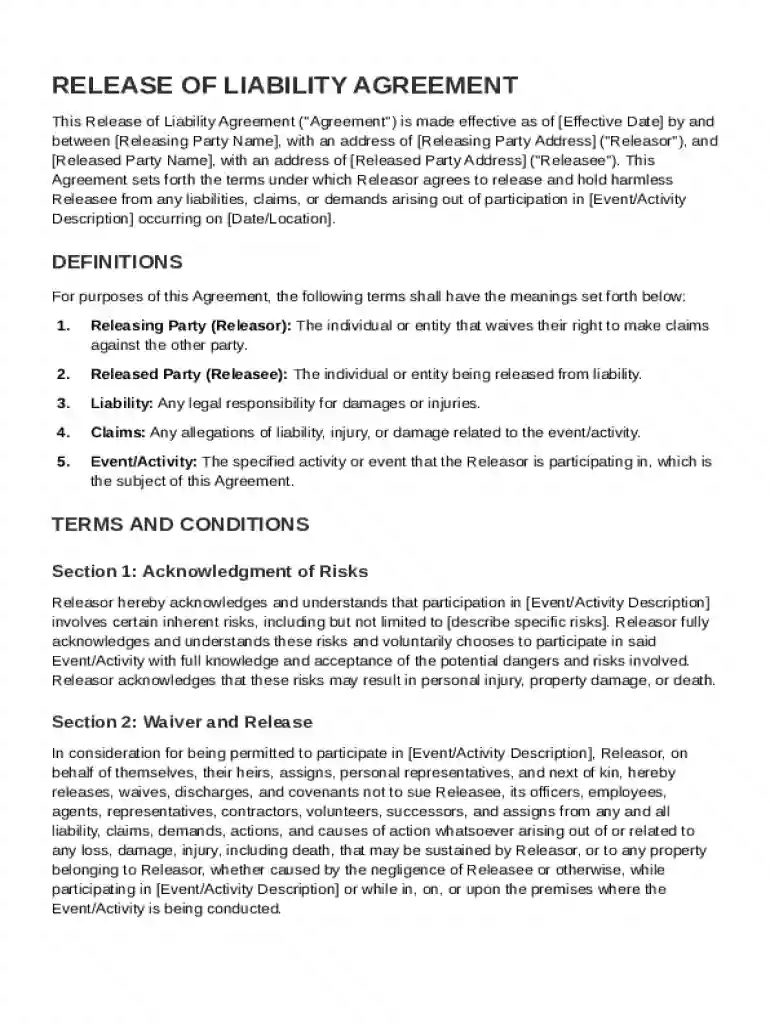
A Release of Liability Agreement Template is a legal document where the Releasor agrees to waive certain legal claims against the Releasee. This agreement plays a crucial role in managing risk by outlining specific terms under which liabilities can be released. Typically used for events or activities with inherent risks, this document defines key terms and conditions that bind both parties to prevent future disputes.
The agreement provides a clear acknowledgment that the participant understands the risks involved and agrees not to hold the organizing party responsible for any resulting injuries or damages.
Understanding the core components of a Release of Liability Agreement Template is essential for ensuring its effectiveness:
Description of Activity/Event: Clear specification of the event or activity covered by the agreement.
Assumption of Risk: Acknowledgment by the Releasor of the inherent risks involved.
Waiver of Claims: Agreement by the Releasor to waive future claims against the Releasee for damages or losses.
Indemnification: Provisions ensuring the Releasor will compensate the Releasee for associated legal expenses.
Severability Clause: Protects the agreement's validity by ensuring that if one part is invalidated, the remainder remains in effect.
Governing Law: Specifies which state's laws apply to the agreement, crucial for legal enforcement.
Signatures: Signatures from both parties are required to formalize the agreement, making it legally binding.
Effectively using a Release of Liability Agreement Template involves several steps to ensure all legal bases are covered:
Identify the Event/Activity: Clearly define and describe the event or activity that necessitates the agreement.
Customize the Document: Tailor the template by inserting specific details relevant to the event, such as dates, locations, and parties involved.
Review the Terms: Carefully review the terms, ensuring they accurately reflect the intended legal protections.
Provide Copies: Distribute copies to all involved parties to review the conditions before signing.
Secure Signed Copies: Obtain and securely store signed copies from all parties to finalize the agreement.
The legal application of a Release of Liability Agreement Template is a fundamental aspect of its utility:
Enforceability: These templates are legally valid when parties enter into them voluntarily and with informed consent, meaning that participants understand the terms and consequences.
Documentation: Maintain thorough documentation, including signed agreements and any related communication. This documentation serves as evidence should any disputes arise.
Use of Legal Counsel: Consider consulting with a legal professional to ensure the document’s language aligns with current laws and adequately protects all parties involved.
A Release of Liability Agreement Template includes several important terms that ensure clarity and enforceability:
Waiver: A voluntary relinquishment of specific legal rights.
Liability: Legal responsibility for an individual's actions or omissions.
Indemnity: An assurance to cover another party's loss or damage.
Breach of Duty: Failure to fulfill legal obligations, which the agreement seeks to waive.
Force Majeure: Clauses that free parties from liability due to extraordinary events beyond control.
Understanding these terms will help ensure that each party knows their rights and obligations under the agreement.
Various individuals and organizations apply Release of Liability Agreement Templates for risk management:
Event Organizers: To mitigate legal risks associated with hosting events.
Sports Coaches: For activities involving physical exertion or potential injury.
Recreational Businesses: Such as adventure tourism companies, gyms, or parks that offer activities with inherent risks.
Volunteers: Organizations that use volunteers for activities involving potential hazards.
In each case, the goal is to protect against significant legal liabilities.


Real-world examples highlight the impact of using a Release of Liability Agreement Template effectively:
Adventure Sports: A rock-climbing gym requires participants to sign the agreement recognizing potential injury risks.
Corporate Retreats: Companies sponsoring outdoor retreats have employees sign agreements acknowledging risks related to activities.
Community Events: Local festivals use these agreements to mitigate liability from potential accidents involving a large crowd.
These examples demonstrate the practical applications of the agreement across different scenarios.
Laws governing liability waivers can vary significantly by state, impacting their enforceability:
California: Strict interpretations often favor the Releasor, requiring clear and explicit language regarding the waiver of negligence claims.
Texas: Allows broader enforceability of waivers, provided they are clearly written and thoroughly explained to the Releasor.
New York: Places restrictions on waivers for certain activities, such as education and entertainment, emphasizing participant protection.
Understanding these variations is crucial for drafting an agreement that holds up under the specific jurisdiction’s laws.
The differences in enforcement and validity of Release of Liability Agreements across states require careful consideration:
Enforceability: Some states require specific language or phrasing for waivers to be legally binding.
Notice Requirements: Certain jurisdictions mandate that participants must receive a conspicuous warning regarding the waiver of rights.
Prohibitions: Specific states restrict the waiver of liability for gross negligence or willful misconduct.
Factor these differences into the drafting process to ensure compliance with local laws and improve the agreement’s enforceability.
At DocHub, your data security is our priority. We follow HIPAA, SOC2, GDPR, and other standards, so you can work on your documents with confidence.

I AM AWARE THAT THIS IS A RELEASE OF LIABILITY AND A CONTRACT. BETWEEN MYSELF AND THE FAIR, THE STATE, THE COUNTY, AND THE LESSOR, AND. SIGN IT OF MY OWN FREE
3.1. The Parties hereby release and forever discharge each other, and each of their past and present predecessors, successors, affiliates, subsidiaries, parents
My signature is proof of my intention to execute a complete and unconditional WAIVER AND. RELEASE of all liability to the full extent of the law. I am 18 years


