




01. Edit your form online
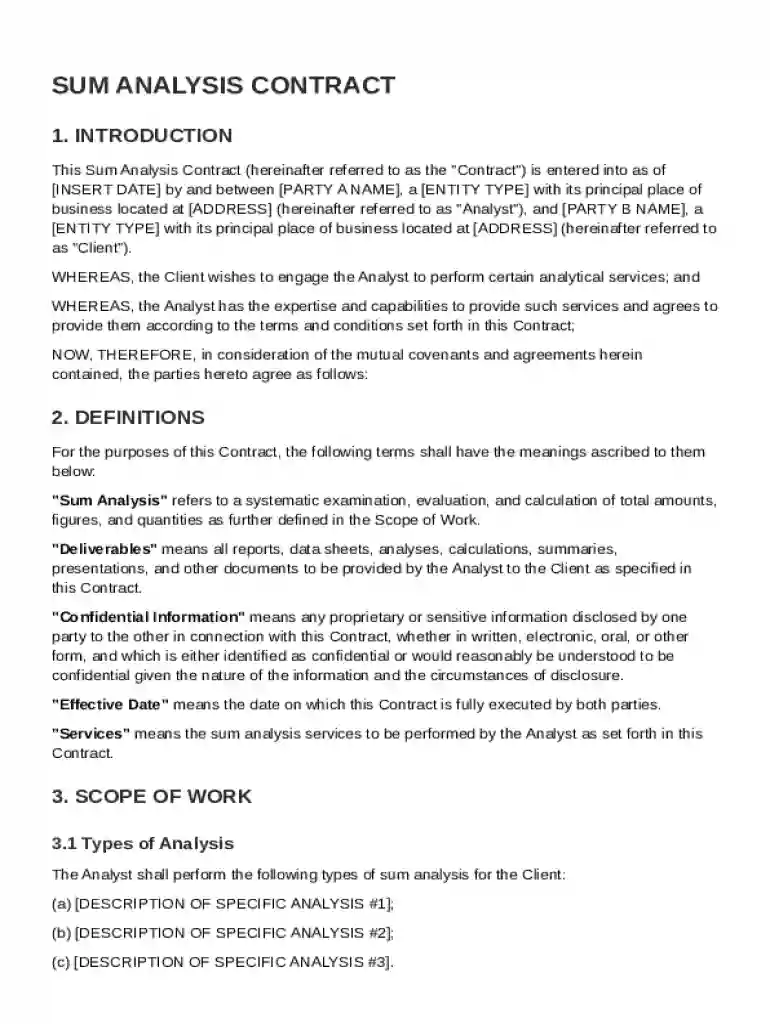
Type text, add images, blackout confidential details, add comments, highlights and more.

Type text, add images, blackout confidential details, add comments, highlights and more.

Draw your signature, type it, upload its image, or use your mobile device as a signature pad.

Send it via email, link, or fax. You can also download it, export it or print it out.
The Sum Analysis Contract Template serves as a formal document used to establish an agreement between an Analyst and a Client for the provision of analytical services that focus on evaluating total amounts and figures. This template outlines the specific roles and responsibilities of both parties, ensuring that the Analyst's services are clearly defined and understood. It covers the scope of work, which includes the types of analyses to be conducted, as well as the methods and data sources to be utilized. This provides a framework for systematic evaluations, ensuring that all analytical processes align with the client's expectations.
The Sum Analysis Contract Template is structured to include essential components that facilitate a clear understanding between the contracting parties. Key elements include:
Scope of Work: This section details the nature and extent of the services to be provided by the Analyst, including specific analytical tasks and methodologies.
Compensation Structure: Outlines the payment terms agreed upon by the Analyst and the Client, encompassing any fixed fees, hourly rates, or performance-based incentives.
Confidentiality Clauses: Establishes the obligations of both parties to protect sensitive data and information shared during the course of the contract.
Termination Conditions: Provides the terms under which the contract can be terminated, including breach of contract or fulfillment of the contractual obligations.
Dispute Resolution: Defines the process for resolving any disagreements or conflicts that may arise, typically through mediation or arbitration.
To successfully complete the Sum Analysis Contract Template, follow these steps:
Identify the Parties: Clearly state the names and contact information of both the Analyst and the Client.
Define the Scope of Work: List the specific analytical services, including detailed descriptions of the tasks to be performed.
Establish the Compensation Terms: Document the agreed-upon financial arrangements, including payment schedules and any contingencies.
Include Confidentiality Clauses: Outline the confidentiality obligations to safeguard proprietary and sensitive information.
Specify Termination Conditions: Detail the circumstances under which the contract may be terminated and any notice requirements.
Detail Dispute Resolution Processes: Include procedures for addressing disputes, specifying preferred methods such as mediation or arbitration.
Review and Finalize: Before signing, both parties should review the document to ensure accuracy and completeness, making any necessary revisions.
The legal use of the Sum Analysis Contract Template involves ensuring that the contract complies with relevant U.S. laws and regulations. This includes adherence to:
Contract Law Principles: Ensuring the agreement is legally binding, with mutual consent, consideration, and lawful purpose.
Data Protection Regulations: Observing applicable state and federal laws regarding data privacy and protection, particularly when handling sensitive client data.
Non-Disclosure Agreements (NDAs): If required, integrating NDAs within the contract to prevent unauthorized disclosure of privileged information.
Legal counsel may be consulted to ensure that the contract meets all legal requirements and adequately protects the interests of both parties.
For users looking to manage and execute the Sum Analysis Contract Template digitally, it is compatible with various document management systems, including:
DocHub: Allows for seamless editing, signing, and sharing of contract documents, supporting formats such as PDF, DOC, and XLS.
Google Suite: Integrates with Google Drive for easy access and storage, facilitating collaborative editing within Google Docs.
Microsoft Office: Compatible with Word and Excel, enabling detailed formatting and data analysis within the Microsoft Office suite.
This compatibility ensures the flexibility and convenience of managing contracts in a digital format, promoting efficiency in document workflow.
The Sum Analysis Contract Template is widely used in scenarios such as:
Business Analysis: Corporations hiring analysts to evaluate financial performance, identify inefficiencies, and propose data-driven strategies for growth.
Research Collaborations: Academic institutions engaging external analysts to perform systematic reviews and data analyses for extensive research projects.
Consultancy Projects: Consulting firms securing contracts with clients to provide detailed market or financial analyses, contributing to strategic decision-making.
These scenarios illustrate the diverse applications of the template across various sectors, highlighting its utility and adaptability.
Several critical terms are associated with the Sum Analysis Contract Template, including:
Analyst: The party providing analytical services and insights based on data interpretation.
Client: The recipient of the analytical services, typically seeking expertise to inform decisions or validate data.
Data Sources: The origins of the data to be analyzed, which must be specified to establish the scope and accuracy of the analysis.
Understanding these terms aids in comprehending the contractual obligations and expectations involved in the analytical agreement.
The Sum Analysis Contract Template is typically utilized by a diverse range of professionals and industries, including:
Financial Analysts: Engaged by businesses to assess financial health and guide investment decisions.
Market Researchers: Hired to analyze market trends and consumer behavior, providing strategic insights to companies.
Data Scientists: Collaborating with organizations to extract meaningful patterns and insights from large datasets.
These users leverage the template to ensure clear communication and alignment on analytical objectives and deliverables.


At DocHub, your data security is our priority. We follow HIPAA, SOC2, GDPR, and other standards, so you can work on your documents with confidence.


3.4. Contract Sum means the total amount of all compensation payable to the Construction Manager for the Project and shall not exceed the sum of the Pre-
Contract Sum Analysis (if any) that are not included in the Employers. Requirements are to be treated as fixed allowances made by the Contractor and will


