01. Edit your form online
Type text, add images, blackout confidential details, add comments, highlights and more.

Type text, add images, blackout confidential details, add comments, highlights and more.

Draw your signature, type it, upload its image, or use your mobile device as a signature pad.

Send it via email, link, or fax. You can also download it, export it or print it out.
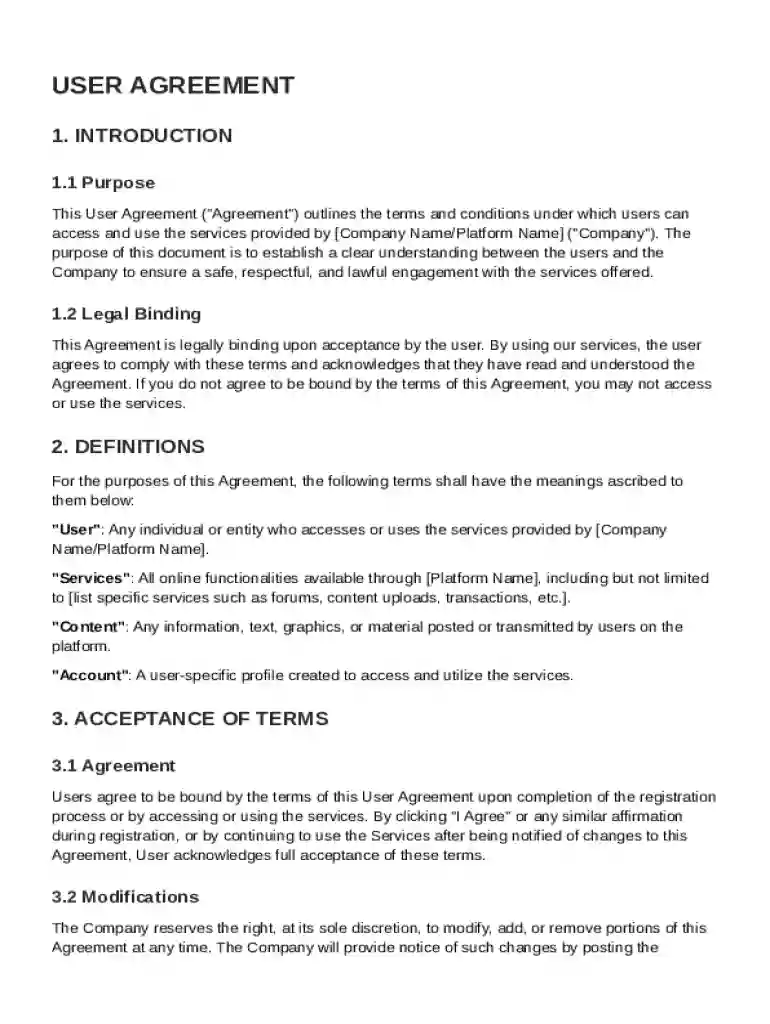
The User Agreement Template is a crucial document that sets out the terms and conditions between a user and a service provider. It establishes a legal framework governing the user's interaction with the platform, covering aspects such as user responsibilities, account security, and compliance with applicable laws. By defining these terms, the template ensures both parties have a clear understanding of their rights and obligations. This template is essential for maintaining the integrity and trust in the relationship between users and service providers.
The User Agreement typically encompasses several sections, including disclaimers of warranties, termination rights, and governing law, which are crucial for legal protection. It may also outline rules regarding the use of the platform, intellectual property rights, and privacy policies. This clarity helps prevent disputes by providing a reference point for resolving issues that might arise during the use of the service.
The User Agreement Template comprises various critical components that ensure comprehensive coverage of legal and operational aspects. Key elements typically include:
Account Security: Guidelines ensuring users maintain the security of their accounts, often detailing password protection measures.
Content Ownership: Clauses defining the ownership rights of content posted by users on the platform, ensuring clear boundaries over intellectual property.
User Responsibilities: Detailed descriptions of user actions required to comply with the agreement, such as adhering to community standards and reporting violations.
Privacy and Data Rights: Information on user data handling, including collection, processing, and safeguarding measures adopted by the service provider.
Termination Clauses: Conditions under which the agreement can be terminated by either party, ensuring clear protocols are in place for the severance of the relationship.
Dispute Resolution: Mechanisms established for resolving disputes, which may involve arbitration or other legal processes.
Each element is structured to protect both parties by ensuring that the terms of use are not only fair but also legally enforceable.
Using the User Agreement Template involves several methodical steps to ensure that the document is customized effectively for the specific context of the service provider. These steps include:
Identify Specific Needs: Understand the nature of the service provided and the interactions expected with users to tailor the agreement appropriately.
Consult Legal Experts: Engage with legal professionals to help draft or review the agreement ensuring compliance with applicable laws and regulations.
Customize Core Sections: Modify key sections to reflect service-specific requirements, such as unique privacy policies or content-usage clauses.
Ensure Clarity: Use clear and unambiguous language that is easy for users to understand, avoiding overly technical jargon unless necessary.
Implement a Review Process: Establish a routine review and update mechanism to keep the agreement current with evolving legal standards and business practices.
Communicate and Obtain Consent: Clearly present the agreement to users and ensure a method for obtaining their explicit consent to the terms.
Following these steps assists in drafting a comprehensive, legally sound User Agreement Template that aligns with the service provider’s goals and user expectations.
Completing a User Agreement Template requires careful attention to detail to ensure all necessary legal and administrative aspects are covered:
Gather Required Information: Compile information about the service, user interactions, and any legal mandates specific to the industry.
Draft Initial Template: Create a draft agreement with preliminary clauses covering essential sections like user duties, privacy, and data usage.
Insert Legal Terms: Incorporate necessary legal terminology that accurately reflects the intentions of the company and complies with jurisdiction-specific laws.
Review and Revise: Collaborate with legal advisors to scrutinize the draft for legal accuracy and relevance to current law.
Finalize Agreement: After revisions, approve the final version of the agreement to be issued to users.
Document User Consent: Implement a system to collect and store evidence of user consent to the agreement terms, often through digital acknowledgments.
These steps are essential in ensuring legal compliance and robust user agreements that effectively protect all involved parties.
The User Agreement Template serves various legal purposes, providing a foundation for regulation of user interactions on a platform. Its legal significance includes:
Constraint on User Actions: Legally limits certain actions by users, protecting the service provider's interests and intellectual property.
Liability Management: Reduces liabilities by clarifying scenarios where the service provider cannot be held responsible for user actions.
Compliance with Laws: Assures that interactions comply with national and international regulations like data protection laws, offering protection against legal challenges.
Enforceability: Provides a robust legal document that can be relied upon in court to support claims or defenses against breaches or misuse by users.
By driving compliance, managing risk, and setting legally sound boundaries, the User Agreement Template is crucial for safeguarding service operations.
The User Agreement Template is widely utilized across various sectors where digital interactions and transactions occur. Typical users include:
Online Platforms: Websites and applications offering services, content, or products require user agreements to govern platform use.
Software Companies: Developers and distributors use agreements to regulate software licensing and user interaction terms.
E-commerce Businesses: Online retailers incorporate user agreements to detail transaction terms and buyer-seller obligations.
Social Media Services: Platforms facilitating social interactions use these templates to establish content usage norms and privacy policies.
Such templates are particularly vital for entities interacting broadly with the public, ensuring compliance, protection, and management of user relationships.


Understanding the terms related to the User Agreement Template enhances comprehension and ensures accurate implementation. Some critical terms include:
Indemnification: User's agreement to compensate the service provider for any losses arising from their breach of the terms.
Governing Law: Clauses specifying the jurisdiction whose laws will be applied to interpret the agreement.
Limitation of Liability: Caps the maximum liability of the service provider in case of losses or damages experienced by users.
Force Majeure: Conditions under which the service provider is not liable for failure to comply with the agreement due to events beyond their control.
Severability: Ensures that if one clause of the agreement is invalid, the rest remains enforceable.
Clear comprehension and integration of these terms solidify the User Agreement Template’s effectiveness in legal enforcement and user clarity.
The User Agreement Template can be adapted for digital use alongside various document management platforms such as DocHub. Key considerations include:
Format Compatibility: Ensure the template is compatible with popular file formats like DOC, PDF, and TXT for easy integration into digital workflows.
Editable and Fillable Fields: Utilize platforms that allow creation of editable agreements where users can input and acknowledge consent digitally.
Cloud Integration: Leverage cloud services for storage and collaboration, ensuring effortless access and modification by authorized personnel.
Security Protocols: Apply cutting-edge encryption and password protection to safeguard sensitive agreement data during storage and transmission.
Employing such technologies streamlines the agreement process while maintaining security and accessibility, aligning with modern digital practices.
At DocHub, your data security is our priority. We follow HIPAA, SOC2, GDPR, and other standards, so you can work on your documents with confidence.