Definition & Meaning
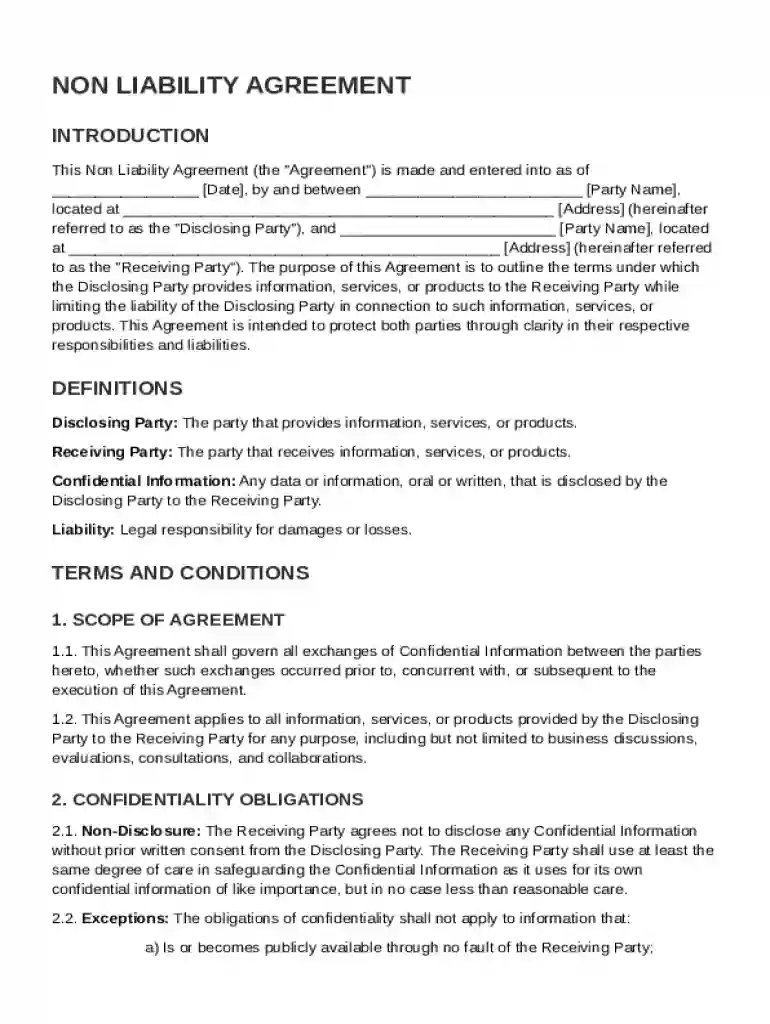
A Non Liability Agreement Template is a legal document used to outline terms between a disclosing party and a receiving party. It is primarily designed to limit liability concerning the exchange of information, services, or products. This template forms a crucial part of formalizing agreements where one party agrees not to hold the other liable for potential issues arising from the disclosed information. The template includes confidentiality clauses, indemnification requirements, and liability limitations, providing clear legal boundaries and protections for involved parties.
Key Elements of the Non Liability Agreement Template
The Non Liability Agreement Template includes several crucial components:
- Confidentiality Obligation: This section mandates the receiver to maintain the confidentiality of the information shared by the disclosing party.
- Liability Limitation: It specifies that the receiving party cannot hold the disclosing party liable for damages resulting from using the shared information.
- Indemnification Clause: This clause outlines the conditions under which the disclosing party will compensate the receiving party for damages or losses incurred.
- Duration of Agreement: States the time frame for which the agreement remains active and relevant.
- Termination Conditions: Describes how and when the agreement can be terminated by either party.
How to Use the Non Liability Agreement Template
To effectively use a Non Liability Agreement Template:
- Identify Parties: Clearly identify the disclosing and receiving parties involved in the agreement.
- Customize Terms: Tailor the template to reflect the specific terms and conditions that suit the transaction or interaction.
- Include all Necessary Clauses: Ensure all relevant clauses are included, such as confidentiality obligations and indemnification conditions.
- Review and Negotiate: Both parties should review the document, negotiate terms if necessary, and ensure mutual understanding and agreement.
- Sign the Agreement: Once reviewed, both parties should sign the document to formalize the agreement.
Steps to Complete the Non Liability Agreement Template
Completing a Non Liability Agreement Template involves several steps:
- Fill in Party Details: Enter the names and contact information of both the disclosing and receiving parties.
- Specify Terms: Define the scope of information exchange and any applicable limitations on liability.
- Include Binding Clauses: Add any required clauses that both parties must adhere to, such as indemnification or confidentiality.
- Set Duration and Termination: Establish the effective period of the agreement and outline conditions for termination.
- Finalize and Sign: Ensure all sections are complete, review with the involved parties, and obtain signatures to validate the agreement.
Legal Use of the Non Liability Agreement Template
Legally, this template helps in:
- Protecting Sensitive Information: Ensures that any sensitive data exchanged is not misused.
- Defining Liabilities: Clearly establishes what liability falls to each party, reducing the risk of legal disputes.
- Facilitating Business Transactions: Provides a legal framework for businesses to operate within, particularly when handling proprietary or sensitive information.
- Meeting Regulatory Requirements: Aligns with legal standards, such as the ESIGN Act, to ensure the enforceability of electronic agreements and signatures.
State-Specific Rules for the Non Liability Agreement Template
Different states may impose unique rules concerning these agreements:
- Jurisdictional Variations: Some states have stricter laws concerning data protection and liability, requiring customized clauses to align with local regulations.
- Governing Law: The agreement should specify which state's laws will govern the agreement, which could affect enforcement.
- Regulatory Requirements: Understand and incorporate any state-specific legal mandates to ensure compliance and enforceability.
Who Typically Uses the Non Liability Agreement Template
This template is commonly used by:
- Businesses: Engaging in contracts that include the exchange of proprietary information or joint ventures.
- Individuals: Sharing personal or sensitive information during private transactions or service agreements.
- Legal Professionals: Drafting agreements on behalf of clients to protect against potential liabilities.
- Consultants and Freelancers: Who often handle sensitive client information and need to establish clear liability terms.
Examples of Using the Non Liability Agreement Template
This template can be applied in various scenarios:
- Technology Collaborations: Tech companies often use these agreements when collaborating on projects involving proprietary software or technology.
- Research Partnerships: Academic or corporate research partnerships where sensitive data must be protected.
- Freelance Work: Where a freelancer needs to access confidential company information to complete a project.
- Joint Ventures: Businesses entering into joint ventures to develop new products or services, requiring mutual confidentiality and defined liability boundaries.
Important Terms Related to Non Liability Agreement Template
Several key terms are integral to understanding these agreements:
- Disclosing Party: The entity providing the information.
- Receiving Party: The entity receiving the information.
- Indemnification: The obligation to compensate for any loss or damage, typically specified in a clause within the agreement.
- Confidentiality: The requirement to not disclose or misuse information shared under the agreement.
- Liability Waiver: Agreement between parties waiving the right to hold each other responsible for certain types of claims or damages.