






Definition & Meaning
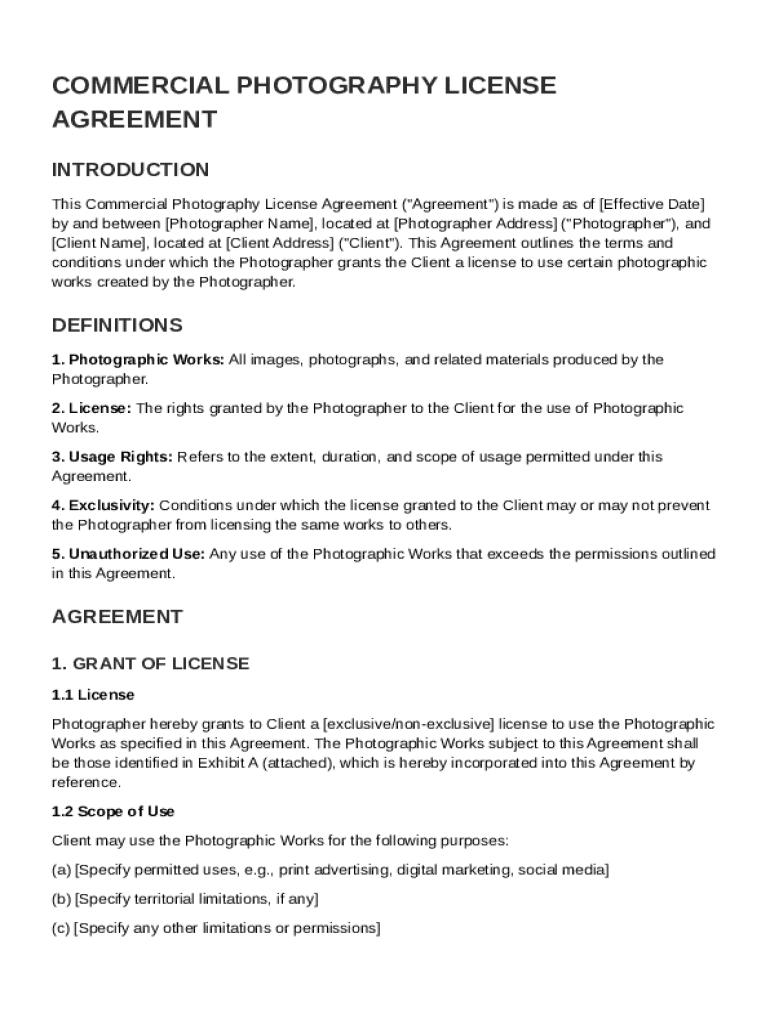
A Commercial Photography License Agreement Template is a structured document used to establish the terms under which a photographer licenses their photographic works to a client. This template defines critical components such as 'License', which details the scope and limitations of use for the photographic works, and 'Photographic Works', referring specifically to the images in question. Additionally, it outlines 'Usage Rights', specifying how the client may utilize the photographs, whether for promotional, digital, or print mediums. By setting clear definitions and meanings, both parties involved understand the expectations and legal boundaries associated with the agreement, reducing the risk of misunderstandings.
Key Elements of the Commercial Photography License Agreement Template
The Commercial Photography License Agreement Template comprises several essential elements that ensure a comprehensive understanding between the photographer and the client.
- Identification of Parties: Includes the full legal names of the photographer and the client, establishing who is granting and receiving the license.
- Description of Photographic Works: Specifies the photographs covered under the agreement, providing a detailed description or attaching thumbnails for clarity.
- License Duration: States the period during which the client may use the photographs, ensuring that usage does not extend beyond the agreed timeframe.
- Compensation and Payment Terms: Outlines the fees associated with licensing the photographs, including deadlines and payment methods.
- Usage Restrictions: Lists any limitations on how the photographs may be used, such as geographical restrictions or prohibitions on modifications.
- Warranties and Liabilities: Details the responsibilities and assurances both parties offer, along with limitations on liabilities.
- Termination Conditions: Specifies scenarios under which the agreement may be prematurely ended and the procedures for doing so.
By clearly enumerating these elements, the template helps prevent potential disputes and align the expectations of both the photographer and the client.
Important Terms Related to Commercial Photography License Agreement Template
Understanding key terms within the Commercial Photography License Agreement Template is crucial for stakeholders.
- Exclusivity: Indicates whether the client has exclusive rights to use the photographs or if the photographer can license them to other clients.
- Transferability: Defines whether the rights can be transferred to a third party, influencing how the client can leverage the photographic works.
- Derivative Works: Refers to whether modifications or adaptations of the original photographs are allowed.
- Model Release: Needed for photographs that feature identifiable individuals, ensuring legal permissions are in place.
These terms play a vital role in customizing the license agreement to meet specific needs and protect both parties legally.
Steps to Complete the Commercial Photography License Agreement Template
Completing a Commercial Photography License Agreement Template involves several methodical steps to ensure accuracy and compliance.
- Download the Template: Obtain the latest version of the template from a reliable and legally recognized source.
- Fill in Party Details: Enter the full legal names and contact information of both the photographer and the client.
- Specify Photographic Works: Clearly list or attach visual examples of the pictures being licensed.
- Define License Terms: Input the duration, scope, and territory of the license.
- Detail Compensation: State the payment terms, including how and when payments will be made.
- Review Restrictions and Conditions: Verify all usage terms, limitations, and responsibilities are included.
- Consult Legal Professionals: Engage with legal experts to ensure the agreement complies with applicable laws and serves both parties' interests.
- Sign and Execute: Once all terms are agreed upon, both parties should sign and retain a copy for records.
Following these steps helps to create a binding agreement that safeguards the interests of both parties.
Why Should You Use a Commercial Photography License Agreement Template?
Utilizing a Commercial Photography License Agreement Template is advantageous for several reasons.
- Clarity and Understanding: The template provides a structured format to outline expectations and responsibilities, reducing ambiguities.
- Legal Protection: Ensures compliance with intellectual property and licensing laws, protecting both the photographer's and client's interests.
- Efficiency and Standardization: Facilitates the creation of agreements without starting from scratch, saving time and maintaining consistency in business transactions.
- Dispute Resolution: Offers clear conditions and processes for resolving any disagreements, which can otherwise lead to lengthy and costly litigation.
- Professionalism: Elevates the business standing of photographers, showcasing a serious and organized approach to licensing arrangements.
For photographers and clients alike, adopting such templates is integral to fostering transparent and secure professional relations.
Legal Use of the Commercial Photography License Agreement Template
The legal use of a Commercial Photography License Agreement Template involves adhering to specific guidelines to ensure enforceability.
- Alignment with State Laws: The terms must be drafted in accordance with the laws of the specific U.S. state where the agreement is executed.
- Availability of Model Releases: For photos featuring individuals, model releases must be obtained and referenced within the license agreement.
- Compliance with Copyright Laws: Assure that all involved photographic works are legally owned or controlled by the photographer.
- Documentation and Invoicing: Maintain records of all correspondence, drafts, and signed agreements to provide evidence of compliance and intent.
Proper legal use of the template safeguards against future legal challenges, ensuring the license agreement is respected and maintained in court if necessary.
Examples of Using the Commercial Photography License Agreement Template
Commercial Photography License Agreements can be applied across numerous scenarios.
- Advertising Campaigns: A business may license images for use in a national advertising campaign, where specific usage rights and terms are essential.
- Event Photography: Event organizers can use the template to license photographs for promotional materials or media coverage.
- Editorial Publications: Magazines and online publications often require rights to use photographs within their content, necessitating defined licenses.
- E-Commerce Product Photos: Retailers may acquire licenses for product images intended for digital storefronts, where usage and modification rights are crucial.
These examples illustrate the versatility and necessity of having well-drafted agreements in place for various commercial photography applications.
State-Specific Rules for the Commercial Photography License Agreement Template
State-specific rules can significantly influence the terms within a Commercial Photography License Agreement.
- Jurisdictional Variations: Different states may have unique requirements for contract enforceability, including specific language or formalities.
- Intellectual Property Statutes: How a state interprets intellectual property rights may affect license terms regarding exclusivity and derivative works.
- Privacy and Publicity Laws: Some states have more stringent regulations concerning model releases and permissions for using individual likenesses.
Understanding these nuances ensures the agreement is legally sound across different geographic locations in the United States, offering better protection for both photographers and clients.
Digital vs. Paper Version
The choice between a digital or paper version of the Commercial Photography License Agreement Template has several implications.
- Digital Version Benefits: Allows for easy edits, storage in cloud systems, and electronic signatures with built-in audit trails, providing efficient management.
- Paper Version Considerations: Offers a traditional approach, which may be preferred by certain clients or for archival purposes in situations requiring wet-ink signatures.
- Hybrid Approach: Combining both versions can maximize accessibility and ensure there is a physical and digital record, catering to diverse preferences and legal requirements.
Selecting the appropriate format depends on operational preferences, logistical needs, and compliance with legal standards, while both remain viable options.