






Definition & Meaning
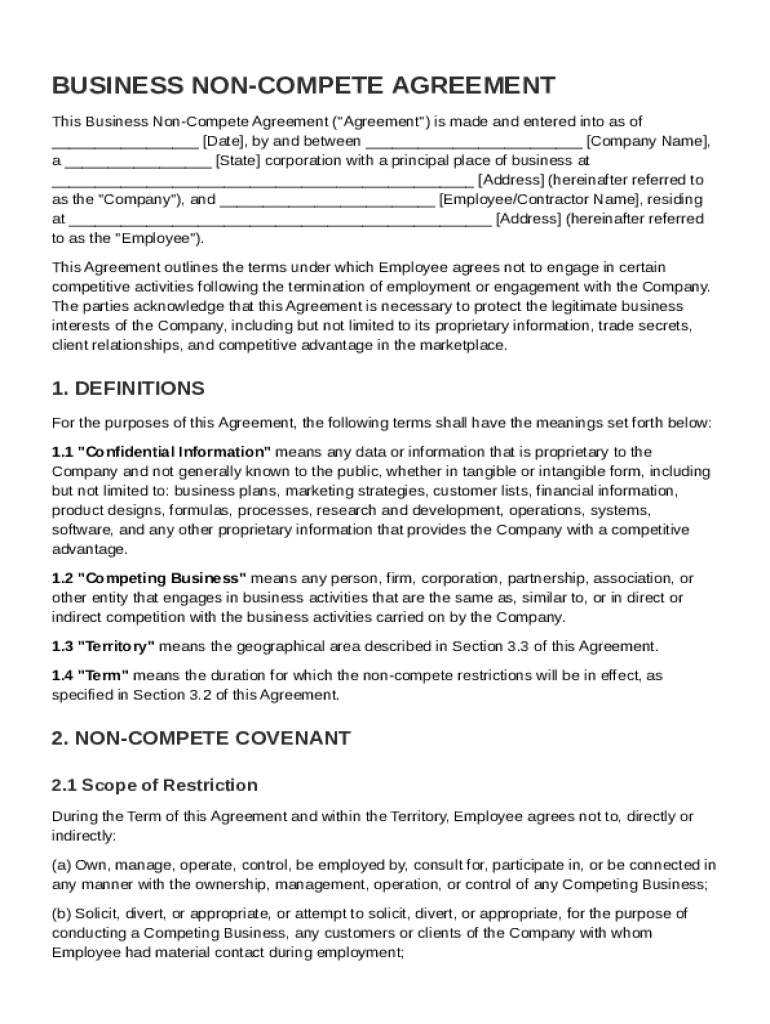
A Business Non-Compete Agreement is a legally binding contract that outlines specific conditions under which an employee agrees not to engage in business activities that compete directly with the employer after leaving the company. This agreement is designed to protect sensitive company information, such as trade secrets and client lists, by preventing former employees from leveraging that knowledge to benefit competitors. The agreement details pivotal terms like 'Confidential Information' and 'Competing Business,' specifying restrictions on the employee's actions regarding competition and solicitation of clients.
Key Components
- Confidential Information: Ensures protection of trade secrets, proprietary data, and sensitive business knowledge.
- Competing Business: Defines what constitutes competitive activity or business.
- Geographic and Temporal Limits: Specifies the duration and geographic location where restrictions apply.
How to Use the Business Non-Compete Agreement Template
Using a non-compete agreement template helps streamline the drafting process. This template is designed to be customizable, ensuring that the specific needs of your business are reflected in the document without starting from scratch. By clearly defining what competitive actions are prohibited, the template ensures comprehensive coverage. Before using, tailored adjustments should be made to suit specific business circumstances.
Customization Tips
- Identify what constitutes confidential information for your company.
- Determine the scope of what you classify as a competing business.
- Set reasonable geographic and temporal restrictions that comply with state laws.
Steps to Complete the Business Non-Compete Agreement Template
Completing a Business Non-Compete Agreement Template involves several precise steps to ensure legal compliance and effectiveness:
- Specify Involved Parties: Clearly list the names and roles of the employee and employer.
- Define Key Terms: Include definitions for 'Confidential Information,' 'Competing Business,' and other crucial terms.
- Detail Restrictions: Outline the specific activities and geographic and temporal limits of the non-compete.
- Legal Consequences: Enumerate potential legal remedies in case of agreement breach.
- Additional Clauses: Add any miscellaneous provisions concerning enforcement and potential agreement assignment.
Finalization
Once the document is completed, both parties should review the agreement to ensure clarity and understanding—a critical step before signing to affirm mutual acceptance.
Key Elements of the Business Non-Compete Agreement Template
A comprehensive non-compete agreement contains specific sections to ensure its legal enforceability. Recognizing these key elements safeguards the company’s interests while ensuring compliance with relevant statutes.
Core Elements
- Duration of Restrictions: Specifies how long after employment termination the employee is restricted.
- Geographic Scope: Outlines the areas where competitive activities are prohibited.
- Scope of Activities: Clearly mentions prohibited actions or business activities.
- Legal Remedies: Includes potential legal and financial penalties for contract breach.
Important Terms Related to Business Non-Compete Agreement Template
Understanding the following terms is essential when dealing with non-compete agreements:
- Solicitation: Engaging current or former clients of the company.
- Trade Secret: Any formula, practice, design, process, or assortment of information that grants a business advantage over competitors.
- Restrictive Covenant: Clauses that limit actions post-employment, including non-compete, non-solicitation, and confidentiality agreements.
Clarity in Definitions
Having precise definitions for these terms within the agreement ensures all parties are aligned regarding expectations and responsibilities.
State-Specific Rules for the Business Non-Compete Agreement Template
Non-compete agreements must align with state laws, which can vary significantly. Certain states, like California, impose more stringent limitations on non-compete agreements, focusing more on employee rights and business needs. Therefore, it's crucial to draft the document in compliance with state-specific statutes to avoid invalidation.
State Law Considerations
- California: Strongly restricts non-compete agreements, emphasizing employee mobility.
- Texas: Permits non-competes if they protect legitimate business interests and are reasonable.
- New York: Allows non-competes that are reasonable in duration and geographic scope.
Legal Use of the Business Non-Compete Agreement Template
To ensure a non-compete agreement’s legality, both parties must consent to the terms without undue pressure or coercion. These agreements are primarily allowed to protect legitimate business interests like confidential business information or specialized training. It's also crucial that the contract is reasonable in its restrictions; otherwise, courts may deem it unenforceable.
Enforceability Factors
- Reasonableness: Ensuring the agreement does not overly restrict an employee’s ability to work.
- Public Interest: Balancing business protection with free labor market policies.
- Specific Intent: Focusing on genuine business necessity, not merely limiting competition.
Examples of Using the Business Non-Compete Agreement Template
Non-compete agreements are critical in industries with high intellectual property stakes or intense competition. Examples include:
- Technology Sector: Protecting code, software strategies, and client data.
- Healthcare: Safeguarding patient lists and proprietary procedures.
- Sales Roles: Preventing former employees from soliciting company clients for a competitor.
Case Studies
- Tech Startups: A tech company successfully protects its novel algorithm by enforcing a two-year non-compete agreement.
- Pharmaceutical Firms: Implement contracts to prevent ex-employees from joining rivals and leveraging insider research.