






Definition and Meaning of a Quote Contract Template
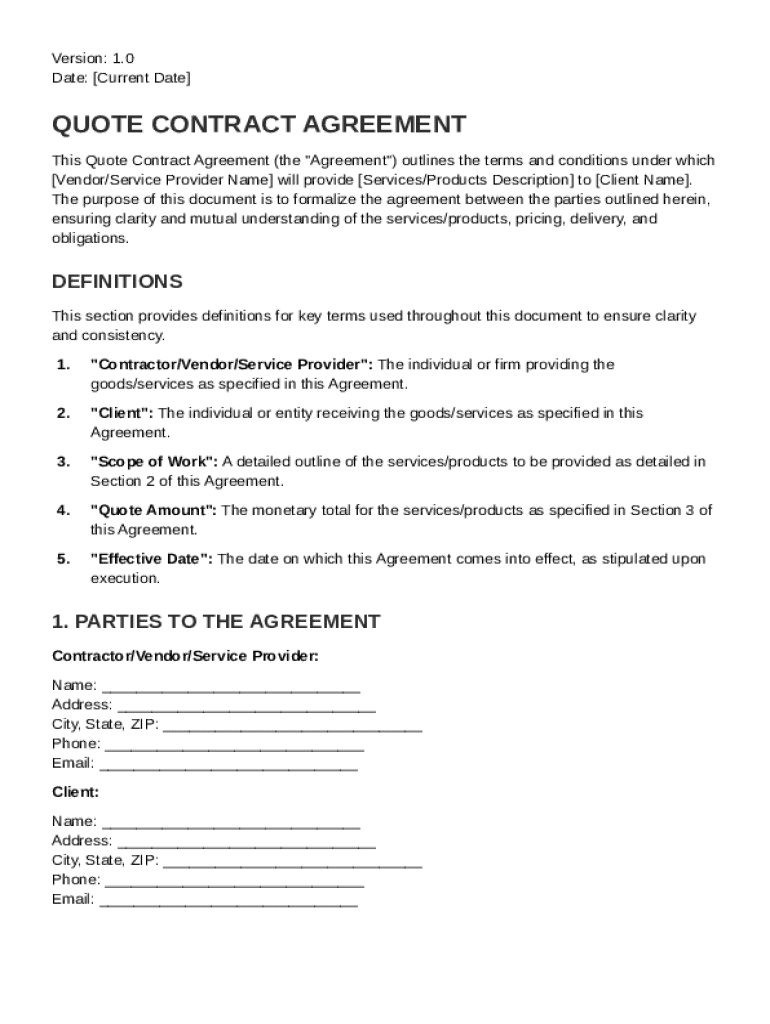
A Quote Contract Template is a pre-formulated document that outlines the essential terms and conditions between a vendor or service provider and a client. This template serves as a foundation for creating a legally binding agreement pertaining to the provision of specified services or products. The template typically includes sections such as definitions, the scope of work, pricing structures, and payment terms. It also addresses the responsibilities of both parties, confidentiality clauses, termination conditions, governing law, and signature sections. By using a template, parties can ensure clarity and mutual understanding of the terms, which helps to prevent potential disputes.
Key Elements and Sections
- Definitions: Clarifies the specific terminology used within the contract to avoid ambiguity.
- Scope of Work: Outlines the tasks, services, or products to be delivered, providing detailed descriptions to set clear expectations.
- Pricing Structure: Details the cost of services or products, including itemized pricing, discounts, and payment schedule.
- Payment Terms: Specifies the payment methods, due dates, and late payment penalties to ensure compliance.
- Responsibilities: Details the obligations of each party, reinforcing accountability for delivery and acceptance of services or products.
- Confidentiality Clauses: Protects proprietary information and ensures sensitive data is not disclosed unauthorizedly.
- Termination Conditions: Provides options for contract termination, specifying acceptable reasons and processes to conclude the agreement.
- Governing Law: Indicates the jurisdiction’s legal principles that govern and interpret the contract.
How to Use the Quote Contract Template
To effectively utilize a Quote Contract Template, begin by customizing the document to reflect the unique aspects of the business arrangement. Start with entering the basic information of both parties, such as names, addresses, and contact details. Modify sections to include any specific terms agreed upon during negotiations, ensuring that all parties have reviewed and agreed upon these terms.
Step-by-Step Customization
- Identify Parties: Enter the complete information for all involved parties.
- Define Services or Products: Clearly outline what will be provided or produced, paced as bullet points for clarity.
- Detail Pricing and Payment: Include a breakdown of costs and outlined payment schedules.
- Assign Responsibilities: Specify roles and tasks for clarity on what each party must deliver.
- Review Legal Clauses: Consider existing laws and customize clauses like confidentiality and termination conditions.
By thoroughly customizing the template, you ensure that all parties are aligned with the project’s goals and contractual obligations.
Steps to Complete the Quote Contract Template
Completing the Quote Contract Template involves detailed input of agreed-upon terms, followed by a review process to confirm accuracy and completeness. Finalizing this document is essential to creating a legally binding contract.
Detailed Completion Process
- Input Details: Enter specific details for the project, ensuring names and roles are correctly stated.
- Fill in Service Descriptions: Clearly describe the scope and deliverables of the contract.
- Specify Pricing and Terms: Outline the financial terms, including costs, payment methods, and deadlines.
- Review Confidentiality and Legal Terms: Ensure that legal clauses meet the compliance standards and are fully understood.
- Obtain Approvals: Both parties should review and agree upon the terms before signing.
- Collect Signatures: Acquire signatures from both parties to execute the document.
By following these steps thoroughly, the Quote Contract Template becomes a complete and comprehensive agreement that guides the service or product delivery.
Key Elements of the Quote Contract Template
The Quote Contract Template is composed of critical sections that provide the backbone of the agreement, ensuring all necessary aspects of the business transaction are covered.
Fundamental Components
- Definitions: Ensures clarity on terminology used throughout the contract.
- Scope and Objectives: Indicates the main goals, tasks, and expectations from the business relationship.
- Pricing and Financial Terms: Clearly details how much, when, and how payments will be made.
- Party Responsibilities: Establishes accountability for all parties, stating specific roles.
- Privacy and Legal Clauses: Though these seem standard, they should be tailored to fit the industry's needs and legal requirements.
These elements collectively ensure the creation of a robust and understandable contract that serves the interests of all involved parties.
Legal Use of the Quote Contract Template
Quote Contract Templates have a legal basis rooted in common contractual agreements and can be used as evidence of terms agreed upon by all parties. Given their nature, they must align with federal and state regulations to be enforceable, and any deviations or special conditions must also comply with local laws.
Compliance and Enforceability
- Alignment with Legal Standards: Ensure the template complies with existing contract laws and is consistent with the ESIGN Act for digital signatures.
- Incorporate Jurisdiction-Specific Clauses: Tailor the contract’s legal framework to adhere to the rules of the jurisdiction governing the contract.
- Auditable Trails: Maintain signed copies, digital records, and evidence of agreement acknowledgment.
By aligning your Quote Contract Template with these legal standards, you ensure that it holds up in court and serves its intended purpose of protecting both parties.
Who Typically Uses the Quote Contract Template
Typically, small to medium enterprises, freelancers, and agencies use Quote Contract Templates to formalize agreements with clients or customers. These templates assist in setting firm expectations while protecting service providers and clients legally.


Application Across Industries
- Freelancers and Consultants: Utilize the template to detail project scope, timeline, and deliverables.
- Service Oriented Businesses: Gain assurance in their business dealings with comprehensive agreement documentation.
- Sales and Procurement Departments: Standardize contracts when dealing with multiple vendors and clients to maintain consistency.
By addressing diverse industries and roles, the Quote Contract Template becomes an indispensable tool for securing favorable and clear contractual agreements.
Important Terms Related to Quote Contract Templates
Several terminologies are commonly used within Quote Contract Templates that may require clarity or definition to ensure mutual comprehension between parties.
Key Terms and Their Significance
- Scope of Work: Provides an in-depth look at expectations and deliverables, setting clear operational guidelines.
- Confidentiality Clause: Protects sensitive information, ensuring it’s not disclosed.
- Termination Clause: Specifies conditions under which the contract may be ended amicably.
- Payment Terms: Clarifies when payments are due and the preferred channels, avoiding disputes over late payments.
- Governing Law: Indicates jurisdiction, ensuring parties understand the legal framework that applies.
Understanding these terms is crucial for all parties involved and assists them in navigating the contract effectively.
Examples of Using Quote Contract Templates
Real-world scenarios provide context and understanding of how Quote Contract Templates are applied in practical situations. This enhances their effectiveness and applicability across industries.
Practical Applications
- Freelance Graphic Design: A graphic designer details the terms for a series of logo designs, using the template to outline the scope and pricing.
- Tech Support Services: A company contracts with an IT service provider to ensure regular maintenance contracts are clearly defined.
- Marketing Agencies: Agencies use the template to create consistency when establishing deliverables and billing with clients.
These examples depict the versatility of the Quote Contract Template, showing how it adapts to specific industry needs while maintaining foundational legal protections.