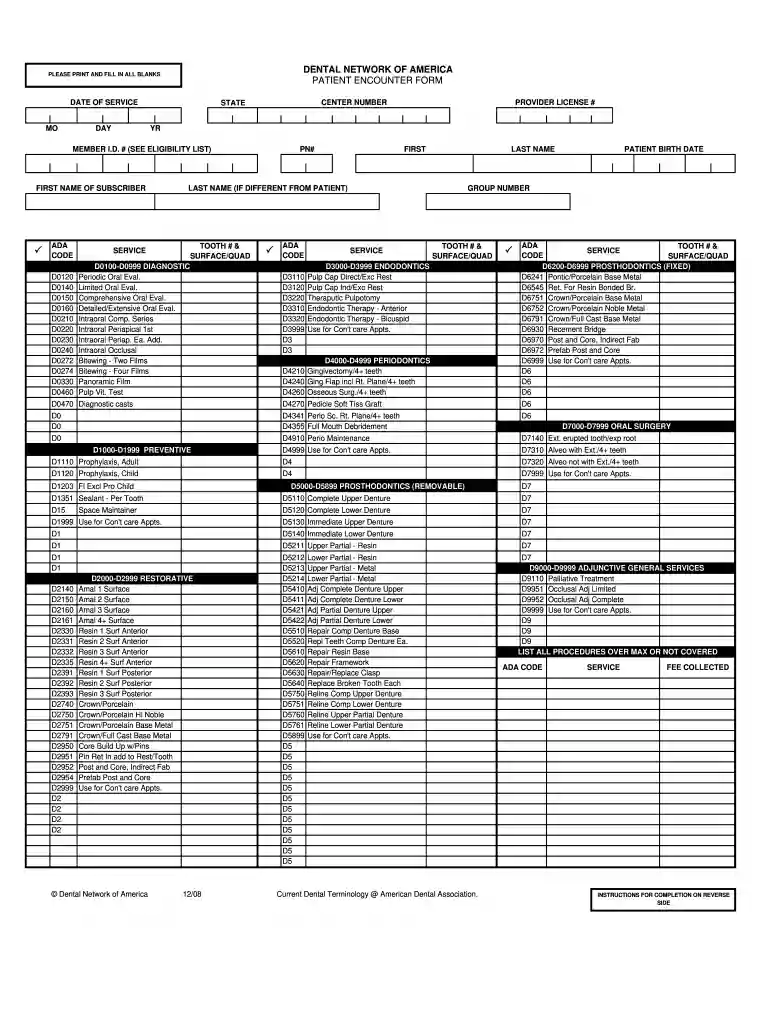
Encounter form 2026

Get Form
encounter form Preview on Page 1

Here's how it works

01. Edit your encounter form online
Type text, add images, blackout confidential details, add comments, highlights and more.

02. Sign it in a few clicks
Draw your signature, type it, upload its image, or use your mobile device as a signature pad.

03. Share your form with others
Send encounter form medical definition via email, link, or fax. You can also download it, export it or print it out.

Definition and Meaning of the Encounter Form

The encounter form serves as a critical document in various professional healthcare and administrative settings. It is primarily utilized by healthcare providers to detail patient interactions, ensuring that information about medical services rendered is accurately captured. In a clinical context, the encounter form may also be referred to as a superbill, capturing details on diagnosis codes, procedure codes, and patient demographics.

This form is essential for billing and reimbursement processes, allowing providers to document the care delivered while also aiding in the coding process for insurance claims. In a broader administrative perspective, encounter forms play a vital role in tracking both patient treatment and outcomes, hence contributing to the overall quality of care.

Key elements of the Encounter Form

  • Patient Information: This includes basic demographics such as name, date of birth, and insurance details.
  • Visit Details: Time and date of the visit, along with a summary of the visit purpose and any relevant notes.
  • Procedure Codes: Utilization of standardized coding systems, such as ICD-10 for diagnoses, and CPT codes for procedures, ensuring precision for billing.
  • Authorization Information: Any pre-authorization details related to treatments or procedures covered under the patient's insurance plan.

How to Use the Encounter Form

Utilizing an encounter form effectively requires an understanding of how to navigate its sections and extract the necessary information. Begin by filling in the patient’s demographic details, which are crucial for any healthcare-related documentation.

Practical Use Cases

  1. During a Patient Visit:

    • The healthcare provider should complete the form in real-time, noting down relevant services and observations.
    • This ensures accuracy, allowing providers to quickly reference and validate details during consultations.
  2. Billing Process:

    • After the encounter, the charged services, along with the relevant codes, can be compiled and submitted to insurance providers for reimbursement.
    • Ensure that all entries are accurate to prevent delays in payment.
  3. Electronic Submission:

    • With advancements in digital tools, many encounter forms can be completed and submitted online, facilitating quicker processing and improved documentation efficiency.

Steps to Complete the Encounter Form

Accurate completion of an encounter form is crucial for effective billing and documentation. Below are structured steps for filling it out:

  1. Gather Patient Information:

    • Collect the patient's full name, date of birth, and insurance information.
  2. Record Encounter Details:

    • Fill in the date and purpose of the visit, along with pertinent clinical notes.
  3. List Procedures and Diagnoses:

    • Utilize proper codes from the ICD and CPT manuals to describe the encounter accurately.
  4. Review and Verify:

    • Double-check all entries for accuracy and completeness before submission to eliminate errors that could affect billing.
  5. Submit the Form:

    • Follow the designated submission method for the encounter form, whether electronically or physically, ensuring that all necessary attachments are included.

Why You Should Use the Encounter Form

Using the encounter form results in several key advantages for healthcare providers:

  • Facilitates Accurate Billing: Well-documented details help ensure proper reimbursement from insurance companies and reduce the incidence of billing disputes.
  • Enhances Patient Care: The detailed record allows healthcare practitioners to provide consistent, informed treatment to returning patients.
  • Compliance and Audit Preparedness: Proper documentation aids compliance with healthcare regulations and is crucial in the event of audits or reviews by regulatory bodies.

Who Typically Uses the Encounter Form?

Various professionals in the healthcare arena rely on the encounter form for operational efficiency. These include:


  • Physicians: To document patient visits and claim reimbursements for services rendered.
  • Medical Coders: Responsible for translating patient encounters into coding formats for billing processes.
  • Healthcare Administrators: Utilize encounter forms to monitor service trends, patient outcomes, and potential areas for improvement in care delivery.
  • Insurance Companies: Review encounter forms to determine the validity of healthcare claims and ensure that services billed align with provided care.
decoration image ratings of Dochub

Important Terms Related to Encounter Form

Understanding specific terminology associated with encounter forms enriches comprehension and relevance:

  • Superbill: Another name for an encounter form, primarily used in medical billing.
  • ICD Codes: International Classification of Diseases codes used to classify diagnoses.
  • CPT Codes: Current Procedural Terminology codes that document the procedures and services offered by healthcare providers.
  • Insurance Authorization: The process of obtaining approval from insurance companies before delivering certain medical services.

Digital vs. Paper Version of the Encounter Form

With the rise of electronic health records (EHR), encounter forms are now commonly available in both digital and paper formats.

Advantages of Digital Forms

  • Accessibility: Digital forms can be accessed remotely, allowing healthcare teams to complete them from various locations.
  • Efficiency: Reduces the time spent on physical documentation and aids in faster submissions for billing.
  • Storage and Retrieval: Easier to store and retrieve patient information without the clutter of paper records.

Advantages of Paper Forms

  • Simplicity for Some Providers: Some users find traditional paper forms easier to handle, especially in settings lacking digital infrastructure.
  • Less Technical Barrier: Paper forms do not require technical knowledge or training for usage, making them accessible to a broader range of users.

This duality in encounter forms illustrates the flexibility available to healthcare providers, catering to diverse operational needs and capabilities.

be ready to get more

Complete this form in 5 minutes or less

Get form

Got questions?

We have answers to the most popular questions from our customers. If you can't find an answer to your question, please contact us.
Contact us
Encounter forms are also referred to as encounter slips, routing slips, or superbills. It is a document used to record medical encounters between patients and healthcare providers. An encounter form often comes with a care slip, which physicians use to note essential details about patient appointments.
An encounter form, also known as a superbill, is a document used in healthcare settings that lists the services provided during a patient visit. It includes information necessary for billing, such as CPT and diagnosis codes.
An encounter; a meeting.
/ɪnˈkaʊntər/ Verb Forms. he / she / it encounters. past simple encountered. -ing form encountering.

Security and compliance

At DocHub, your data security is our priority. We follow HIPAA, SOC2, GDPR, and other standards, so you can work on your documents with confidence.

Learn more