
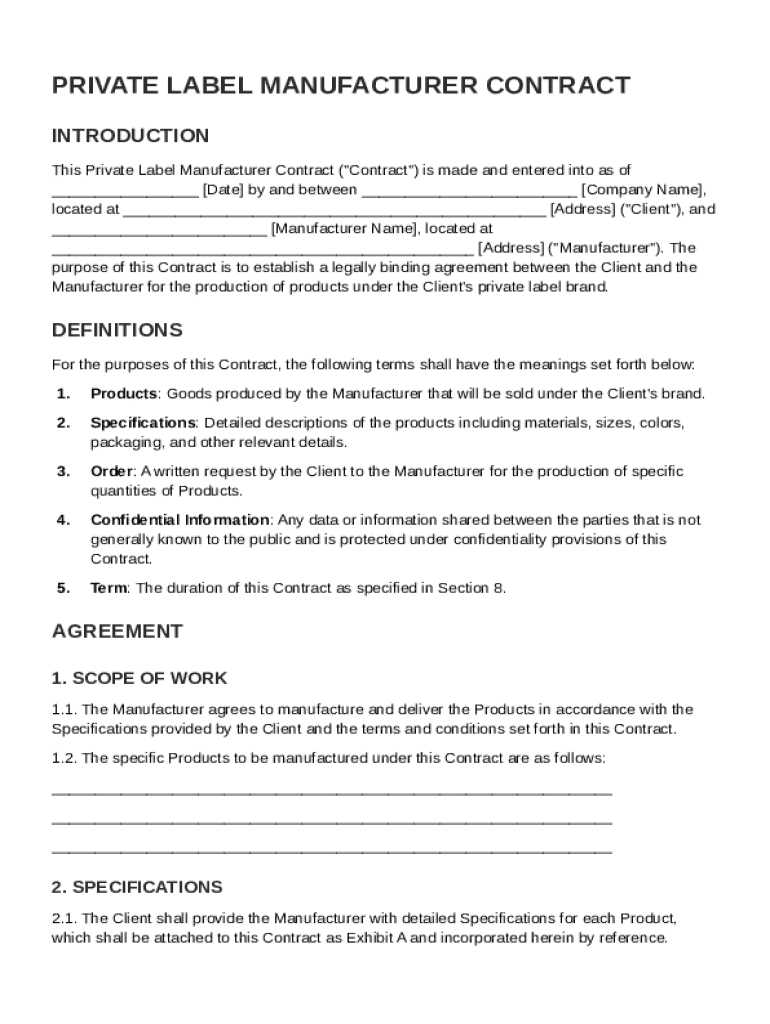







Definition and Meaning
The Private Label Manufacturer Contract Template establishes a formal agreement between a client and a manufacturer engaged in creating products under the client's brand. This contract serves as a comprehensive framework outlining the roles, responsibilities, and expectations of both parties within the manufacturing process. Specifics covered in the template include the product specifications, scope of work, payment terms, and quality assurance requirements. Additionally, it addresses important legal aspects such as confidentiality, intellectual property rights, and liability provisions. This agreement aims to streamline interactions between the parties, thereby facilitating efficient and trouble-free production.
Key Elements of the Private Label Manufacturer Contract Template
Scope of Work and Specifications
The contract specifies the detailed requirements of the product, including dimensions, materials, and any distinctive features. A thorough description ensures that both parties understand the product's expected outcome, minimizing potential disagreements or deviations during the manufacturing process. It typically includes:
- Product Details: Specific dimensions, materials, and finishes required.
- Quality Standards: Specifications for acceptable levels of quality and any testing procedures to be implemented.
- Customization Options: Possibilities for changes or personalization according to the client's brand.
Pricing and Payment Terms
A critical section of the contract, this part delineates the agreed-upon pricing, payment schedules, and any conditions under which payments are made. Transparency in this section helps in mitigating future disputes over financial transactions. Important points encompass:
- Pricing Structure: Breakdown of costs per unit, bulk order discounts, or cost variations for different versions.
- Payment Schedule: Timelines and stages for payments (e.g., upfront deposit, post-delivery payment).
- Penalties: Charges or fines for delayed payments or breaches of terms.
Production and Delivery Processes
This component provides insights into the timelines for production and delivery, ensuring that products are manufactured and distributed within an acceptable frame. Elements covered under this section include:
- Timeline Projections: Expected start and end dates for production cycles.
- Delivery Method: Means of transportation and terms regarding who bears the risks and costs during transit.
- Force Majeure: Clauses addressing unforeseen circumstances that could delay production.
Legal Use and Compliance
Confidentiality Obligations
The protection of sensitive information is paramount. This section mandates that both parties commit to maintaining confidentiality regarding trade secrets, data, and proprietary information, often incorporating non-disclosure agreements (NDAs) to reinforce these obligations. Essential features:
- Definition of Confidential Information: What constitutes confidential data for the purposes of the contract.
- Permissible Disclosures: Circumstances under which disclosure might be allowed.
- Consequences for Breach: Penalties or legal actions in response to unauthorized disclosures.
Intellectual Property Rights
This ensures that the client retains ownership of the product's design, branding, and intellectual creations. The contract clearly describes how intellectual property rights are managed and protected. Key stipulations involve:
- Ownership Rights: Who holds the rights to designs, patents, and trademarks.
- Usage Permissions: Under which conditions the manufacturer might use the intellectual property.
- Resolution Procedures: Methods for resolving disputes over intellectual property claims.
How to Use the Private Label Manufacturer Contract Template
Step-by-Step Completion Process
- Review the Template: Start by carefully going through the entire document to understand all the provisions included.
- Customize Sections: Adjust clauses and sections to fit your particular business needs, including product-specific terms and conditions.
- Consult Legal Advice: Before finalizing, have a legal professional review the contract to ensure compliance with applicable laws.
- Share with Stakeholders: Distribute to all involved parties for review and input.
- Execute the Contract: Once all parties agree on the terms, execute the contract with appropriate signatures.
How to Obtain the Template
Prospective users can access the Private Label Manufacturer Contract Template from a variety of resources:
- Online Platforms: Many legal and document management sites offer templates.
- Professional Services: Legal advisors may provide customized templates tailored to specific needs.
- Industry Associations: Certain industry bodies offer templates as part of their member services.
Important Terms Related to the Template
Governing Law and Dispute Resolution
The section on governing law specifies the jurisdiction under which the contract is governed, ensuring alignment with state laws in the U.S. Dispute resolution methods typically include:
- Mediation or Arbitration: Preferred over litigation for faster and potentially less costly resolutions.
- Jurisdiction Clauses: Defines which state's laws apply and where disputes will be handled.
Who Typically Uses the Template
The template is mainly used by businesses seeking to enter into private label agreements with manufacturers. It is particularly relevant for:
- Small to Medium Enterprises (SMEs): Looking to brand their products with limited production resources.
- Retailers: Expanding their product lines without setting up manufacturing units.
- Startups: New businesses needing to establish clear production terms efficiently.


State-Specific Rules
U.S. contract law has state-specific nuances. Therefore, parties should be aware of:
- State Regulations: Some states may have particular laws affecting the enforceability of specific provisions (such as non-compete clauses).
- Contractual Requirements: Variations in witnessing and acknowledgment requirements could influence the contract's validity.
In summary, the Private Label Manufacturer Contract Template is an essential tool for formalizing the production of branded goods under clear, mutually agreed-upon terms. Proper utilization of this template ensures the safeguarding of rights, performance quality, and financial obligations in private label manufacturing relationships.




