







Definition and Meaning
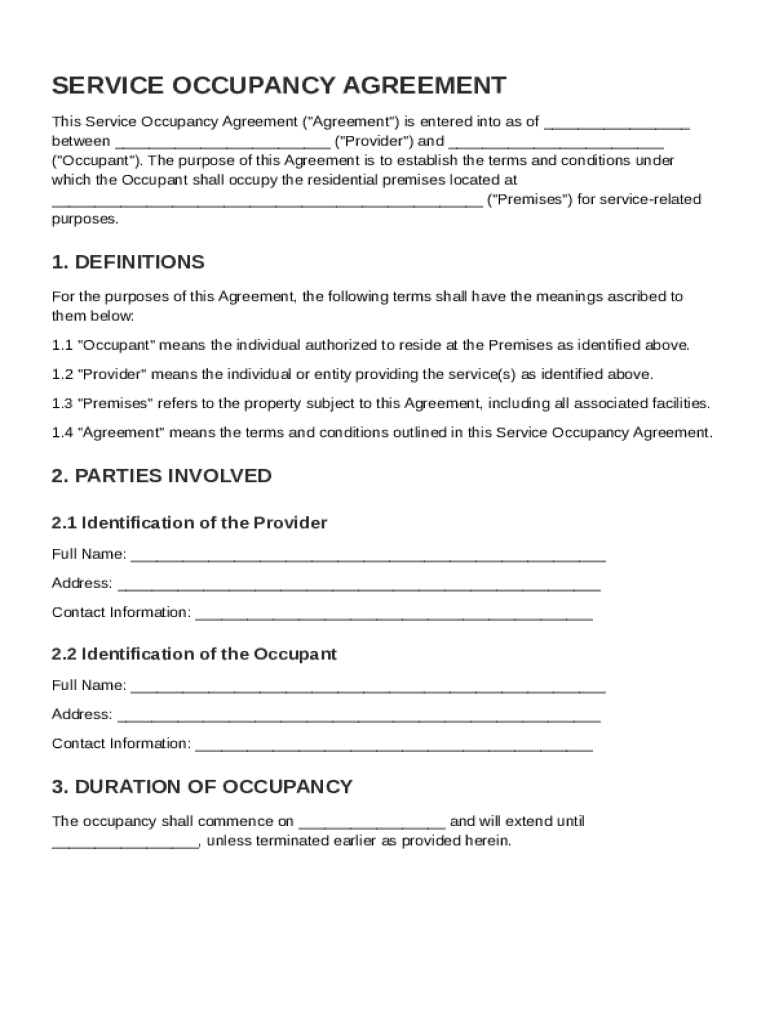
A Service Occupancy Agreement outlines the terms through which an individual, referred to as the Occupant, is allowed to reside in a residential property owned by another party, known as the Provider. This arrangement typically occurs for service-related purposes, where the residence is provided as part of employment or service agreement. The document clearly defines key aspects such as the roles and identities of the involved parties, the duration of the occupancy, and the nature of services to be provided in exchange for the use of the premises.
Structure and Components
- Parties Identified: Both the occupant and provider are explicitly named.
- Duration: Specifies the start and end dates of occupancy.
- Service Description: Details services expected from the occupant.
- Terms and Conditions: Rules governing the use of the premises, including restrictions and responsibilities.
How to Use the Service Occupancy Agreement Template
Utilizing a Service Occupancy Agreement Template involves several steps to ensure it accurately reflects both parties' expectations and legal obligations.
Steps to Utilize the Template
- Download the Template: Obtain a standardized template that includes all necessary legal components.
- Fill Out Party Details: Input the names and contact information of both the occupant and provider.
- Define Occupancy Terms: Clearly delineate the period of occupancy and services involved.
- Review and Customize: Tailor the template to meet jurisdiction-specific legal requirements and personal agreements.
- Consult Legal Experts: For higher accuracy, consult a legal professional.
Steps to Complete the Service Occupancy Agreement Template
Completing this template requires attention to detail to ensure all legal components are correctly addressed.
Detailed Completion Guide
- Initial Set-Up: Enter parties' full legal names and addresses.
- Service Specifications: List detailed descriptions of services the occupant is to provide.
- Payment Terms: Outline how any remuneration or compensation will be managed.
- Additional Clauses: Add confidentiality, amendment, and termination clauses as necessary.
- Signatures: Obtain the necessary signatures from all parties involved.
Important Terms Related to Service Occupancy Agreement Template
Understanding specific terms used within the agreement is critical.
Key Terms Explained
- Occupier: The individual inhabiting the property.
- Provider: The entity or person that owns the premises.
- Premises: The specified residential property covered by the agreement.
- Service Requirement: Services to be carried out by the occupant as part of the occupancy conditions.
Legal Use of the Service Occupancy Agreement Template
The legal use of this template ensures both parties are protected under the law.
Legal Considerations
- Compliance with State Laws: The agreement should align with the laws of the state where the premises are located.
- Binding Agreement: Once signed, it becomes enforceable under legal standards.
- Amendment Procedures: Outlines how changes can be legally made.
Key Elements of the Service Occupancy Agreement Template
A comprehensive agreement includes several critical elements to cover all bases.
Crucial Sections
- Identification of Parties: Must clearly define who is involved in the agreement.
- Rights and Responsibilities: Clearly lists what each party is entitled to and must ensure.
- Termination Clauses: Specifies how and under what conditions the agreement can be ended prematurely.
Examples of Using the Service Occupancy Agreement Template
Real-world scenarios can illustrate how this template is applied.
Application Scenarios
- Employer-Provided Housing: Used by companies offering temporary housing to employees.
- Service-Oriented Roles: For service jobs requiring residence near the work location.
- Caretaker Arrangements: When property management includes living on-site.
State-Specific Rules for the Service Occupancy Agreement Template
Different states may have unique requirements for these agreements.
Variations by State
- Specific Legal Requirements: Some states require additional clauses unique to state law.
- Registration and Filing: Certain jurisdictions may mandate filing the agreement with a governing body.
- Diverse Termination Laws: Varying rules on notice periods and reasons for terminating occupancy.







