






Definition & Meaning of the Land Swap Agreement Template
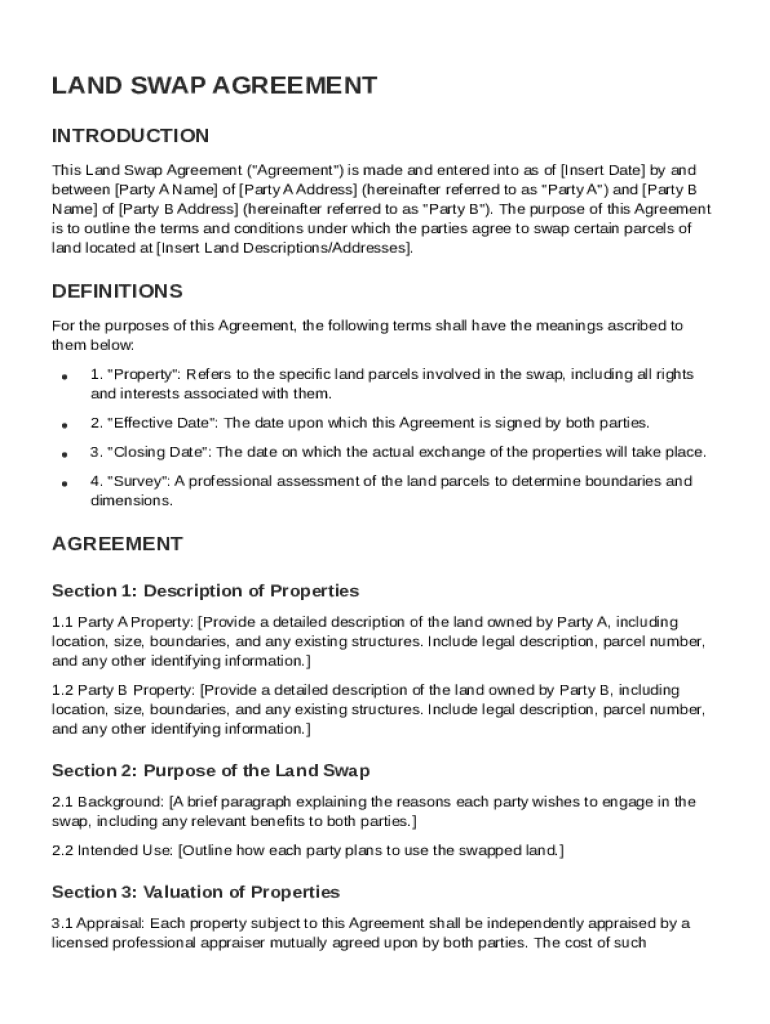
A Land Swap Agreement Template is a standardized legal document used to outline the exchange of specific parcels of land between two parties, typically known as Party A and Party B. This template provides a structured framework to ensure both parties agree on the exchange conditions, thereby minimizing potential disputes. The agreement typically encompasses several critical components, including property descriptions, terms and conditions for the exchange, and legal obligations of both parties. By employing a template, parties can streamline the drafting process and focus on customizing sections related to their specific transaction.
Key components within the agreement generally include:
- Property Descriptions: Detailed information about each parcel of land involved.
- Valuation Processes: Methods for appraising the land to ensure fair exchange.
- Representations and Warranties: Legal assurances made by each party regarding the land's status and ownership.
- Indemnification Clauses: Provisions to protect each party from future legal claims.
These elements ensure that the exchange is legally binding and protects both parties' interests.
Steps to Complete the Land Swap Agreement Template
Completing a Land Swap Agreement Template involves several important steps to ensure accuracy and compliance with legal standards. Here's a step-by-step guide to assist users:
- Identify the Parties Involved: Clearly state the names and contact details of Party A and Party B.
- Detail Property Descriptions: Accurately describe the parcels of land involved in the swap, including their legal descriptions and any unique identifiers.
- Specify the Valuation Method: Agree upon and document the method used to determine the land’s value. This could be a professional appraisal or a mutually agreed figure.
- Outline the Closing Procedure: Include a timeline for the transaction and specify any required closing costs or procedures.
- Draft Representations and Warranties: Each party should make clear legal assurances regarding the property's current state and title validity.
- Insert Indemnification and Dispute Resolution Clauses: Protect both parties from post-swap claims and outline processes for resolving potential disputes.
Each step is essential to ensuring that the agreement is comprehensive and provides a clear legal framework for the land exchange.
Key Elements of the Land Swap Agreement Template
A successful Land Swap Agreement Template includes several vital elements that address legal and practical concerns. These elements are designed to ensure comprehensive coverage of the transaction:
- Definitions: Establishes key terms used in the agreement to prevent misunderstandings.
- Governing Law: Identifies the jurisdiction whose laws will govern the agreement's interpretation and enforcement.
- Miscellaneous Provisions: Include any additional clauses that cater to specific needs, such as confidentiality agreements or conditions precedent.
By incorporating these key elements, the template facilitates a structured and enforceable agreement tailored to the specific needs of both parties involved.
Legal Use of the Land Swap Agreement Template
The Land Swap Agreement Template serves as a legally binding document. It adheres to U.S. laws and regulations concerning property exchanges. Users must ensure that the template is customized to reflect any state-specific legal requirements, such as zonal laws or property taxes that might affect the land swap.
The legal use of the template involves:
- Ensuring that all sections of the document are filled out correctly and completely.
- Having both parties review the agreement to confirm mutual understanding and consent.
- Obtaining signatures from both parties, preferably in the presence of a notary public or legal professional, to enhance the document’s legality.
By fulfilling these legal use requirements, parties can ensure the agreement is enforceable and protects their rights throughout the transaction.
Important Terms Related to the Land Swap Agreement Template
Understanding the legal terminology within a Land Swap Agreement Template is crucial to ensure both parties are on the same page. Here are some important terms users should be familiar with:
- Closing: The final step in completing the land exchange, where property ownership transfers occur.
- Easement: A legal right for one party to use the land for a specific purpose, which may affect the swap terms.
- Encumbrance: A claim or lien on a property that could impact its transferability.
- Due Diligence: Investigations carried out by parties to confirm property details and legal standing.
A firm grasp of these terms will aid parties in navigating the land swap process more effectively, ensuring clarity and mutual understanding.
State-Specific Rules for the Land Swap Agreement Template
Each state in the U.S. may impose distinct rules and regulations regarding land swap agreements. Users must adapt the template to meet their respective state's requirements, which may include disclosures about environmental conditions or additional documentation.
Key state-specific considerations might include:
- Local Zoning Laws: Regulations governing land use that could affect the swap's feasibility.
- Property Tax Considerations: How a land swap may influence property tax assessments.
- Recording Requirements: Procedures for registering the completed agreement with local authorities to solidify the swap officially.
Adhering to these state-specific rules is essential for the successful completion and legality of the land swap agreement.
Real-World Examples of Using the Land Swap Agreement Template
Understanding how a Land Swap Agreement Template is applied in real-world scenarios can provide useful insights for users. Here are some examples:
- Municipal Land Exchanges: Cities often use land swap agreements to acquire land for public projects in exchange for other city-owned parcels.
- Private Developers: Developers may exchange parcels to consolidate land for larger projects, enhancing the project’s scope and viability.
- Conservation Efforts: Environmental organizations might swap land to protect specific ecological areas while allocating less sensitive land for development.
These examples highlight the template's versatility and efficiency in facilitating diverse land exchanges tailored to specific goals and needs.
Who Typically Uses the Land Swap Agreement Template
Various entities and individuals may use a Land Swap Agreement Template due to its adaptability and effectiveness. Common users include:
- Real Estate Developers: To streamline the process of exchanging land for project expansion.
- Government Entities: For executing public land exchanges that align with infrastructure goals.
- Non-Profit Organizations: Engaging in swaps to protect environmentally valuable land.
- Private Landowners: Individuals wishing to exchange property to achieve personal or investment objectives.
The template's structured approach ensures that all users can carry out land swaps that are legally sound and beneficial.


Digital vs. Paper Version of the Land Swap Agreement Template
While both digital and paper versions of the Land Swap Agreement Template serve a purpose, each has distinct advantages. Understanding these can aid users in selecting the best option.
-
Digital Version:
- Offers ease of access and editing, allowing for quick modifications.
- Can be shared conveniently via email or cloud storage for remote collaboration.
- Ensures better security with options for password protection and electronic signatures.
-
Paper Version:
- Offers a tangible format which some might find easier for comprehensive reviews.
- Useful where legal or procedural requirements demand physical documentation.
- Ideal in situations lacking digital access or electronic signing support.
Choosing the right version depends on the specific needs of the parties involved and their capabilities with digital tools.