
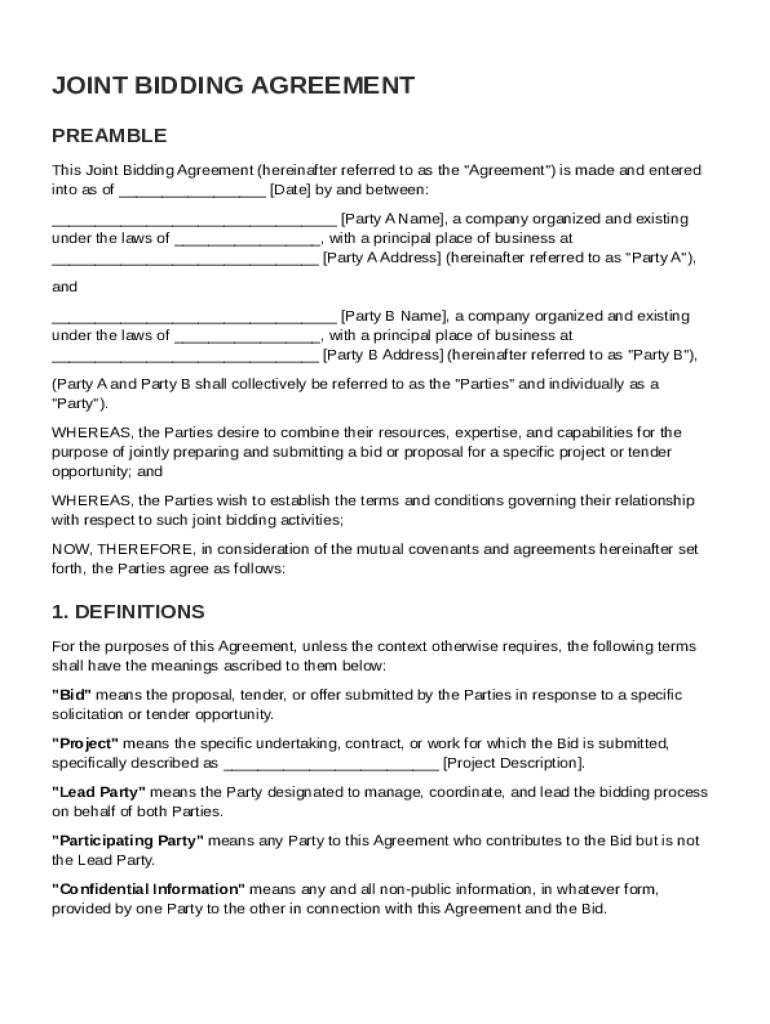







Definition and Meaning
The Joint Bidding Agreement Template is a legal document used to define the collaboration between two or more parties, such as Party A and Party B, when preparing and submitting a joint bid for a project or tender opportunity. This agreement sets forth the roles and responsibilities of each party, ensuring clarity and mutual understanding. It addresses aspects such as financial arrangements, confidentiality obligations, and possible dispute resolutions. Importantly, the agreement clarifies that this collaboration does not create a partnership or joint venture beyond the scope of the specific project at hand.
How to Use the Joint Bidding Agreement Template
Using the Joint Bidding Agreement Template involves following several critical steps to ensure that all required elements are captured and that the agreement serves its intended purpose. Start by gathering details about each party involved, including their official names and addresses. Define the specific project or tender opportunity that the bid targets, providing all relevant details. Clearly outline the roles and responsibilities of each party, ensuring there is shared understanding about who handles which aspects of the bid preparation. Address financial arrangements in detail, specifying resource contributions and cost-sharing mechanisms.
Steps to Complete the Joint Bidding Agreement Template
- Identify Parties: Begin by specifying the parties entering the agreement, commonly referred to as Party A and Party B.
- Define Objectives: Clearly state the objectives of the joint bid, including the nature of the project or tender.
- Assign Roles: Outline the roles and responsibilities of each party, ensuring the allocation of tasks and obligations.
- Financial Arrangements: Detail financial contributions, cost-sharing methods, and profit distribution agreements.
- Confidentiality Obligations: Include clauses that address confidentiality and the handling of sensitive information.
- Dispute Resolution: Define procedures for resolving disputes, including arbitration or mediation options.
- Sign and Date: Ensure all parties review, sign, and date the agreement to signify their consent and commitment.
Key Elements of the Joint Bidding Agreement Template
- Parties Involved: Identification of the entities forming the joint bid.
- Project Description: A detailed description of the project or tender the bid relates to.
- Roles and Responsibilities: A clear definition of each party's duties and obligations.
- Financial Provisions: Clauses outlining how costs and profits are managed.
- Confidentiality Clause: Provisions for the protection of proprietary or sensitive information.
- Dispute Resolution Methods: Established processes for handling conflicts or disagreements.
Legal Use of the Joint Bidding Agreement Template
This template must be used in compliance with legal standards to be binding and enforceable. Parties should ensure the document includes precise language to avoid ambiguity. It's recommended to have the agreement reviewed by legal counsel to verify that it meets all legal requirements and is tailored to the specific project or jurisdiction, particularly if the project is subject to regulations that vary state-by-state within the United States.
Important Terms Related to Joint Bidding Agreement Template
- Confidentiality: Obligations to maintain the secrecy of shared information.
- Arbitration: A form of dispute resolution outlined within the agreement.
- Joint Venture: A business agreement between parties for a specific project.
- Financial Arrangement: How costs and profits are allocated and shared.
Who Typically Uses the Joint Bidding Agreement Template
The template is commonly used by businesses looking to pool resources and expertise to increase their competitiveness in bidding for large-scale projects. Typical users include construction companies, engineering firms, consultancy agencies, and any other entities looking to collaborate on a joint bid. The agreement helps manage the complex dynamics of working jointly, especially when resources, expertise, or territory jurisdiction might overlap or vary significantly.


Examples of Using the Joint Bidding Agreement Template
Consider a situation where two top construction firms wish to bid on a multi-billion dollar highway project facilitated by a government agency. Both firms have significant resources but recognize that a collaborative effort improves their bid's viability. Another example might involve a consultancy and an IT firm joining forces to propose a comprehensive solution for a city’s digital infrastructure upgrade. Through the agreement template, each party crystalizes their contributions and protects their interests legally.
Business Types That Benefit Most from Joint Bidding Agreement Template
- Construction Companies: Frequently partner for large-scale infrastructure projects.
- Consultancy Services: Collaborate on complex projects requiring diverse expertise.
- Engineering Firms: Combine resources to tackle technically demanding projects.
- IT Services: Partner for comprehensive digital tenders that require integrated solutions.




