
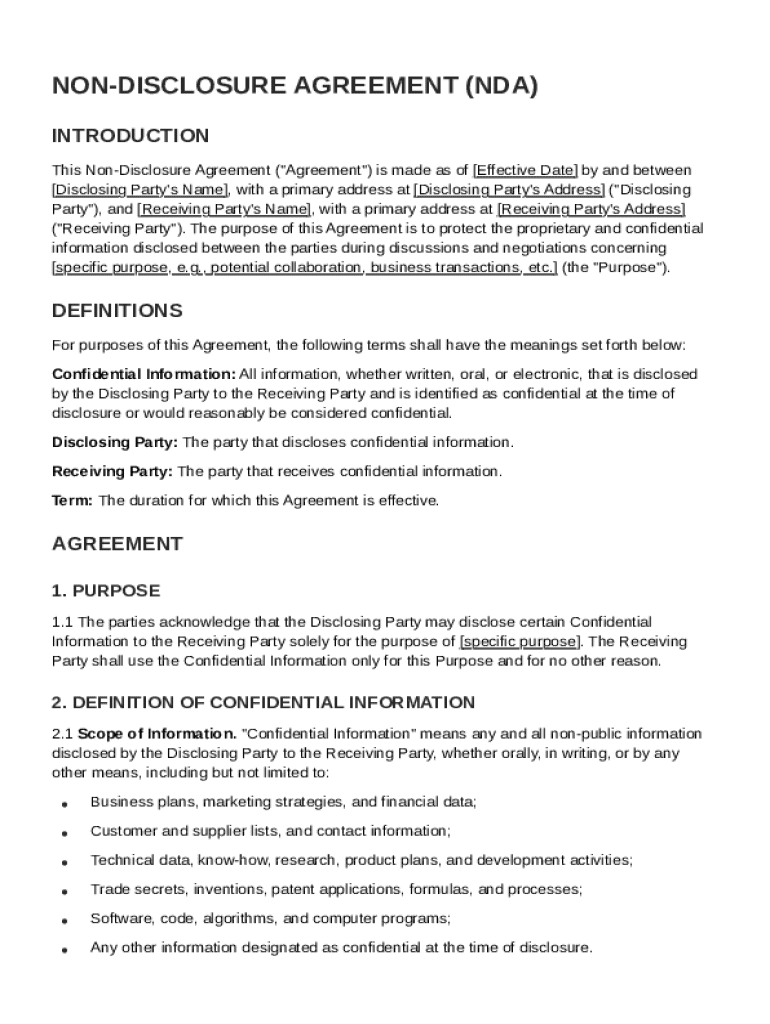







Definition and Meaning of an NDA Contract Template
An NDA Contract Template, or Non-Disclosure Agreement, serves as a formal agreement between parties to safeguard confidential information. It establishes a legal obligation for the Receiving Party to keep sensitive data shared by the Disclosing Party private and secure. This document defines what constitutes 'Confidential Information,' delineates obligations related to confidentiality, and specifies the terms regarding the agreement's duration and termination. Commonly used in business negotiations and collaborations, the NDA helps ensure that proprietary information is used only for its intended purpose.
How to Use the NDA Contract Template
The NDA Contract Template is designed to be user-friendly. Begin by downloading the template that best fits your particular needs, whether a mutual or unilateral NDA. Customize the template by filling in the specific details such as names of the Disclosing and Receiving Parties, the nature of the confidential information, and the purpose for sharing this data. After customization, review the completed template to ensure accuracy and compliance with legal requirements, and have both parties sign the document to make it legally binding.
- Mutual vs. Unilateral NDA: Choose a mutual NDA for situations where both parties will disclose confidential information. Opt for a unilateral NDA when only one party shares information.
- Customization Options: Typically involve adding party names, specific obligations, and exceptions to confidentiality.
- Signing the Agreement: Ensure that all signatories are authorized to represent their respective parties legally.
Steps to Complete the NDA Contract Template
Completing the NDA Contract Template involves several important steps:
- Identification of Parties: Fill in the names and contact details of the Disclosing and Receiving Parties.
- Definition of Confidential Information: Clearly outline what constitutes confidential information within the context of your agreement.
- Obligations and Exceptions: Specify the obligations of the Receiving Party and any exceptions to confidentiality.
- Agreement Duration and Termination: Determine the duration of the confidentiality obligations and conditions for termination.
- Review and Revise: Carefully review the completed document to ensure all information is accurate and legally compliant.
- Obtain Signatures: Have all parties sign the agreement. This makes the NDA legally enforceable.
Key Elements of the NDA Contract Template
The NDA Contract Template incorporates several critical elements that ensure comprehensive protection of confidential information:
- Confidential Information Definition: Specifies what information is considered confidential.
- Purpose of Disclosure: Describes the reason for sharing the confidential information.
- Obligations of the Parties: Outlines what the Receiving Party must do to protect the information.
- Duration of Confidentiality: Indicates how long the confidentiality obligations remain in force.
- Breach Consequences: Describes the repercussions of failing to adhere to the NDA terms.
Legal Use of the NDA Contract Template
The NDA Contract Template is primarily used to legally protect confidential information during business transactions. It is valid once all involved parties sign it. The template ensures compliance with relevant U.S. laws, such as the Uniform Trade Secrets Act, by clearly establishing the terms under which sensitive information is shared and protected. Non-compliance can lead to legal action and penalties, making it essential for parties to understand their obligations fully.
- Enforceability: A properly executed NDA is enforceable in court, offering legal recourse if a breach occurs.
- Compliance with Trade Secret Laws: Helps maintain trade secret status by demonstrating that efforts were made to keep information confidential.
Important Terms Related to the NDA Contract Template
A strong understanding of terms is crucial when dealing with NDAs:
- Disclosing Party: The party sharing confidential information.
- Receiving Party: The entity receiving, and responsible for protecting, the shared information.
- Confidential Information: Data deemed sensitive and protected under the NDA.
- Breach: A failure to comply with the NDA terms, potentially leading to legal consequences.
Who Typically Uses the NDA Contract Template
The NDA Contract Template is widely used across various industries and by different professionals. Common users include:
- Businesses: Companies involved in mergers, joint ventures, or partnerships.
- Startups: Entrepreneurs who need to protect novel ideas or sensitive business plans.
- Freelancers: Independent contractors who have access to client data.
- Researchers and Developers: Professionals working on proprietary technologies or studies.


Examples of Using the NDA Contract Template
Examples of how the NDA Contract Template might be used include:
- Business Collaboration: Two companies partnering on a new project may use an NDA to protect project-specific developments.
- Hiring Scenarios: A potential employee signs an NDA to protect a company’s trade secrets once they have access to sensitive roles.
- Product Development: NDAs are used to secure proprietary information when multiple teams are involved in developing a new product.
- Financial Transactions: During acquisitions, companies use NDAs to protect financial data exchanged during due diligence processes.




