






Definition and Meaning
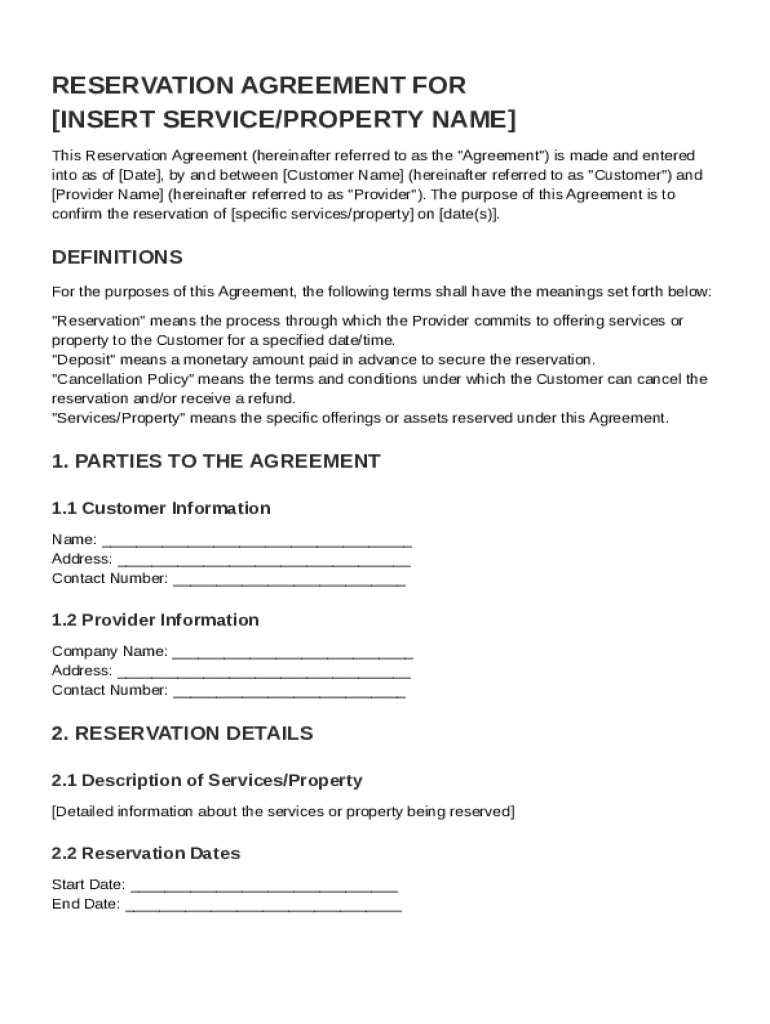
The Reservation Agreement Template is a legal framework designed to outline the terms and conditions under which a customer reserves specific services or properties from a provider. This document establishes the responsibilities and rights of both parties involved, detailing essential components such as the scope of the reservation, payment obligations, cancellation policies, liability limitations, and dispute resolution procedures. Its primary purpose is to confirm a reservation, ensuring clarity and mutual understanding of the agreed terms between the involved entities.
How to Use the Reservation Agreement Template
Utilizing the Reservation Agreement Template involves several critical steps to ensure its effectiveness:
-
Customization: Adapt the template to reflect the specific details of the reservation, including the type of service or property, duration, and associated costs. Each section should be carefully revised to accurately represent the agreement between the customer and provider.
-
Review and Exchange: Both parties should thoroughly review the template to ensure all terms are understood and agreed upon. This might require collaborative editing within platforms like DocHub, which facilitates annotation and commentary for shared documents.
-
Finalization: Once both parties have reviewed and accepted the terms, the document can be finalized. Use DocHub’s e-signature tools to sign the agreement digitally, ensuring the signatures are legally binding and compliant with relevant laws like the ESIGN Act.
Key Elements of the Reservation Agreement Template
The Reservation Agreement Template contains several crucial elements that define its structure and purpose:
-
Definitions: Clear definitions of terms used within the agreement, such as "Customer," "Provider," and specific services or properties involved, to avoid ambiguity.
-
Reservation Details: Information on what is being reserved, including any special conditions or requirements for the reservation.
-
Payment Terms: A breakdown of pricing, payment schedules, and methods, ensuring transparency in financial obligations.
-
Cancellation Policy: Specific procedures and penalties for cancellations, designed to protect both parties in case of unexpected changes.
-
Liability and Indemnity: Clauses that outline the extent of liability for each party and indemnification in cases of disputes or damages.
-
Dispute Resolution: Strategies for resolving disagreements, such as mediation or arbitration, to mitigate legal disputes.
Steps to Complete the Reservation Agreement Template
Completing the Reservation Agreement Template effectively ensures the reservation process is seamless and understood:
-
Enter Basic Information: Start by filling in the details of both parties including names, contact information, and addresses.
-
Specify Reservation Details: Clearly state what is being reserved, alongside start and end dates for the reservation term.
-
Outline Financial Terms: Describe payment amounts, schedules, and accepted payment methods.
-
Clarify Cancellation Policies: Include terms for situations where cancellation might occur, detailing any fees or refunds.
-
Review Contractual Clauses: Go through liability, indemnity, and dispute resolution sections, ensuring both parties understand their implications.
-
Sign the Document: Use DocHub’s electronic signature capabilities for a legally binding conclusion.
Legal Use of the Reservation Agreement Template
The Reservation Agreement Template ensures legal compliance through several features:
-
Adherence to U.S. Laws: Designed to align with U.S. legal standards, including contract formation and consumer rights protections.
-
Legally Binding Signatures: Utilizes features like DocHub’s electronic signatures to guarantee that the agreement is enforceable in legal settings.
-
Confidentiality Clauses: Protects sensitive information shared between parties during the reservation process, in line with privacy laws.
Who Typically Uses the Reservation Agreement Template
The Reservation Agreement Template is widely utilized by a variety of stakeholders:
-
Real Estate Agents: To secure property reservations for buyers or renters.
-
Event Planners: For booking venues and service providers.
-
Service Providers: Such as hotels, rental car companies, and tour operators, to codify reservations.

State-Specific Rules for the Reservation Agreement Template
Although the Reservation Agreement Template is broadly applicable, state-specific regulations might affect its use:
-
Contract Law Variations: Different states have particular rules governing contracts, which may require alterations to specific terms within the template.
-
Consumer Protection Laws: States may impose additional protection measures for consumers, affecting cancellation policies or liability terms.
Creating Interactive Forms with DocHub
DocHub facilitates the creation of interactive, fillable forms based on the Reservation Agreement Template:
-
Form Fields: Use the platform to insert text boxes, checklists, and signature fields into the template, facilitating easy information collection.
-
Customization: Tailor forms to specific needs by adding or removing sections as required for particular reservations.
-
Collaborative Editing: Engage multiple parties in the editing process, ensuring all necessary details are added and agreed upon before finalizing the document.