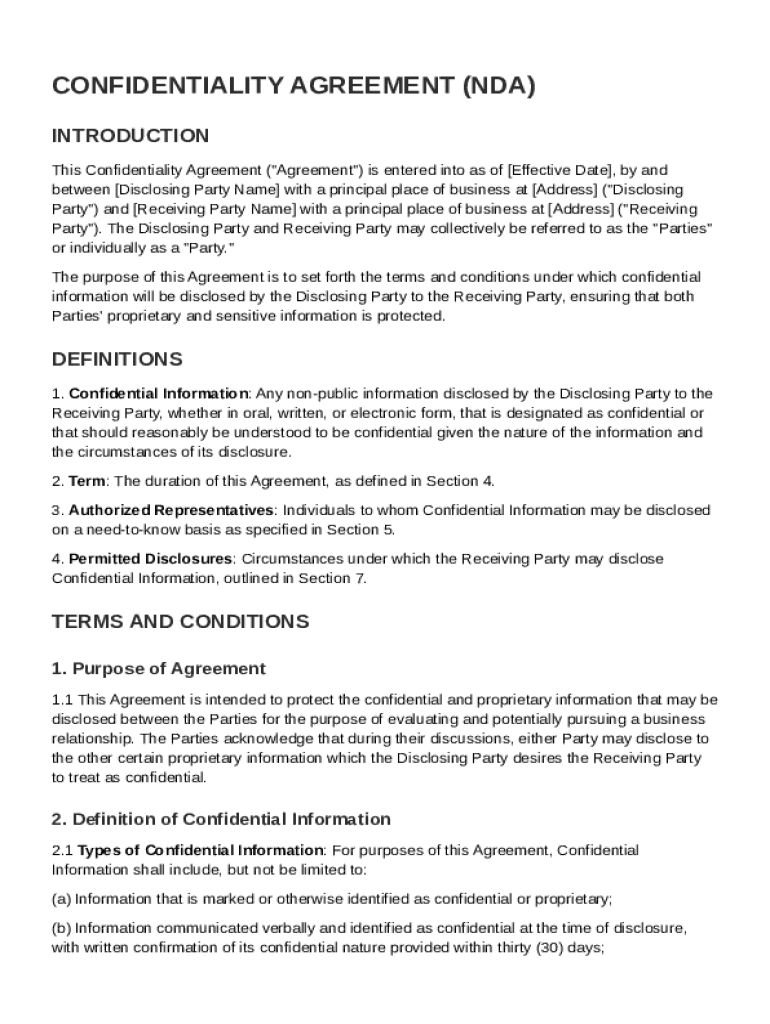







Definition & Purpose of a Confidential Agreement Template
A Confidential Agreement Template, often referred to as a Non-Disclosure Agreement (NDA), establishes a legal framework to protect sensitive information exchanged between two or more parties. Typically, this agreement involves a Disclosing Party, who shares confidential information, and a Receiving Party, who agrees to safeguard this information. The primary goal is to prevent unauthorized disclosure of proprietary data, trade secrets, or other valuable insights.
Key Components
- Confidential Information Definition: Clearly outlines what constitutes confidential information within the context of the agreement.
- Obligations of the Parties: Specifies how the Receiving Party must handle the information and the measures they should take to protect it.
- Permitted Disclosures: Details any circumstances under which confidential information may be disclosed legally.
- Duration of Confidentiality: Defines how long the confidentiality obligations persist after the agreement ends.
How to Use the Confidential Agreement Template
Leveraging a Confidential Agreement Template involves a series of steps that ensure the intentions and legal obligations are clear to all parties involved. The process includes customization, review, and execution of the template.
Customization Steps
- Identify Parties: Clearly define the Disclosing and Receiving Parties involved.
- Specify Confidential Information: Customize the template to include the specific type of information that needs protection.
- Set Terms and Conditions: Determine the duration and restrictions regarding the use and disclosure of the confidential information.
Execution
- Review and Approval: Each party should review the agreement with legal counsel to ensure understanding and acceptance of terms.
- Signing the Agreement: All parties must sign the document to formalize the agreement, after which it becomes legally binding.
Steps to Complete the Confidential Agreement Template
Completing a Confidential Agreement Template requires meticulous attention to detail to ensure all legal and procedural elements are addressed.
- Download the Template: Acquire a reliable and up-to-date Confidential Agreement Template from a trusted source such as DocHub.
- Input Party Details: Enter the full legal names and contact information for all parties involved.
- Define Confidential Information: Clearly delineate what information is deemed confidential to avoid ambiguity.
- Establish Confidentiality Duration: Determine how long confidentiality is to be maintained post-agreement.
- Review Terms: Both parties should carefully review the terms or seek legal counsel.
- Sign and Date: All parties must sign and date the document to validate it.
Key Elements of the Confidential Agreement Template
Vital elements within the Confidential Agreement Template must be articulated to ensure full understanding and enforceability.
Core Components
- Confidential Information: A precise definition allows parties to understand the scope and limitations of what is protected.
- Non-Disclosure Obligations: Outlines the responsibilities of the Receiving Party in maintaining confidentiality.
- Exceptions: Details situations where disclosure might be permissible under law, usually due to court orders or governmental regulations.
- Return or Destruction of Information: Provides guidelines on how to handle information once the agreement or involvement concludes.
- Legal Remedies: Enumerates potential consequences if a breach occurs, enforcing the seriousness of the agreement.
Legal Use of the Confidential Agreement Template
The legal enforceability of a Confidential Agreement Template depends on several factors, including jurisdiction-specific requirements and the precision of language used in the document.
Binding Nature
- Contract Laws: The agreement must conform to the general principles of contract law, including offer, acceptance, and consideration.
- Jurisdictional Compliance: Adhering to state or federal standards ensures it is valid within the applicable legal contexts.
- Dispute Resolution: The agreement should specify mechanisms to resolve any disputes, such as arbitration or litigation.
State-Specific Rules for Confidential Agreements
While the Confidential Agreement Template provides a general structure, state-specific modifications may be necessary to comply with particular legal standards.
Variations by State
- Enforcement Standards: Different states might have unique requirements or interpretations regarding NDAs.
- Reporting Obligations: Certain jurisdictions may require disclosures under special circumstances like public policy concerns or employment law.
- Duration Limits: States may impose maximum durations for confidentiality obligations.
Examples of Using the Confidential Agreement Template
Confidential Agreement Templates are utilized across various industries and scenarios to safeguard sensitive information.
Practical Applications
- Business Transactions: Protects financial or strategic details during mergers and acquisitions.
- Partnerships: Secures shared proprietary data or intellectual property in joint ventures.
- Employment: Ensures employees and contractors safeguard proprietary methodologies or client lists.
Digital vs. Paper Versions of Confidential Agreement Template
There are several factors to consider when choosing between digital and paper formats for a Confidential Agreement Template.
Comparison
- Accessibility: Digital versions offer easy sharing and signing via platforms like DocHub, which can streamline workflow and storage.
- Security: Digital agreements can be secured with encryption and password protection, whereas paper copies require physical security measures.
- Efficiency: E-signatures in digital formats can accelerate the signing process compared to traditional methods requiring physical signatures.