
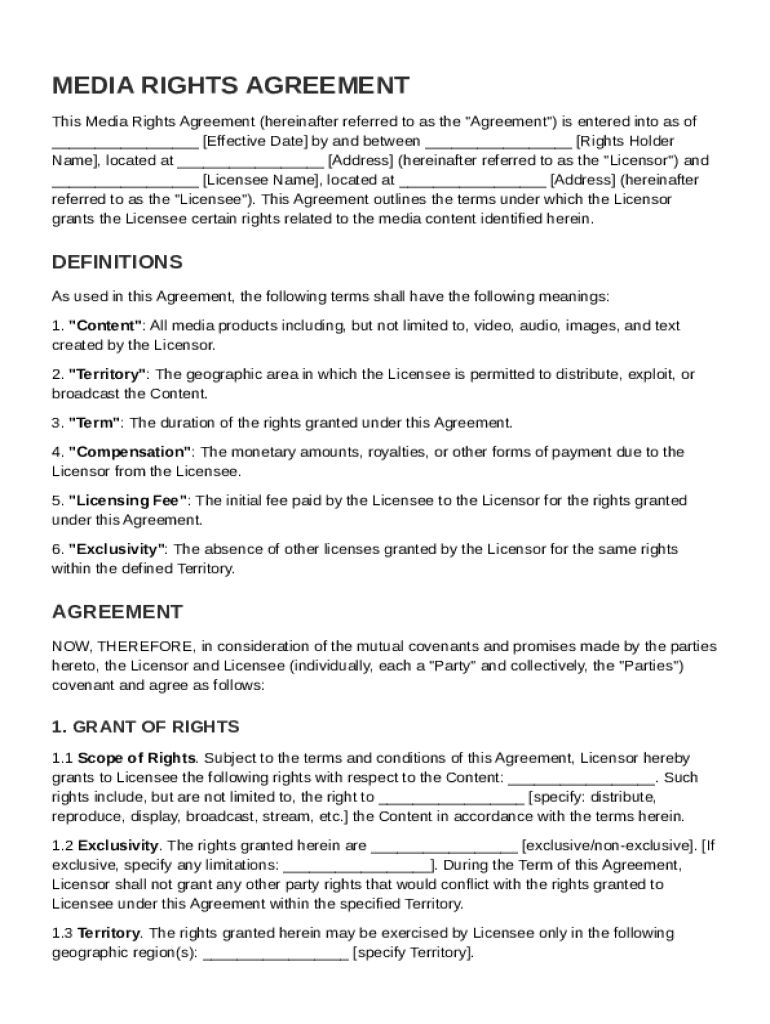







Definition & Meaning
The Media Rights Contract Template is a standardized legal document that establishes the relationship between a licensor and a licensee. This agreement outlines the terms under which media content can be used, distributed, or displayed by the licensee. Key terms that are commonly defined within this contract include "Content," which refers to the specific media or intellectual property being licensed; "Territory," which details the geographical scope of the agreement; "Term," indicating the duration of the contract; and "Compensation," outlining payment obligations. The primary goal of this document is to clearly articulate the rights and responsibilities of both parties, ensuring mutual understanding and reducing the potential for disputes.
Key Elements of the Media Rights Contract Template
The Media Rights Contract includes a variety of sections to detail the essential components of the agreement:
- Grant of Rights: Specifies the rights being transferred from the licensor to the licensee, such as the right to broadcast, distribute, or reproduce media content.
- Payment Terms: Details the compensation structure, including advances, royalties, or fixed payments, and the schedule for such payments.
- Duration and Termination: Defines when the agreement becomes effective and outlines conditions under which it can be terminated prematurely, such as a breach of contract.
- Intellectual Property Rights: Ensures that all intellectual property rights remain with the original owner unless explicitly transferred.
- Warranties and Representations: Contains assurances from both parties regarding their legal authority to enter the agreement and the media’s originality and legality.
- Confidentiality: Mandates that certain information accessed during the contract period must be kept confidential.
- Dispute Resolution: Offers methods for resolving conflicts, typically including mediation or arbitration procedures.
Steps to Complete the Media Rights Contract Template
-
Review the Template: Begin by thoroughly reading through the complete Media Rights Contract Template to understand each section's purpose.
-
Fill Out Party Information: Enter the complete legal names and details of both the licensor and the licensee, ensuring all identification details are accurate.
-
Define the Content and Scope: Specify the exact media content covered under the contract, including descriptions or references. Identify the geographic territories where the rights will apply.
-
Set Terms of Use and Compensation: Agree on the timeline for media rights usage and fill in the agreed-upon compensation structure within the template.
-
Include Intellectual Property Clauses: Clearly state any reserved rights and detail how intellectual property will be handled.
-
Add Confidentiality and Warranties Clauses: Complete sections dealing with data protection, warranties, and obligations to ensure both parties are legally protected.
-
Finalize the Dispute Resolution Process: Decide on a preferred method for resolving any disputes, such as arbitration or legal proceedings, and fill in the necessary details.
-
Sign and Execute: Ensure that all relevant parties review and sign the document to bring the agreement into effect.
Why Use the Media Rights Contract Template
Utilizing a Media Rights Contract Template provides several advantages:
-
Clarity and Structure: The template ensures that all necessary components are included, reducing the risk of forgetting key terms or conditions.
-
Efficiency: Saves time by providing a pre-formatted document that can be filled in easily, reducing the time to draft from scratch.
-
Legal Protection: Creates a legally binding agreement that clearly outlines expectations and responsibilities, deterring potential disputes.
-
Resource for Negotiation: Serves as a baseline for negotiations, allowing both parties to modify specific sections while ensuring essential protections remain intact.
Important Terms Related to Media Rights Contract Template
Understanding the terminology in these contracts is vital for clarity:
-
Licensor and Licensee: The licensor is the party granting rights, while the licensee is the party receiving rights.
-
Royalty: A payment made either as a lump sum or recurring based on the utilization of the licensed media.
-
Exclusive vs. Non-Exclusive: Refers to whether the licensee is the sole party given rights to the media or if the licensor can license it to others.
-
Indemnification: A clause protecting one party against any loss or damage arising from specified actions or circumstances.
Who Typically Uses the Media Rights Contract Template
The Media Rights Contract Template is beneficial for various entities and professionals:
-
Media Companies: For syndicating television shows, movies, or radio programs to different markets or platforms.
-
Publishing Houses: When licensing books for adaptations into different formats or languages.
-
Content Creators: Such as film producers, photographers, and musicians entering agreements for distributing their creations.
-
Corporations: Looking to use media content for advertising or internal communications.


Legal Use of the Media Rights Contract Template
When using the Media Rights Contract Template, legal compliance is paramount:
-
Ensure Agreement Validity: Contracts must comply with relevant intellectual property laws, licensing regulations, and any industry-specific guidelines.
-
Involvement of Legal Experts: A legal professional should review the agreement to ensure all legal obligations are fulfilled.
-
Adherence to the ESIGN Act: For electronic signatures, ensure the process meets compliance standards for them to be legally binding.
State-Specific Rules for the Media Rights Contract Template
Various states might have unique regulations affecting the implementation of a media rights contract:
-
State Laws and Jurisdiction: Verify if any state-specific laws impact contract clauses such as confidentiality or indemnification.
-
Regulatory Compliance: Some states may have additional requirements for licensing certain types of media or within specific industries.
Understanding these regulations ensures that the contract is legally enforceable in the intended jurisdictions.




